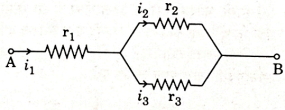
Three resistors having resistances $\mathrm{r}_{1}, \mathrm{r}_{2}$ and $\mathrm{r}_{3}$ are connected as shown in the given circuit. The ratio $\frac{i_{3}}{i_{1}}$ of currents in terms of resistances used in the circuit is :
NEET 2021, Easy


Download our appand get started for free
Experience the future of education. Simply download our apps or reach out to us for more information. Let's shape the future of learning together!No signup needed.*
Similar Questions
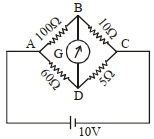
- 1The four arms of a Wheatstone bridge have resistances as shown in the figure. A galvanometer of $15\, \Omega$ resistance is connected across $BD$. Calculate the current through the galvanometer when a potential difference of $10\, V$ is maintained across $AC.$View Solution
- 2A ($100\, W$, $200\, V$) bulb is connected to a $160\, V$ power supply. The power consumption would be ............. $W$View Solution
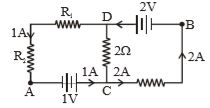
- 3In the circuit shown below, if the potential at point $A$ is taken to be zero, the potential at point $B$ is .............. $V$View Solution
- 4Three copper rods are subjected to different potential difference. Compare the drift speed of electrons through them. Assume that all $3$ are at the same temperature.View Solution
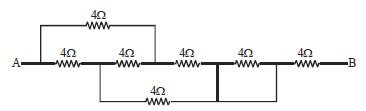
Length Diameter Potential difference $(A)$ $L$ $3d$ $V$ $(B)$ $2L$ $d$ $2V$ $(C)$ $3L$ $2d$ $2V$ - 5Equivalent resistance between $A$ and $B$ is ............ $\Omega$View Solution
- 6View SolutionTwo resistors having equal resistances are joined in series and a current is passed through the combination. Neglect any variation in resistance as the temperature changes. In a given time interval
- 7A steady current $I$ is set up in a wire whose cross-sectional area decreases in the direction of the flow of the current. Then, as we examine the narrowing region,View Solution
- 8View SolutionThe example for non-ohmic resistance is
- 9What amount of heat will be generated in a coil of resistance $R$ due to a charge $q$ passing through it if the current in the coil decreases to zero uniformly during a time interval $\Delta t$View Solution
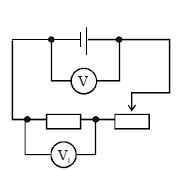
- 10If the rheostat slider were to move from the extreme right to the far left, How will the reading of voltmeter $V_1$ change?View Solution