Question
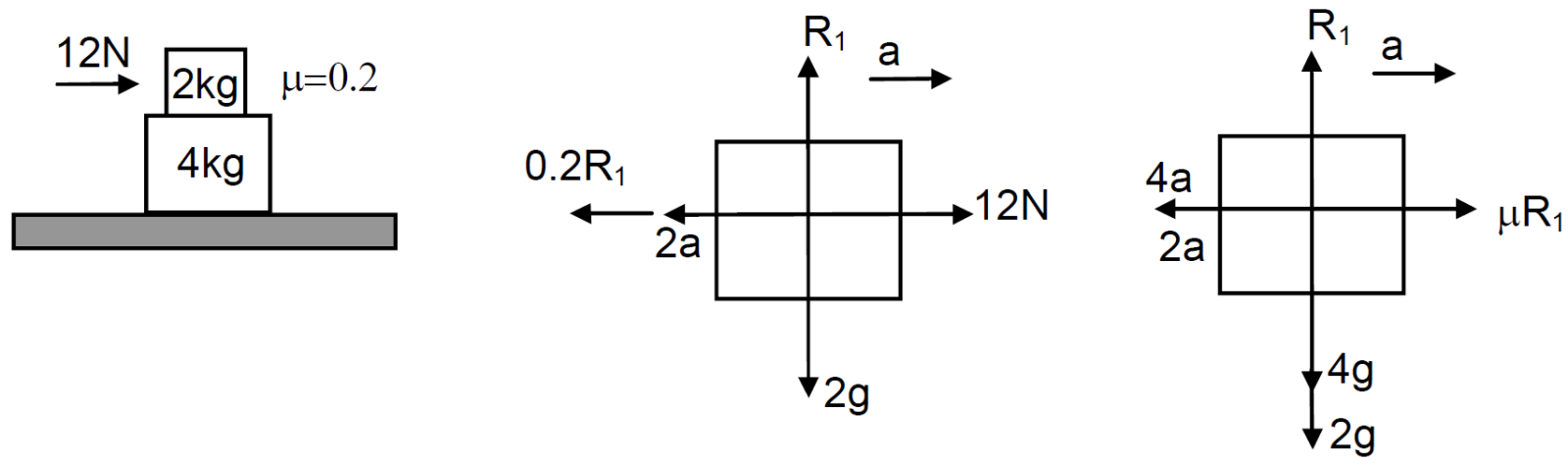
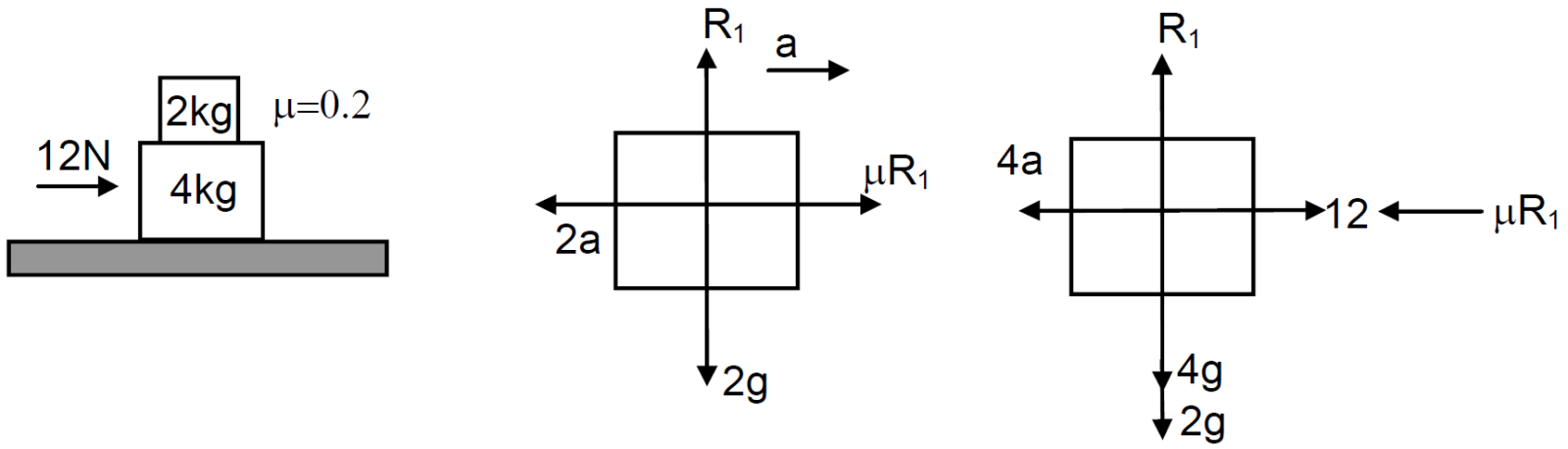
A 2kg block is placed over a 4kg block and both are placed on a smooth horizontal surface. The coefficient of friction between the blocks is 0.20. Find the acceleration of the two blocks if a horizontal force of 12N is applied to:
  1. The upper block.
  2. The lower block. Take g = 10m/s2.

Answer

  1.  

R1 - 2g = 0

⇒ R1 = 2 × 10 = 20

2a + 0.2 R1 - 12 = 0

⇒ 2a + 0.2(20) = 12

⇒ 2a = 12 - 4 = 8

⇒ a = 4m/s2

$4\text{a}_1-\mu\text{R}_1=0$

$\Rightarrow4\text{a}_1=\mu\text{R}_1=0.2(20)$

⇒ 4a1 = 4

⇒ a1 = 1m/s2

2kg block has acceleration 4m/s2 & that of 4kg is 1m/s2

  1.  

R1 = 2g = 20

$\text{Ma}-\mu\text{R}_1=0$

⇒ 2a = 0.2(20) = 4

⇒ a = 2m/s2

4a + 0.2 × 2 × 10 - 12 = 0

⇒ 4a + 4 = 12

⇒ 4a = 8

⇒ a = 2m/s2

Need a full question paper?

Generate a complete, print-ready paper with questions like this in minutes — across 16+ boards, with answer keys.

Start Generating Free

Similar questions

1 litre of an ideal gas $(\gamma=1.5)$ at 300K is suddenly compressed to half its original volume.
  1. Find the ratio of the final pressure to the initial pressure.
  2. If the original pressure is 100kPa, find the work done by the gas in the process.
  3. What is the change in internal energy?
  4. What is the final temperature?
  5. The gas is now cooled to 300K keeping its pressure constant. Calculate the work done during the process.
  6. The gas is now expanded isothermally to achieve its original volume of 1 litre. Calculate the work done by the gas.
  7. Calculate the total work done in the cycle.
A myopic adult has a far point at 0.1m. His power of accomodation is 4 diopters.
  1. What power lenses are required to see distant objects?
  2. What is his near point without glasses?
  3. What is his near point with glasses? (Take the image distance from the lens of the eye to the retina to be 2cm.)
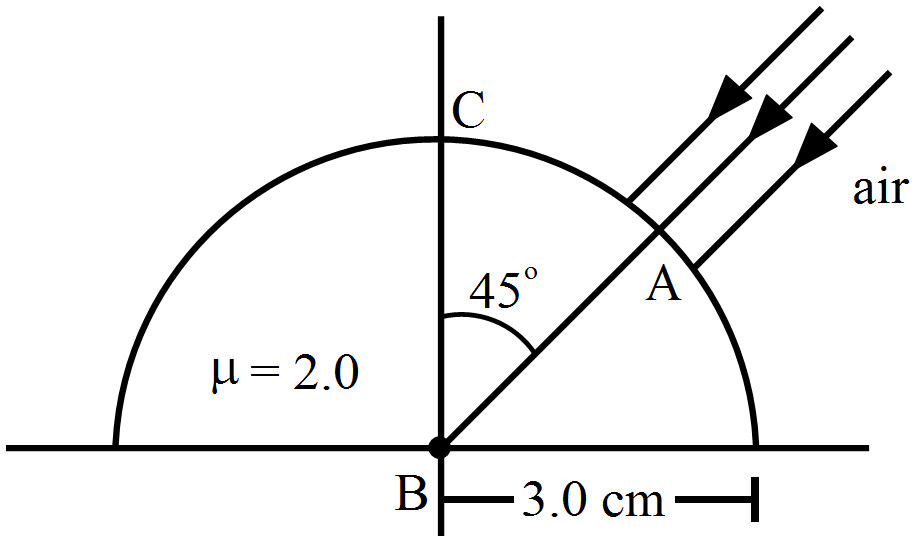
Figure shows a transparent hemisphere of radius 3.0cm made of a material of refractive index 2.0.
  1. A narrow beam of parallel rays is incident on the hemisphere as shown in the figure. Are the rays totally reflected at the plane surface?
  2. Find the image formed by the refraction at the first surface.
  3. Find the image formed by the reflection or by the refraction at the plane surface.
  4. Trace qualitatively the final rays as they come out of the hemisphere.

The resistance of an iron wire and a copper wire at 20°C are $3.9\Omega$ and $4.1\Omega,$ respectively. At what temperature will the resistance be equal? Temperature coefficient of resistivity for iron is $5.0\times10^{-3}\text{K}^{-1}$ and for copper, it is $4.0\times10^{-3}\text{K}^{-1}.$ Neglect any thermal expansion.
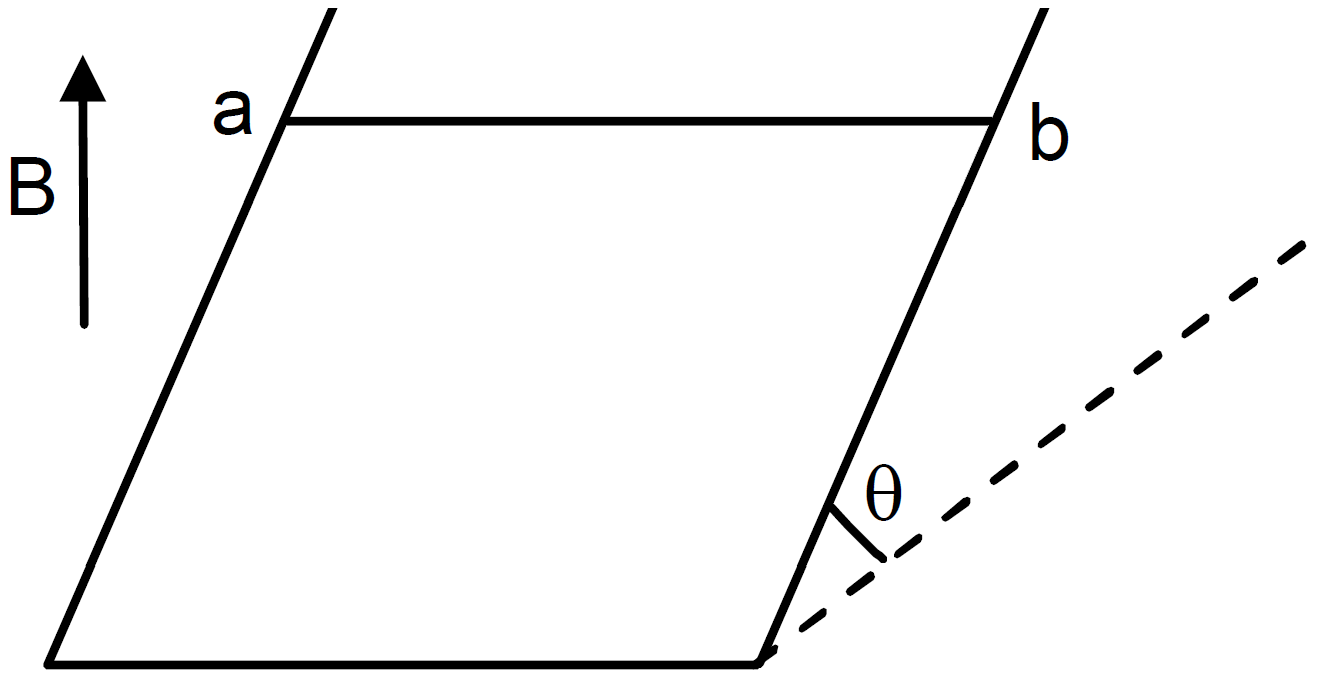
A wire ab of length l, mass m and resistance R slides on a smooth, thick pair of metallic rails joined at the bottom as shown in figure. The plane of the rails makes an angle θ with the horizontal. A vertical magnetic field B exists in the region. If the wire slides on the rails at a constant speed v, show that

$\text{B}=\sqrt{\frac{\text{mgR}\sin\theta}{\text{vl}^2\cos^2\theta}}$

Suppose the ceiling in the previous problem is that of an elevator which is going up with an acceleration of 2.0m/s2. Find the elongations.
A card sheet divided into squares each of size 1 mm2 is being viewed at a distance of 9 cm through a magnifying glass (a converging lens of focal length 9 cm) held close to the eye.
  1. What is the magnification produced by the lens? How much is the area of each square in the virtual image?
  2. What is the angular magnification (magnifying power) of the lens?
  3. Is the magnification in (a) equal to the magnifying power in (b)? Explain.
Consider a wire of length 4m and cross-sectional area 1mm2 carrying a current of 2A. If each cubic metre of the material contains 1029 free electrons, find the average time taken by an electron to cross the length of the wire.
Suppose the ends of the coil in the previous problem are connected to a resistance of $100\Omega.$ Neglecting the reaiatance of the coil, find the heat produced in the circuit in one minute.
$\text{ }^{212}_{33}\text{Bi}$ can disintegrate either by emitting an $\alpha$-particle of by emitting a $\beta^-$-particle.
  1. Write the two equations showing the products of the decays.
  2. The probabilities of disintegration $\alpha$ and $\beta$ -decays are in the ratio $\frac{7}{13}.$ The overall half-life of 212Bi is one hour. If 1g of pure 212Bi is taken at 12.00 noon, what will be the composition of this sample at 1P.m. the same day?