A $2\,\mu F$ capacitor is charged to $100$ $volt$ and then its plates are connected by a conducting wire. The heat produced is........$J$
Easy
Download our app for free and get started
(c) Heat produced = Energy of charged capacitor $ = \frac{1}{2}C{V^2}$
$ = \frac{1}{2} \times (2 \times {10^{ - 6}}) \times {(100)^2} = 0.01\,J$
$ = \frac{1}{2} \times (2 \times {10^{ - 6}}) \times {(100)^2} = 0.01\,J$

Download our appand get started for free
Experience the future of education. Simply download our apps or reach out to us for more information. Let's shape the future of learning together!No signup needed.*
Similar Questions
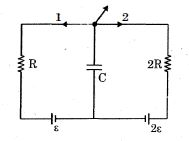
- 1In the circuit shown, the switch is shifted from position $1 \rightarrow 2$ at $t = 0$. The switch was initially in position $1$ since a long time. The graph between charge on capacitor $C$ and time $'t'$ isView Solution
- 2A parallel plate capacitor of capacitance $C$ has spacing $d$ between two plates having area $A$. The region between the plates is filled with $N$ dielectric layers, parallel to its plates, each with thickness $\delta=\frac{ d }{ N }$. The dielectric constant of the $m ^{\text {th }}$ layer is $K _{ m }= K \left(1+\frac{ m }{ N }\right)$. For a very large $N \left(>10^3\right)$, the capacitance $C$ is $\alpha\left(\frac{ K \varepsilon_0 A }{ d \;ln 2}\right)$. The value of $\alpha$ will be. . . . . . . .View Solution
[ $\epsilon_0$ is the permittivity of free space]
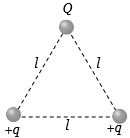
- 3Three charges $Q,( + q)$ and $( + q)$ are placed at the vertices of an equilateral triangle of side l as shown in the figure. If the net electrostatic energy of the system is zero, then $Q$ is equal toView Solution
- 4A $6\,\mu F$ capacitor is charged from $10\;volts$ to $20\;volts$. Increase in energy will beView Solution
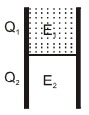
- 5A parallel plate capacitor has a dielectric slab of dielectric constant $K$ between its plates that covers $1 / 3$ of the area of its plates, as shown in the figure. The total capacitance of the capacitor is $C$ while that of the portion with dielectric in between is $C _1$. When the capacitor is charged, the plate area covered by the dielectric gets charge $Q_1$ and the rest of the area gets charge $Q_2$. Choose the correct option/options, igonoring edge effects.View Solution
$(A)$ $\frac{E_1}{E_2}=1$ $(B)$ $\frac{E_1}{E_2}=\frac{1}{K}$ $(C)$ $\frac{Q_1}{Q_2}=\frac{3}{K}$ $(D)$ $\frac{ C }{ C _1}=\frac{2+ K }{ K }$
- 6View SolutionThe angle between the electric lines of force and the equipotential surface is
- 7Two equal positive point charges are kept at points $A$ and $B$ . The electric potential, while moving from $A$ to $B$ along straight lineView Solution
- 8Two capacitor having capacitances $8\ \mu F$ and $16\ \mu F$ have breaking voltages $20\ V$ and $80\ V$. They are combined in series. The maximum charge they can store individually in the combination is...... $\mu C$View Solution
- 9Three capacitors each of $4\,\,\mu F$ are to be connected in such a way that the effective capacitance is $6\,\,\mu F.$ This can be done by connecting thernView Solution
- 10Two electric charges $12\,\mu C$ and $ - 6\,\mu C$ are placed $20\, cm$ apart in air. There will be a point $P$ on the line joining these charges and outside the region between them, at which the electric potential is zero. The distance of $P$ from $ - 6\,\mu C$ charge is.......$m$View Solution