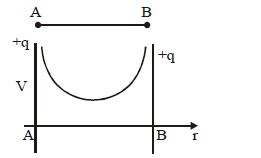
Two equal positive point charges are kept at points $A$ and $B$ . The electric potential, while moving from $A$ to $B$ along straight line
Medium


Download our appand get started for free
Experience the future of education. Simply download our apps or reach out to us for more information. Let's shape the future of learning together!No signup needed.*
Similar Questions
- 1View SolutionThe angle between the electric lines of force and the equipotential surface is
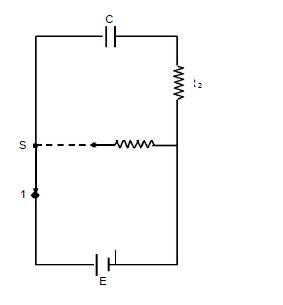
- 2Switch $S$ of circuit shown in figure is in position $1$ for a long time. At instant $t = 0$ , it is thrown from position $1$ to $2$ . The thermal power $P_1(t)$ generated in resistance $R_1$View Solution
- 3An electric field $\vec E\, = (25 \hat i + 30 \hat j)\,NC^{-1}$ exists in a region of space. If the potential at the origin is taken to be zero then the potential at $x\, = 2\, m, y\, = 2\, m$ is......$volt$View Solution
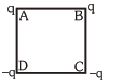
- 4Charges are placed on the vertices of a square as shown. Let $E$ be the electric field and $V$ the potential at the centre. If the charges on $A$ and $B$ are interchanged with those on $D$ and $C$ respectively, thenView Solution
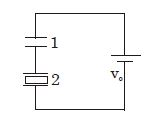
- 5Two identical capacitors $1$ and $2$ are connected in series. The capacitor $2$ contains a dielectric slab of constant $K$ as shown. They are connected to a battery of emf $V_0\ volts$ . The dielectric slab is then removed. Let $Q_1$ and $Q_2$ be the charge stored in the capacitors before removing the slab and $Q'_1$ , and $Q'_2$ be the values after removing the slab. ThenView Solution
- 6Two unlike charges of magnitude $q$ are separated by a distance $2d$. The potential at a point midway between them isView Solution
- 7View SolutionThe charge given to any conductor resides on its outer surface, because
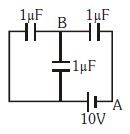
- 8If potential of $A$ is $10\,V$, then potential of $B$ isView Solution
- 9Two capacitors of capacitances $3\,\mu \,F$ and $6\,\mu F$ are charged to a potential of $12 \,V$ each. They are now connected to each other, with the positive plate of each joined to the negative plate of the other. The potential difference across each will be......$volt$View Solution
- 10The capacity of a parallel plate capacitor with no dielectric substance but with a separation of $0.4 \,cm$ is $2\,\mu \,F$. The separation is reduced to half and it is filled with a dielectric substance of value $2.8$. The final capacity of the capacitor is.......$\mu \,F$View Solution