A 4 cm tall object is placed on the principal axis of a convex lens. The distance of the object from the optical centre of the lens is 12cm and its sharp image is formed at a distance of 24cm from it on a screen on the other side of the lens. If the object is now moved a little away from the lens, in which way (towards the lens or away from the lens) will he have to move the screen to get a sharp image of the object on it again? How will the magnification of the image be affected?
CBSE OUTSIDE DELHI - SET 2 2015
Download our app for free and get started
- When the object is moved a little away from the lens, then the screen should be moved towards the lens. A sharp image is formed.
- When the object is moved a little away from the lens, then the magnification of the mage decreases.

Download our appand get started for free
Experience the future of education. Simply download our apps or reach out to us for more information. Let's shape the future of learning together!No signup needed.*
Similar Questions
- 1View SolutionHow could you find the focal length of a convex lens rapidly but approximately?
- 2View SolutionIf two lenses (convex) are in contact with each other, what happens to the ray after refraction?
- 3View SolutionAn object is placed at a distance of 30 cm from a concave lens of focal length 15 cm. List four characteristics (nature, position, etc.) of the image formed by the lens.
- 4View SolutionDraw ray diagrams showing the image formation by a convex lens when an object is placed:Between focus and twice the focal length of the lens.
- 5View SolutionYou are provided with two lenses of focal lengths 10cm and 20cm. Which of the two lenses would you suggest to obtain greater convergence on refracted light? Justify your choice.
- 6View SolutionWhat do you understand by the power of a lens? Name one factor on which the power of a lens depends.
- 7View SolutionTo find the image distance for varying object distances in case of a convex lens of focal length 15 cm, a student obtains on a screen a sharp image of a bright object by placing it at 20 cm distance from the lens. After that he gradually moves the object away from the lens and each time focuses the image on the screen.
- In which direction-towards or away from the lens does he move the screen to focus the object?
- How does the size of image change?
- Approximately at what distance does he obtain the image of magnification -1?
- How does the intensity of image change as the object moves farther and farther away from the lens?
- 8View SolutionState two positions in which a concave mirror produces a magnified image of a given object. List two differences between the two images.
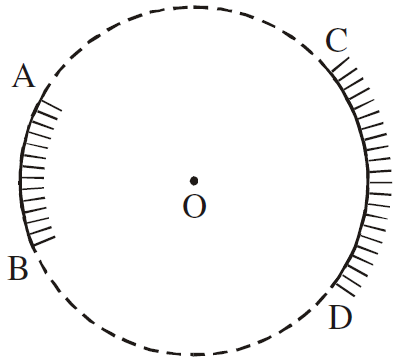
- 9AB and CD, two spherical mirrors, form parts of a hollow spherical ball with its centre at O as shown in the diagram. If arc $\text{AB}=\frac{1}{2}$ arc CD, what is the ratio of their focal lengths? State which of the two mirrors will always form virtual image of an object placed in front of it and why.View Solution
- 10View SolutionWhat is meant by:
- Principal focus of a convex mirror.
- Focal length of a convex mirror?