Question
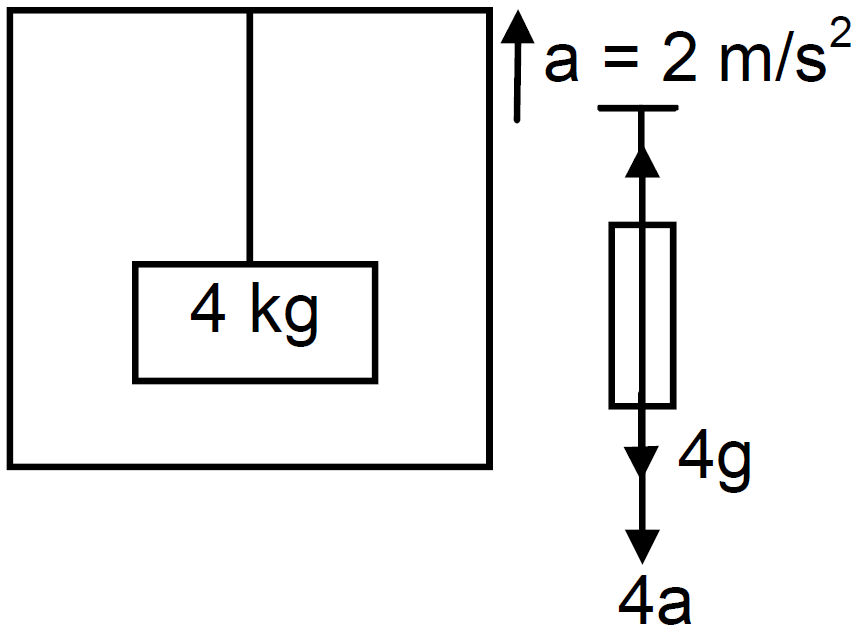
A 4.0kg block is suspended from the ceiling of an elevator through a, string having a linear mass density of $19.2 \times 10^{-3}kg/m$. Find the speed (with respect to the string) with which a wave pulse can proceed on the string if the elevator accelerates up at the rate of $2.0m/s^2$. Take $g = 10m/s^2​​​​​​​$.

Answer


$\text{m}=19.2\times10^{-3}\text{kg/m}$
From the freebody diagram,$\text{T}-4\text{g}-4\text{a}=0$
$\Rightarrow\text{T}=4(\text{a}+\text{g})=48\text{N}$
Wave speed, $\text{v}=\sqrt{\Big(\frac{\text{T}}{\text{m}}\Big)}=50\text{m/s}$

Need a full question paper?

Generate a complete, print-ready paper with questions like this in minutes — across 16+ boards, with answer keys.

Start Generating Free

Similar questions

A child has near point at 10cm. What is the maximum angular magnification the child can have with a convex lens of focal length 10cm?
While watering a distant plant, a gardener partially water than in fresh closes the exit hole of the pipe by putting his finger on it. Explain why this results in the water stream goirig to a larger distance.
A moving-coil galvanometer has a 50-turn coil of size 2cm × 2cm. It is suspended between the magnetic poles producing a magnetic field of 0.5T. Find the torque on the coil due to the magnetic field when a current of 20mA passes through it.
A narrow pencil of parallel light is incident normally on a solid transparent sphere of radius r. What should be the refractive index if the pencil is to he focused.
  1. At the surface of the sphere.
  2. At the centre of the sphere.
Why is the linear portion of the triode characteristic chosen to operate the triode as an amplifier?
If an automobile engine is overheated, it is cooled by putting water on it. It is advised that the water should be put slowly with engine running. Explain the reason.
A unitless quantity:
  1. Never has a non-zero dimension.
  2. Always has a non-zero dimension.
  3. May have a non-zero dimension.
  4. Does not exist.
Read the passage given below and answer the following questions from 1 to 5.In physics, we can classify quantities as scalars or vectors. Basically, the difference is that a direction is associated with a vector but not with a scalar. A scalar quantity is a quantity with magnitude only. It is specified completely by a single number, along with the proper unit. Examples are: the distance between two points, mass of an object, the temperature of a body and the time at which a certain event happened. The rules for combining scalars are the rules of ordinary algebra. Scalars can be added, subtracted, multiplied and divided just as the ordinary numbers. A vector quantity is a quantity that has both a magnitude and a direction and obeys the triangle law of addition or equivalently the parallelogram law of addition. So, a vector is specified by giving its magnitude by a number and its direction. Some physical quantities that are represented by vectors are displacement, velocity, acceleration and force. Answer the following
  1. Force is example of:
  1. Scalar
  2. Vector
  3. Tensor
  4. None of these
  1. Mass of an object is:
  1. Scalar
  2. Vector
  3. Tensor
  4. None of these
  1. Define scalar quantity and vector quantity
  1. Can we add vectors like ordinary algebra? If not then how vectors are added?
  1. Differentiate between scalar and vectors
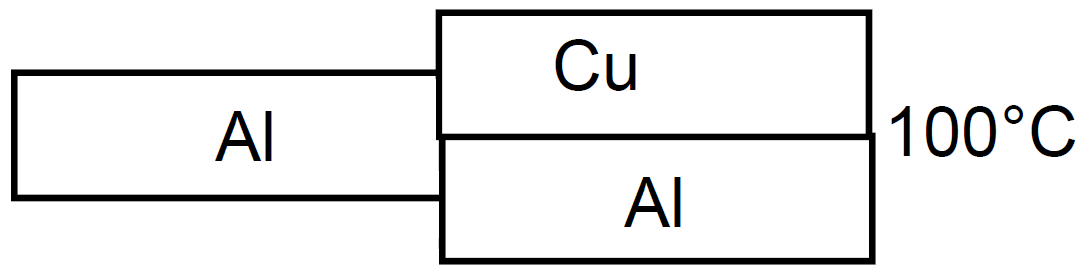
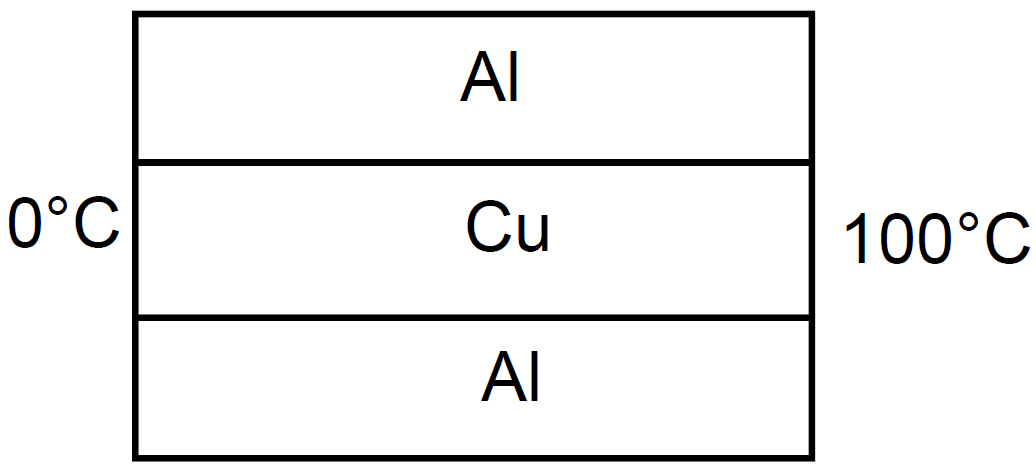
The three rods shown in figure, have identical geometrical dimensions. Heat flows from the hot end at a rate of $40$ Win the arrangement (a) Find the rates of heat flow when the rods are joined as in arrangement (b) and in (c) Thermal conductivities of aluminium and copper are $200Wm^{-1^\circ}C^{-1}$ and $400Wm^{-1^\circ}C^{-1}$ respectively.
  1.  
  1.  
  1.  
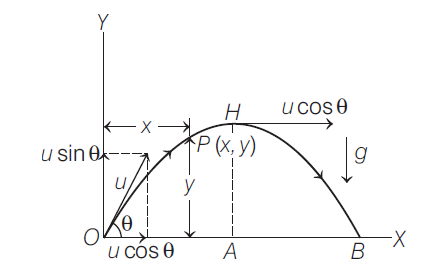
Read the passage given below and answer the following questions from 1 to 5. Projectile motion is a form of motion in which an object or particle is thrown with some initial velocity near the earth’s surface and it moves along a curved path under the action of gravity alone. The path followed by a projectile is called its trajectory, which is shown below. When a projectile is projected obliquely, then its trajectory is as shown in the figure below. Here velocity u is resolved into two components, we get (a) u cosθ along OX and (b) u sinθ along OY.
  1. The example of such type of motion is:
  1. Motion of car on a banked road.
  2. Motion of boat in sea.
  3. A javelin thrown by an athlete.
  4. Motion of ball thrown vertically upward.
  1. The acceleration of the object in horizontal direction is:
  1. Constant
  2. Decreasing
  3. Increasing
  4. Zero
  1. The vertical component of velocity at point H is:
  1. Maximum
  2. Zero
  3. Double to that at O
  4. Equal to horizontal component
  1. A cricket ball is thrown at a speed of 28m/s in a direction 30° with the horizontal. The time taken by the ball to return to the same level will be:
  1. 2.0s
  2. 3.0s
  3. 4.0s
  4. 2.9s
  1. In above case, the distance from the thrower to the point where the ball returns to the same level will be:
  1. 39m
  2. 69m
  3. 68m
  4. 72m