Question
If an automobile engine is overheated, it is cooled by putting water on it. It is advised that the water should be put slowly with engine running. Explain the reason.

Answer

In a hot engine the hot parts are expanded because of heat, if cold water is poured suddenly then there will be uneven thermal contraction in the parts. This will result in a stress to develop between the various parts of the engine and may let the engine to crack down.

Need a full question paper?

Generate a complete, print-ready paper with questions like this in minutes — across 16+ boards, with answer keys.

Start Generating Free

Similar questions

Read the passage given below and answer the following questions from 1 to 5. Satellites in a circular orbits around the earth in the equatorial plane with T = 24 hours are called Geostationary Satellites. Clearly, since the earth rotates with the same period, the satellite would appear fixed from any point on earth. It takes very powerful rockets to throw up a satellite to such large heights above the earth but this has been done in view of the several benefits of much practical application. Weight of an object is the force with which the earth attracts it. We are conscious of our own weight when we stand on a surface, since the surface exerts a force opposite to our weight to keep us at rest. The same principle holds good when we measure the weight of an object by a Spring balance hung from a fixed point e.g. the ceiling. The object would fall down unless it is subject to a force opposite to gravity. This is exactly what the spring exerts on the object. This is because the spring is pulled down a little by the gravitational pull of the object and in turn the spring exerts a force on the object vertically upwards. Now, imagine that the top end of the balance is no longer held fixed to the top ceiling of the room. Both ends of the spring as well as the object move with identical acceleration g. The spring is not stretched and does not exert any upward force on the object which is moving down with acceleration g due to gravity. The reading recorded in the spring balance is zero since the spring is not stretched at all. If the object were a human being, he or she will not feel his weight since there is no upward force on him. Thus, when an object is in free fall, it is weightless and this phenomenon is usually called the phenomenon of weightlessness. In a satellite around the earth, every part and parcel of the satellite has acceleration towards the centre of the earth which is exactly the value of earth’s acceleration due to gravity at that position. Thus in the satellite everything inside it is in a state of free fall. This is just as if we were falling towards the earth from a height. Thus, in a manned satellite, people inside experience no gravity. Gravity for us defines the vertical direction and thus for them there are no horizontal or vertical directions, all directions are the same.
  1. Astronaut experiences weightlessness in space because:
  1. Acceleration due to gravity is zero.
  2. Actual weight of astronaut is zero.
  3. They are going with same acceleration due to gravity.
  4. None of these.
  1. Weighing machine measures:
  1. Mass of the person.
  2. Normal reaction exerted by machine on person.
  3. Both a and b.
  4. None of these.
  1. What is geostationary satellite?
  1. What is weight? How it is measured?
  1. What is weightlessness astronaut in satellite experienced by ?
The reduction factor K of a tangent galvanometer is written on the instrument. The manual says that the current is obtained by multiplying this factor to tane. The procedure works well at Bhuwaneshwar. Will the procedure work if the instrument is taken to Nepal? If there is some error, can it be corrected by correcting the manual or the instrument will have to be taken back to the factory?
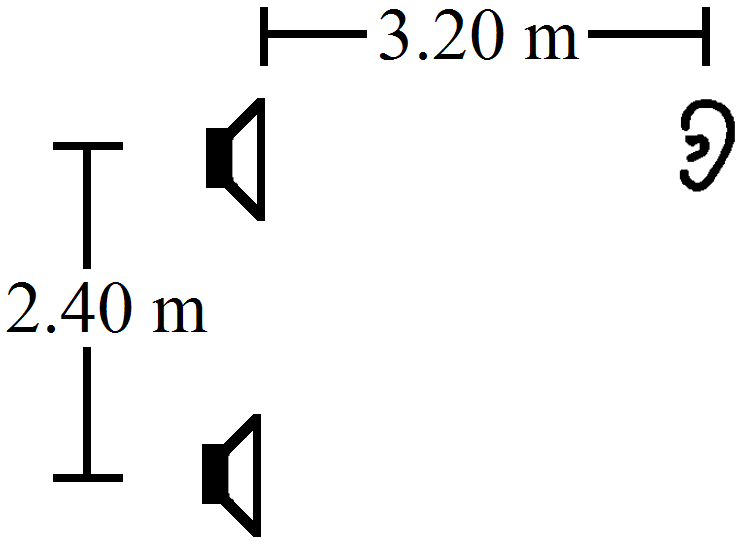
Two stereo speakers are separated by a distance of 2.40m. A person stands at a distance of 3.20m directly in front of one of the speakers as shown in figure, Find the frequencies in the audible range (20-2000Hz) for which the listener will hear a minimum sound intensity. Speed of sound in air = 320m/s.
The dimensions $\text{ML}^{-1}\text{T}^{-2}$ may correspond to:
  1. Work done by a force.
  2. Linear momentum.
  3. Pressure.
  4. Energy per unit volume.
A bar magnet takes $\frac{\pi}{10}$ second to complete one oscillation in an oscillation magnetometer. The moment of inertia of the magnet about the axis of rotation is $1.2 \times 10^{-4} \mathrm{~kg}-\mathrm{m}^2$ and the earth's horizontal magnetic field is $30\mu \text{T}.$ Find the magnetic moment of the magnet.
The needle of a dip circle shows an apparent dip of 45° in a particular position and 53° when the circle is rotated through 90°. Find the true dip.
Read the passage given below and answer the following questions from (i) to (iv). Zeroth Law of Thermodynamics states that two systems in thermal equilibrium with a third system separately are in thermal equilibrium with each other. The Zeroth Law clearly suggests that when two systems A and B, are in thermal equilibrium, there must be a physical quantity that has the same value for both. This thermodynamic variable whose value is equal for two systems in thermal equilibrium is called temperature (T). Thus, if A and B are separately in equilibrium with C, TA = TC and TB = TC. This implies that TA = TB i.e. the systems A and B are also in thermal equilibrium. Zeroth Law of Thermodynamics leads to the concept of internal energy of a system. We know that every bulk system consists of a large number of molecules. Internal energy is simply the sum of the kinetic energies and potential energies of these molecules. A certain amount of heat is supplied to the system’ or ‘a certain amount of work was done by the system its energy changes.
  1. Three thermodynamic systems are at temperature of 500 c .what can we say about them?
  1. Heat flows between them
  2. It obeys Zeroth Law of Thermodynamics
  3. Temperature of one system will increase and temperature of remaining two will decrease
  4. None of these
  1. Zeroth law of thermodynamics helped in the creation of which scale?
  1. Temperature
  2. Heat energy
  3. Pressure
  4. Internal energy
  1. State Zeroth Law of Thermodynamics:
  2. Define Internal energy of system:
A lady cannot see objects closer than 40cm from the left eye and closer than 100cm from the right eye. While on a mountaineering trip, she is lost from her team. She tries to make an astronomical telscope from her reading glasses to look for her teammates.
  1. Which glass should she use as the eyepiece?
  2. What magnification can she get with relaxed eye?
A narrow pencil of parallel light is incident normally on a solid transparent sphere of radius r. What should be the refractive index if the pencil is to he focused.
  1. At the surface of the sphere.
  2. At the centre of the sphere.
Read the passage given below and answer the following questions from $1$ to $5.$ Friction: Let us return to the example of a body of mass m at rest on a horizontal table. The force of gravity $(mg)$ is cancelled by the normal reaction force $(N)$ of the table. Now suppose a force F is applied horizontally to the body. We know from experience that a small applied force may not be enough to move the body. But if the applied force F were the only external force on the body, it must move with acceleration F/m, however small. Clearly, the body remains at rest because some other force comes into play in the horizontal direction and opposes the applied force F, resulting in zero net force on the body. This force fs parallel to the surface of the body in contact with the table is known as frictional force, or simply friction. When there is no applied force, there is no static friction. It comes into play the moment there is an applied force. As the applied force $F$ increases, fs also increases, remaining equal and opposite to the applied force $($up to a certain limit$),$ keeping the body at rest. Hence, it is called static friction. Static friction opposes impending motion. The term impending motion means motion that would take place $($but does not actually take place$)$ under the applied force, if friction were absent. It is found experimentally that the limiting value of static friction $(fs )$ max f is independent of the area of contact and varies with the normal force$(N)$ approximately as: $(\text{f}_{\text{s}})\text{max}=\mu\text{N}$ where μs is a constant of proportionality depending only on the nature of the surfaces in contact. The constant μs is called the coefficient of static friction. The law of static friction may thus be written as $(\text{f}_{\text{s}})\leq\mu\text{sN}$ Frictional force that opposes relative motion between surfaces in contact is called kinetic or sliding friction and is denoted by $fk$. Kinetic friction, like static friction, is found to be independent of the area of contact. Further, it is nearly independent of the velocity. It satisfies a law similar to that for static friction: $(\text{f}_{\text{k}})=\mu_{\text{k}}\text{N}$
  1. Force of static friction is directly proportional to:
  1. Normal reaction
  2. Force by gravity
  3. Velocity of body
  4. None of these
  1. Coefficient of kinetic friction is independent of area of contact. True or false?
  1. True
  2. False
  1. Give formula for law of static friction
  1. Explain law of static friction
  1. Explain kinetic friction.