Question
A child has near point at 10cm. What is the maximum angular magnification the child can have with a convex lens of focal length 10cm?

Answer

The child has D = 10cm and f = 10cm. The maximum angular magnification is obtained when the image is formed at near point.$\text{m}=1+\frac{\text{D}}{\text{f}}=1+\frac{10}{10}=1+1=2$

Need a full question paper?

Generate a complete, print-ready paper with questions like this in minutes — across 16+ boards, with answer keys.
Start Generating Free

Similar questions

A container contains water upto a height of 20cm and there is a point source at the centre of the bottom of the container. A rubber ring of radius r floats centrally on the water. The ceiling of the room is 2.0m above the water surface.
  1. Find the radius of the shadow of the ring formed on the ceiling if r = 15cm.
  2. Find the maximum value of r for which the shadow of the ring is formed on the ceiling. Refractive index of water $\frac{4}{3}.$
A simple pendulum fixed in a car has a time period of 4 seconds when the car is moving uniformly on a horizontal road. When the accelerator is pressed, the time period changes to 3.99 seconds. Making an approximate analysis, find the acceleration of the car.
Read the passage given below and answer the following questions from (i) to (v). Monatomic Gases: The molecule of a monatomic gas has only three translational degrees of freedom. Thus, the average energy of a molecule at temperature T is $\frac{3}{2}\text{K}_\text{b}\text{T}$. The total internal energy of a mole of such a gas is $\text{U}=(\frac{3}{2})\text{RT}$. The molar specific heat at constant volume cv is given by$\text{C}_{\text{v}}=\frac{\text{Du}}{\text{Dt}}=(\frac{3}{2})\text{R}$
For an ideal gas, $C_p - C_v = R$ Where Cp is the molar specific heat at constant pressure. Thus, $\text{C}_\text{P} =(\frac{5}{2})\text{R}$ The ratio of specific heats IS $\gamma=\frac{\text{cp}}{\text{cv}}=\frac{5}{3}$ Diatomic Gases: a diatomic molecule treated as a rigid rotator, like a dumbbell, has 5 degrees of freedom: 3 translational and 2 rotational. Using the law of equipartition of energy, the total internal energy of a mole of such a gas is $\text{U}=\frac{5}{2}\text{RT}$ The molar specific heat at constant volume cv is given by$\text{Cv}=\frac{\text{DU}}{\text{DT}}=(\frac{5}{2})\text{R}$
For an ideal gas, $C_p – C_v= R$ Where Cp is the molar specific heat at constant pressure. Thus, $\text{C}_\text{P} =(\frac{7}{2})\text{R}$ The ratio of specific heats IS $γ( \text{for rigid diatomic)}=\frac{\text{C}_\text{P}}{\text{C}_\text{v}} =(\frac{7}{5})\text{R}$ For non rigid diatomic molecules they have additional mode of vibrations therefore$\gamma=\frac{\text{C}_\text{p}}{\text{C}_\text{v}}=\frac{9}{7}$
Polyatomic Gases: In general a polyatomic molecule has 3 translational, 3 rotational degrees of freedom and a certain number (f) of vibrational modes. According to the law of equipartition of energy, it is easily seen that one mole of such a gas has$ C_v= (3 + f)$ R and $C_p= (4 + f) R$ and $\gamma=\frac{(4 + \text{f})}{(3+\text{f})}$
  1. For monatomic molecules ratio of specific heats is $\gamma$
  1. $\frac{5}{3}$
  2. $\frac{7}{5}$
  3. $\frac{9}{5}$
  4. None of these
  1. For diatomic rigid molecules ratio of specific heats is γ
  1. $\frac{5}{3}$
  2. $\frac{7}{5}$
  3. $\frac{9}{7}$
  4. None of these
  1. For diatomic non rigid molecules ratio of specific heats is γ
  1. $\frac{5}{3}$
  2. $\frac{7}{5}$
  3. $\frac{9}{7}$
  4. None of these
  1. Give cp and cv values and ratio of specific heat for monatomic gas molecules.
  2. Give cp and cv values and ratio of specific heat for polyatomic gas molecules
Which of the following sets cannot enter into the list of fundamental quantities in any system of units?
  1. Length, mass and velocity.
  2. Length, time and velocity.
  3. Mass, time and velocity.
  4. Length, time and mass.
A unitless quantity:
  1. Never has a non-zero dimension.
  2. Always has a non-zero dimension.
  3. May have a non-zero dimension.
  4. Does not exist.
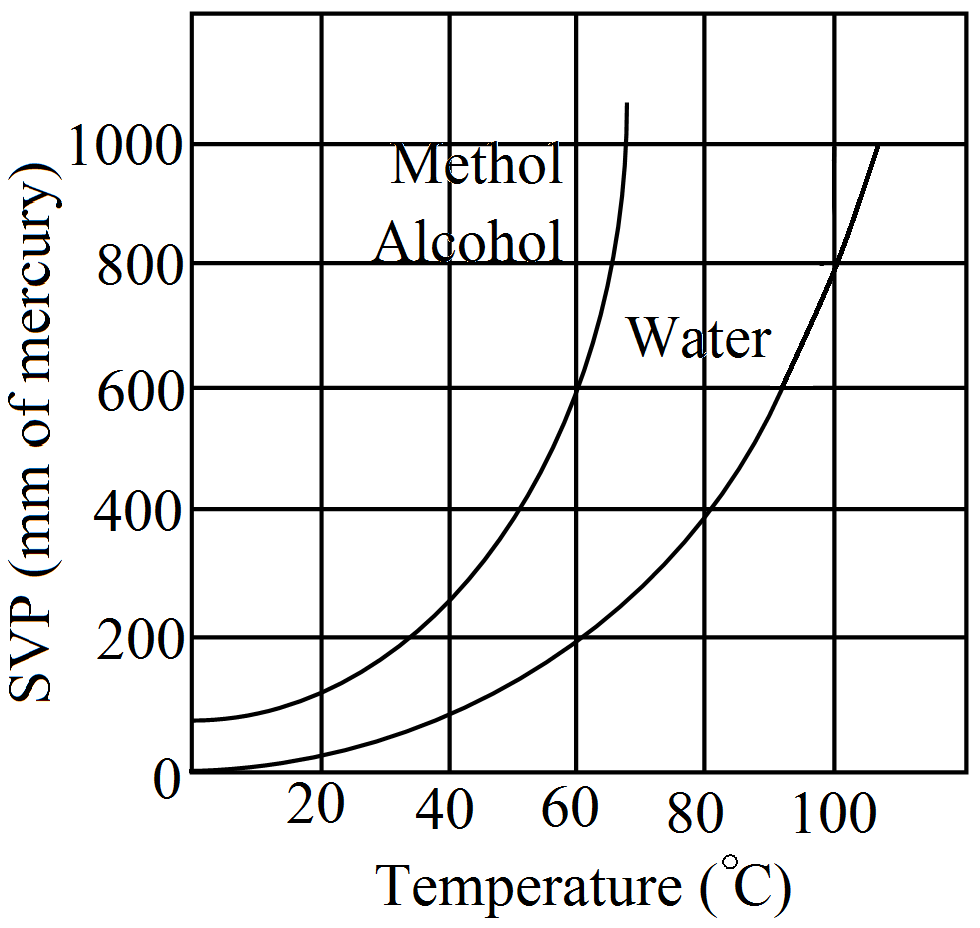
The human body has an average temperature of 98°F. Assume that the vapour pressure of the blood in the veins behaves like that of pure water. Find the minimum atmospheric pressure which is necessary to prevent the blood from boiling. Use figure. of the text for the vapour pressures.
In one of the exercises to strengthen the wrist and fingers, a person squeezes and releases a soft rubber ball. Is the work done on the ball positive, negative or zero during compression? During expansion?
The plate current in a triode value is maximum when the potential of the grid is:
  1. Positive.
  2. Zero.
  3. Negative.
  4. Non-positive.
Read the passage given below and answer the following questions from 1 to 5. The kinetic energy possessed by an object of mass, m and moving with a uniform velocity, v is $\text{K}=\frac{1}{2}\times\text{mv}^2=\frac{1}{2}\text{v}.\text{v}$ Kinetic energy is a scalar quantity. The kinetic energy of an object is a measure of the work and The energy possessed by an object is thus measured in terms of its capacity of doing work. The unit of energy is, therefore, the same as that of work, that is, joule (J). Work energy theorem: The change in kinetic energy of a particle is equal to the work done on it by the net force. Mathematically $K_f - K_i = W$ Where Ki and Kf are respectively the initial and final kinetic energies of the object. Work refers to the force and the displacement over which it acts. Work is done by a force on the body over a certain displacement.
  1. Kinetic energy is:
  1. Scalar quantity
  2. Vector quantity
  3. None of these
  1. Which of the following has same unit?
  1. Potential energy and work
  2. Kinetic energy and work
  3. Force and weight
  4. All of the above
  1. What is work energy theorem?
  1. Kinetic energy is scalar quantity. Justify the statement.
  1. Give formula for kinetic energy of body.
Read the passage given below and answer the following questions from 1 to 5. Beat The phenomenon of regular variation in intensity of sound with time at a particular position due to superposition of two sound waves of slightly different frequencies is called beats. For waves
$\therefore\text{y}=2\text{a}\cos\pi(\text{v}_1-\text{v}_2)\text{t}.\sin\pi(\text{v}_1-\text{v}_2)\text{t}$ is the required equation of beats. Beat frequency is given by $\text{v}_{\text{beat}}=\text{v}_1-\text{v}_2$ Beat period is given by
$\text{T}=\frac{1}{\text{Beat frequency}}=\frac{1}{\text{v}_1-\text{v}_2}$
  1. Which of the following phenomenon is used by the musicians to tune their musical instruments?
  1. Interference
  2. Diffraction
  3. Beats
  4. Polarisation
  1. The phenomenon of beats can take place
  1. For longitudinal waves only
  2. For transverse wave only
  3. For sound waves only
  4. For both longitudinal and transverse waves
  1. When two waves of almost equal frequencies $v_1$ and $v_2$ reach at a point simultaneously, the time interval between successive maxima is:
  1. $\text{v}_1+\text{v}_2$
  2. $\text{v}_1-\text{v}_2$
  3. $\frac{1}{\text{v}_1+\text{v}_2}$
  4. $\frac{1}{\text{v}_1-\text{v}_2}$
  1. Two turning forks of frequencies $n_1$ and $n_2$ produces n beats per second. If $n_2$ and n are known, $n_1$ may be given by:
  1. $\frac{\text{n}_2}{\text{n}}+\text{n}_2$
  2. $\text{n}_2\text{n}$
  3. $\text{n}_2\pm\text{n}$
  4. $\frac{\text{n}_2}{\text{n}}-\text{n}_2$
  1. P and Q are two wires whose fundamental frequencies are 256 Hz and 382 Hz respectively. How many beats in two seconds will be heard by the third harmonic of A and second harmonic of B?
  1. 4
  2. 8
  3. 16
  4. zero