A $4\,\mu F$ condenser is connected in parallel to another condenser of $8\,\mu F$. Both the condensers are then connected in series with a $12\,\mu F$ condenser and charged to $20\;volts$. The charge on the plate of $4\,\mu F$ condenser is......$\mu C$
Medium
Download our app for free and get started
(b) Equivalent capacitance of the circuit ${C_{eq}} = 6\,\mu F$
Charge supplied from source $Q = 6 × 20 =120 \,µC$
Hence charge on the plates of $4 \,µF$ capacitor
$ = Q' = \frac{4}{{(4 + 8)}} \times 120 = 40\,\mu C$
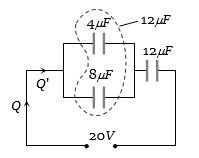
Charge supplied from source $Q = 6 × 20 =120 \,µC$
Hence charge on the plates of $4 \,µF$ capacitor
$ = Q' = \frac{4}{{(4 + 8)}} \times 120 = 40\,\mu C$

Download our appand get started for free
Experience the future of education. Simply download our apps or reach out to us for more information. Let's shape the future of learning together!No signup needed.*
Similar Questions
- 1A sphere of radius $1\,cm$ has potential of $8000\,V$, then energy density near its surface will beView Solution
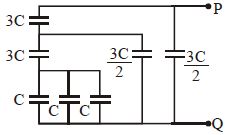
- 2The value of equivalent capacitance of the combination shown in figure between the points $P$ and $Q$ isView Solution
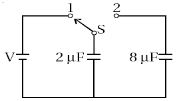
- 3A capacitor of $2\,\, \mu F$ is charged as shown in the diagram. When the switch $S$ is turned to position $2,$ the percentage of its stored energy dissipated is ......$\%$View Solution
- 4Two equal point charges are fixed at $x = - a$ and $x = + a$ on the $x-$axis. Another point charge $Q$ is placed at the origin. The Change in the electrical potential energy of $Q$, when it is displaced by a small distance $x$ along the $x$-axis, is approximately proportional toView Solution
- 5A charge $( - q)$ and another charge $( + Q)$ are kept at two points $A$ and $B$ respectively. Keeping the charge $( + Q)$ fixed at $B$, the charge $( - q)$ at $A$ is moved to another point $C$ such that $ABC$ forms an equilateral triangle of side $l$. The net work done in moving the charge $( - q)$ isView Solution
- 6The electric potential $V$ is given as a function of distance $x$ (metre) by $V = (5{x^2} + 10x - 9)\,volt$. Value of electric field at $x = 1$ is......$V/m$View Solution
- 7Two capacitors of capacitances $C$ and $2\, C$ are charged to potential differences $V$ and $2\, V$, respectively. These are then connected in parallel in such a manner that the positive terminal of one is connected to the negative terminal of the other. The final energy of this configuration is$.....CV^2$View Solution
- 8A particle of mass $m$ having negative charge $q$ move along an ellipse around a fixed positive charge $Q$ so that its maximum and minimum distances from fixed charge are equal to $r_1$ and $r_2$ respectively. The angular momentum $L$ of this particle isView Solution
- 9A $4\ \mu F$ capacitor, a resistance of $2.5 \,MW$$\Omega$ is in series with $12\, V$ battery. Find the time after which the potential difference across the capacitor is $3$ times the potential difference across the resistor.......$s$ [Given $ln(2)= 0.693$]View Solution
- 10Two identical particles of mass m carry a charge $Q$ each. Initially one is at rest on a smooth horizontal plane and the other is projected along the plane directly towards first particle from a large distance with speed $v.$ The closest distance of approach beView Solution