A sphere of radius $1\,cm$ has potential of $8000\,V$, then energy density near its surface will be
Easy
Download our app for free and get started
(d) Energy density ${u_e} = \frac{1}{2}{\varepsilon _0}{E^2} = \frac{1}{2} \times 8.86 \times {10^{ - 12}} \times {\left( {\frac{V}{r}} \right)^2}$
$= 2.83\, J/m^3$
$= 2.83\, J/m^3$

Download our appand get started for free
Experience the future of education. Simply download our apps or reach out to us for more information. Let's shape the future of learning together!No signup needed.*
Similar Questions
- 1Consider a spherical shell of radius $R$ with a total charge $+ Q$ uniformly spread on its surface (centre of the shell lies at the origin $x=0$ ). Two point charges $+q$ and $-q$ are brought, one after the other from far away and placed at $x=-a / 2$ and $x=+a / 2( < R)$, respectively. Magnitude of the work done in this process isView Solution
- 2Two identical thin rings each of radius $R$ meters are coaxially placed at a distance $R$ meters apart. If $Q_1$ coulomb and $Q_2$ coulomb are respectively the charges uniformly spread on the two rings, the work done in moving a charge $q$ from the centre of one ring to that of other isView Solution
- 3Force acting upon a charged particle kept between the plates of a charged condenser is $F$. If one plate of the condenser is removed, then the force acting on the same particle will becomeView Solution
- 4View SolutionIf the distance between parallel plates of a capacitor is halved and dielectric constant is doubled then the capacitance will become
- 5Two capacitors $C_1$ and $C_2$ are charged to $120\ V$ and $200\ V$ respectively. It is found that connecting them together the potential on each one can be made zero. ThenView Solution
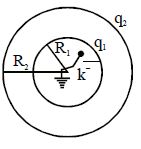
- 6Two concentric spherical shells of radius $R_1$ and $R_2$ have $q_1$ and $q_2$ charge respectively as shown in figure. How much charge will flow through key $k$ when it is closedView Solution
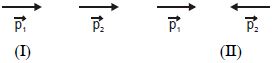
- 7View SolutionFor shown situation of two dipoles the nature of forces between them are
- 8View SolutionA table tennis ball which has been covered with conducting paint is suspended by a silk thread so that it hang between two plates, out of which one is earthed and other is connected to a high voltage generator. This ball
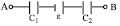
- 9A circuit shown in the figure consists of a battery of $emf$ $10$ $V$ and two capacitance $C_1$ and $C_2 $ of capacitances $1.0$ $ \mu F$ and $2.0$ $\mu F$ respectively. The potential difference $V_A - V_B$ is $5\,V$View Solution
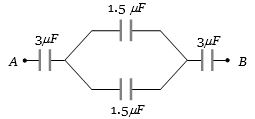
- 10The capacitance between the points $A$ and $B$ in the given circuit will be.......$\mu \,F$View Solution