Two identical particles of mass m carry a charge $Q$ each. Initially one is at rest on a smooth horizontal plane and the other is projected along the plane directly towards first particle from a large distance with speed $v.$ The closest distance of approach be
Advanced
Download our app for free and get started
Due to repulsive force the other particle will start moving away. The velocity of the first particle will decrease while that of the other will increase. At the point of minimum distance between the two both the particles will be moving at same velocity. Let this velocity be $u$
So using conservation of momentum we get
$m v=2 m u$ or $u=\frac{v}{2}$
The initial energy of the system is given as $\frac{1}{2} m v^{2}$
and the energy at the minimum distance is given as
$\frac{1}{2} m\left(\frac{v}{2}\right)^{2}+\frac{1}{2} m\left(\frac{v}{2}\right)^{2}+\frac{1}{4 \pi \epsilon_{o}} \frac{Q^{2}}{R}$
Equating the two energies we get
$\frac{1}{2} m v^{2}=\frac{1}{4} m v^{2}+\frac{1}{4 \pi \epsilon_{o}} \frac{Q^{2}}{R}$
Or
$\frac{1}{4} m v^{2}=\frac{1}{4 \pi \epsilon_{o}} \frac{Q^{2}}{R}$
Or
$R=\frac{4 Q^{2}}{4 \pi \epsilon_{o} m v^{2}}$

Download our appand get started for free
Experience the future of education. Simply download our apps or reach out to us for more information. Let's shape the future of learning together!No signup needed.*
Similar Questions
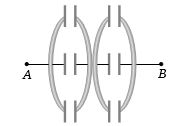
- 1All six capacitors shown are identical, Each can withstand maximum $200\, volts$ between its terminals. The maximum voltage that can be safely applied between $A$ and $B$ is.....$V$View Solution
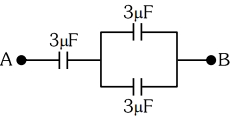
- 2The equivalent capacitance of the system shown in the following circuit is $...........\mu F$View Solution
- 3The potential (in volts ) of a charge distribution is given byView Solution
$V(z)\, = \,30 - 5{z^2}for\,\left| z \right| \le 1\,m$
$V(z)\, = \,35 - 10\,\left| z \right|for\,\left| z \right| \ge 1\,m$
$V(z)$ does not depend on $x$ and $y.$ If this potential is generated by a constant charge per unit volume $\rho _0$ (in units of $\varepsilon _0$ ) which is spread over a certain region, then choose the correct statement
- 4Three capacitors of capacitance $1\ \mu F$, $2 \ \mu F$ and $3\ \mu F$ are connected in series and a potential difference of $11 V$ is applied across the combination. Then, the potential difference across the plates of $1\ \mu F$ capacitor is......$V$View Solution
- 5In an hydrogen atom, the electron revolves around the nucleus in an orbit of radius $0.53 \times {10^{ - 10}}\,m$. Then the electrical potential produced by the nucleus at the position of the electron is......$V$View Solution
- 6View SolutionIf the distance between the plates of parallel plate capacitor is halved and the dielectric constant of dielectric is doubled, then its capacity will
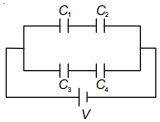
- 7Find the charge on capacitor $C_3$View Solution
Given, that $C_1=C_2=C$ and $C_3=C_4=3 C$.
- 8The radii of the inner and outer spheres of a condenser are $9\,cm$ and $10\,cm$ respectively. If the dielectric constant of the medium between the two spheres is $6$ and charge on the inner sphere is $18 \times {10^{ - 9}}\;coulomb$, then the potential of inner sphere will be, if the outer sphere is earthed........$volts$View Solution
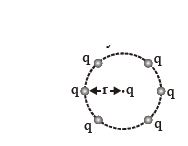
- 9A point charge is surrounded symmetrically by six identical charges at distance $r$ as shown in the figure. How much work is done by the forces of electrostatic repulsion when the point charge $q$ at the centre is removed at infinityView Solution
- 10A capacitor of capacity $C$ has charge $Q$ and stored energy is $W$. If the charge is increased to $2Q$, the stored energy will beView Solution