A $5\, m$ long aluminium wire ($Y = 7 \times {10^{10}}N/{m^2})$ of diameter $3\, mm$ supports a $40\, kg$ mass. In order to have the same elongation in a copper wire $(Y = 12 \times {10^{10}}N/{m^2})$ of the same length under the same weight, the diameter should now be, in $mm.$
Diffcult


Download our appand get started for free
Experience the future of education. Simply download our apps or reach out to us for more information. Let's shape the future of learning together!No signup needed.*
Similar Questions
- 1Stress required in a wire to produce $0.1\%$ strain is $4 \times10^8\, N/m^2$. Its yound modulus is $Y_1$. If stress required in other wire to produce $0.3\%$ strain is $6 \times 10^8\, N/m^2$. Its young modulus is $Y_2$. Which relation is correctView Solution
- 2View SolutionThe isothermal bulk modulus of a gas at atmospheric pressure is
- 3A copper wire of length $1.0\, m$ and a steel wire of length $0.5\, m$ having equal cross-sectional areas are joined end to end. The composite wire is stretched by a certain load which stretches the copper wire by $1\, mm$. If the Young's modulii of copper and steel are respectively $1.0\times10^{11}\, Nm^{-2}$ and $2.0\times10^{11}\, Nm^{- 2}$, the total extension of the composite wire is ........ $mm$View Solution
- 4The stress-strain curves are drawn for two different materials $X$ and $Y$. It is observed that the ultimate strength point and the fracture point are close to each other for material $X$ but are far apart for material $Y$. We can say that materials $X$ and $Y$ are likely to be (respectively)View Solution
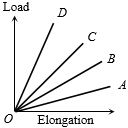
- 5View SolutionThe load versus elongation graph for four wires of the same material is shown in the figure. The thickest wire is represented by the line
- 6One end of a slack wire (Young's modulus $Y$, length $L$ and cross-sectional area $A$ ) is clamped to a rigid wall and the other end to a block (mass $m$ ), which rests on a smooth horizontal plane. The block is set in motion with a speed $v$. What is the maximum distance, then the block will travel after the wire becomes taut?View Solution
- 7Steel ruptures when a shear of $3 .5 \times 10^8\,\,N\,m^{-2}$ is applied. The force needed to punch a $1\,cm$ diameter hole in a steel sheet $0.3\,cm$ thick is nearlyView Solution
- 8In an experiment, brass and steel wires of length $1\,m$ each with areas of cross section $1\,mm^2$ are used. The wires are connected in series and one end of the combined wire is connected to a rigid support and other end is subjected to elongation. The stress requires to produced a new elongation of $0.2\,mm$ is [Given, the Young’s Modulus for steel and brass are respectively $120\times 10^9\,N/m^2$ and $60\times 10^9\,N/m^2$ ]View Solution
- 9In $CGS$ system, the Young's modulus of a steel wire is $2 \times {10^{12}}$. To double the length of a wire of unit cross-section area, the force required isView Solution
- 10A uniform copper rod of length $50 \,cm$ and diameter $3.0 \,mm$ is kept on a frictionless horizontal surface at $20^{\circ} C$. The coefficient of linear expansion of copper is $2.0 \times 10^{-5} \,K ^{-1}$ and Young's modulus is $1.2 \times 10^{11} \,N / m ^2$. The copper rod is heated to $100^{\circ} C$, then the tension developed in the copper rod is .......... $\times 10^3 \,N$View Solution