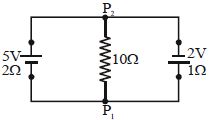
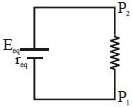
A $5\, V$ battery with internal resistance $2\, \Omega$ and a $2\,V$ battery internal resistance $1\, \Omega$ are connected to a $10\, \Omega$ resistor as shown in the figure. The current in the $10\, \Omega$ resistor is :-
Medium


Download our appand get started for free
Experience the future of education. Simply download our apps or reach out to us for more information. Let's shape the future of learning together!No signup needed.*
Similar Questions
- 1If two electric bulbs have $40\,W$ and $60\,W$ rating at $220\,V$, then the ratio of their resistances will beView Solution
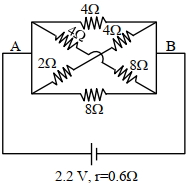
- 2In the given figure, the $emf$ of the cell is $2.2\, {V}$ and if internal resistance is $0.6\, \Omega$. Calculate the power dissipated in the whole circuit: (in $W$)View Solution
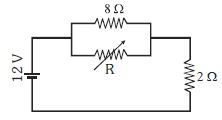
- 3The value of the resistance $R$ in figure is adjusted such that power dissipated in the $2\,\Omega $ resistor is maximum. Then the power dissipated in the $2\,\Omega $ will be ................ $W$View Solution
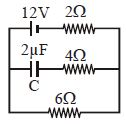
- 4Find the charge on the capacitor $C$ in the following circuit ............ $\mu C$View Solution
- 5Eight copper wire of length $l$ and diameter $d$ are joined in parallel to form a single composite conductor of resistance $R$. If a single copper wire of length $2\,l$ have the same resistance $(R)$ then its diameter will be $.....d$.View Solution
- 6A rod of a certain metal is $1.0\, m$ long and $0.6\, cm$ in diameter. Its resistance is $3.0 × {10^{ - 3}}\, ohm$. Another disc made of the same metal is $2.0\, cm$ in diameter and $1.0\, mm$ thick. What is the resistance between the round faces of the discView Solution
- 7The resistance of a wire of uniform diameter $d$ and length $L$ is $R$. The resistance of another wire of the same material but diameter $2d$ and length $4L$ will beView Solution
- 8A potentiometer wire of length $100\, cm$ has a resistance of $10\,\Omega $. It is connected in series with a resistance and a cell of $emf$ $2\, V$ and of negligible internal resistance. A source of $emf$ $10\,mV$ is balanced against a length of $40\, cm$ of the potentiometer wire. What is the value of external resistance ? .................. $\Omega$View Solution
- 9View SolutionAccording to Joule's law, if the potential difference across a conductor having a material of specific resistance remains constant, then the heat produced in the conductor is directly proportional to
- 10Resistances ${R_1}$ and ${R_2}$ are joined in parallel and a current is passed so that the amount of heat liberated is ${H_1}$ and ${H_2}$ respectively. The ratio $\frac{{{H_1}}}{{{H_2}}}$ has the valueView Solution