The resistance of a wire of uniform diameter $d$ and length $L$ is $R$. The resistance of another wire of the same material but diameter $2d$ and length $4L$ will be
Easy


Download our appand get started for free
Experience the future of education. Simply download our apps or reach out to us for more information. Let's shape the future of learning together!No signup needed.*
Similar Questions
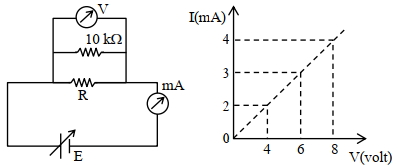
- 1To determine the resistance ($R$) of a wire, a circuit is designed below, The $V-I$ characteristic curve for this circuit is plotted for the voltmeter and the ammeter readings as shown in figure. The value of $\mathrm{R}$ is . . . . . . .$\Omega$View Solution
- 2At room temperature $\left(27^{\circ} \mathrm{C}\right)$, the resistance of a heating element is $50 \Omega$. The temperature coefficient of the material is $2.4 \times 10^{-4}{ }^{\circ} \mathrm{C}^1$. The temperature of the element, when its resistance is $62 \Omega$, is $\qquad$ ${ }^{\circ} \mathrm{C}$.View Solution
- 3The resistivity of alloys $ = {R_{{\rm{alloy}}}}$; the resistivity of constituent metals ${R_{{\rm{metal}}}}$. Then, usuallyView Solution
- 4Temperature coefficient at $0\,^oC$ is $0.00125\,^oC^{-1}$. At a temperature of $25\,^oC$ its resistance is $1\,\Omega $. Find the temperature at which resistance is $1.2\,\Omega $View Solution
- 5The emf of a battery is $2\, V$ and its internal resistance is $0.5 \,\Omega$. The maximum power which it can deliver to any external circuit will be ............. $watt$View Solution
- 6Give colors of the ring in sequence marked on a resistance of $56 \ k\Omega$ with tolerance $\pm 5\%$View Solution
- 7The specific resistance of a wire is $\rho $, its volume is $3\,{m^3}$ and its resistance is $3\, ohms$, then its length will beView Solution
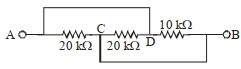
- 8The equivalent resistance between $A$ and $B$ as shown in figure is $........\,k\Omega$View Solution
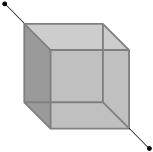
- 9Twelve wires of equal length and same cross-section are connected in the form of a cube. If the resistance of each of the wires is $R$, then the effective resistance between the two diagonal ends would beView Solution
- 10$1.6\, mA$ current is flowing in conducting wire then the number of electrons flowing per second isView Solution