MCQ
A $50 \mathrm{ohm}$ galvanometer gets full scale deflection when a current of $0.01 A$ passes through the coil. When it is comvetted to a $10 A$ ammeter, the shunt resistance is
  • A
    $0.01 \Omega$
  • $0.05 \Omega$
  • C
    $2000 \Omega$
  • D
    $5000 \Omega$

Answer

Correct option: B.
$0.05 \Omega$
(b) $i_g=i \frac{S}{G+S} \Rightarrow \frac{0.01}{10}=\frac{5}{50+S} \Rightarrow S=\frac{50}{999}=0.05 \Omega$.

Need a full question paper?

Generate a complete, print-ready paper with questions like this in minutes — across 16+ boards, with answer keys.
Start Generating Free

Similar questions

The frequency of a FM transmitter without signal input is called
A transverse sinusoidal wave of amplitude $a$, wavelength $\lambda$ and frequency $n$ is travelling on a stretched string. The maximum speed of any point on the string is $v / 10$, where $v$ is the speed of propagation of the wave. If $a=10^{-3} \mathrm{~m}$ and $v=10 \mathrm{~ms}^{-1}$, then $\lambda$ and $n$ are given by
The work function of a metal is $1.6 \times 10^{-19} \mathrm{~J}$. When the metal surface is illuminated by the light of wavelength $6400 \mathring A$, then the maximum kinetic energy of emitted photo-electrons will be (Planck's constant $h=6.4 \times 10^{-34} \mathrm{Js}$ )
If work function of metal is $3\ \mathrm{eV}$ then threshold wavelength will be
A hollow double concave lens is made of very thin transparent material. It can be filled with air or either of two liquids $L$ and $L$ having refractive indices $n$ and $n$ respectively $(n>n>1)$. The lens will diverge a parallel beam of light if it is filled with
A block of mass $m$ is placed on a smooth wedge of inclination $\theta$. The whole system is accelerated horizontally so that the block does not slip on the wedge. The force exerted by the wedge on the block ( $g$ is acceleration due to gravity) will be
Absorption co-efficient of an open window is...
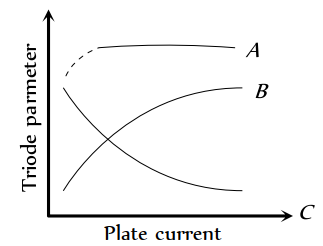
The figure represents variation of triode parameter ( $\mu$ or $r$ or $g$ ) with the plate current. The correct variation of $\mu$ and $r$ are given, respectively by the curves
Image
The masses of two planets are in the ratio $1: 2$. Their radii are in the ratio $1: 2$. The acceleration due to gravity on the planets are in the ratio
A plane glass slab is kept over various coloured letters, the letter which appears least raised is