MCQ
A $500 \,kg$ car takes a round turn of radius $50 \,m$ with a velocity of $36 \,km/hr$. The centripetal force is ..........  $N$
  • A
    $250$
  • B
    $750$
  • $1000$
  • D
    $1200$

Answer

Correct option: C.
$1000$
c
(c)$v = 36\frac{{km}}{h} = 10\frac{m}{s}$

$F = \frac{{m{v^2}}}{r} = \frac{{500 \times 100}}{{50}} = 1000\,N.$

Need a full question paper?

Generate a complete, print-ready paper with questions like this in minutes — across 16+ boards, with answer keys.
Start Generating Free

Similar questions

The displacement $x$ of a particle in a straight line motion is given by $x=1-t-t^2$. The correct representation of the motion is $..............$.
A body of mass $m=3.513 \;kg$ is moving along the $x$ - axis with a speed of $5.00 \;ms ^{-1}$. The magnitude of its momentum is recorded as  (Consider significant figures)
A tuning fork sends sound waves in air. If the temperature of the air increases, which of the following parameters will change?
Out of the following pair, which one does not have identical dimensions
For a particle executing $\text{SHM}$ along $x-$axis force is given by:
A rectangular block of mass $m$ and area of cross section $A$ floats in a liquid of density $\rho$ If it is given a small vertical displacement from equilibrium, it undergoes oscillations with a time period $T,$ then:
$M$ grams of steam at $100^{\circ} \mathrm{C}$ is mixed with $200\; \mathrm{g}$ of ice at its melting point in a thermally insulated container. If it produces liquid water at $40^{\circ} \mathrm{C}$ [heat of vaporization of water is $540 \;cal/\mathrm{g}$ and heat of fusion of ice is $80 \;\text { cal/g }]$ the value of $\mathrm{M}$ is
In which of the following systems will the radius of the first orbit $(n = 1)$ be minimum?
A block is stationary on a rough inclined plane. How many forces are acting on the block?
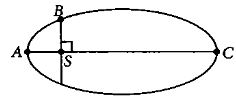
The kinetic energies of a planet in an elliptical orbit about the Sun, at positions $A, B$ and $C$ are   $K_A, K_B$ and $K_C$, respectively. $AC$ is the major axis and $SB$ is perpendicular to $AC$ at the position of the Sun $S$ as shown in the figure. Then