A $50\,\Omega $ resistance is connected to a battery of $5\,V$. A galvanometer of resistance $100\, \Omega $ is to be used as an ammeter to measure current through the resistance, for this a resistance $r_s$ is connected to the galvanometer. Which of the following connections should be employed if the measured current is within $1\% $ of the current without the ammeter in the circuit ?
JEE MAIN 2016, Diffcult
Download our app for free and get started
As we know, $\mathrm{I}=\frac{\mathrm{V}}{\mathrm{R}}=\frac{5}{50}=0.1$
$I' = 0.099$
When Galvanometer is connected
$R_{e q}=50+\frac{100 S}{100+S}=\frac{V}{I}$
$\Rightarrow \frac{100 \mathrm{S}}{100+\mathrm{S}}=\frac{5}{0.099}-50$
$\Rightarrow \frac{100 \mathrm{S}}{100+\mathrm{S}}=50.50-50 \Rightarrow \frac{100 \mathrm{S}}{100+\mathrm{S}}=0.5$
$\Rightarrow 100 \mathrm{S}=50+0.55 \Rightarrow 99.5 \mathrm{S}=50$
$S=\frac{50}{99.05}=0.5 \,\Omega$
So, shunt of resistance $=0.5\, \Omega$ is onnected in parallel with the galvanometer.

Download our appand get started for free
Experience the future of education. Simply download our apps or reach out to us for more information. Let's shape the future of learning together!No signup needed.*
Similar Questions
- 1A coaxial cable consists of an inner wire of radius $'a'$ surrounded by an outer shell of inner and outer radii ' ${b}$ ' and '$c$' respectively. The inner wire carries an electric current is, which is distributed uniformly across cross-sectional area. The outer shell carries an equal current in opposite direction and distributed uniformly. What will be the ratio of the magnetic field at a distance ${x}$ from the axis when $(i)$ ${x}<{a}$ and $(ii)$ ${a}<{x}<{b}$ ?View Solution
- 2An electron is projected with velocity $v_0$ in a uniform electric field $E$ perpendicular to the field. Again it is projetced with velocity $v_0$ perpendicular to a uniform magnetic field $B/$ If $r_1$ is initial radius of curvature just after entering in the electric field and $r_2$ is initial radius of curvature just after entering in magnetic field then the ratio $r_1:r_2$ is equal toView Solution
- 3View SolutionField inside a solenoid is
- 4Two parallel beams of protons and electrons, carrying equal currents are fixed at a separation $d$. The protons and electrons move in opposite directions. $P$ is a point on a line joining the beams, at a distance $x$ from any one beam. The magnetic field at $P$ is $B$. If $B$ is plotted against $x$, which of the following best represents the resulting curveView Solution
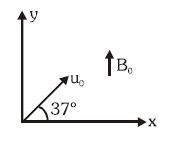
- 5At $t$ = $0$, a positively charged particle of mass $m$ is projected from the origin with velocity $u_0$ at an angle $37^o $ from the $x-$axis as shown in the figure. A constant magnetic field ${\vec B_0} = {B_0}\hat j$ is present in space. After a time interval $t_0$ velocity of particle may be:-View Solution
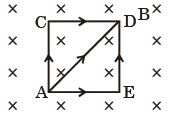
- 6A square of side $2.0\,m$ is placed in a uniform magnetic field $B = 2.0\, T$ in a direction perpendicular to the plane of the square inwards. Equal current, $i = 3.0\, A$ is flowing in the direction shown in figure. Find the magnitude of magnetic force on the loopView Solution
- 7A galvanometer of $10 \,\Omega$ resistance gives full scale deflection with $0.01$ ampere of current. It is to be converted into an ammeter for measuring $10$ ampere current. The value of shunt resistance required will beView Solution
- 8A uniform magnetic field $\vec B\,\, = \,\,{B_0}\,\hat j$ exists in a space. A particle of mass $m$ and charge $q$ is projected towards negative $x$-axis with speed $v$ from the a point $(d, 0, 0)$. The maximum value $v$ for which the particle does not hit $y-z$ plane isView Solution
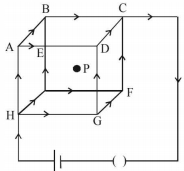
- 9A steady current is set up in a cubic network composed of wires of equal resistance and length $d$ as shown in figure. What is the magnetic field at the centre P due to the cubic networkView Solution
- 10A electron experiences a force $\left( {4.0\,\hat i + 3.0\,\hat j} \right)\times 10^{-13} N$ in a uniform magnetic field when its velocity is $2.5\,\hat k \times \,{10^7} ms^{-1}$. When the velocity is redirected and becomes $\left( {1.5\,\hat i - 2.0\,\hat j} \right) \times {10^7}$, the magnetic force of the electron is zero. The magnetic field $\vec B$ is :View Solution