A 600 pF capacitor is charged by a 200 V supply. It is then disconnected from the supply and is connected to another uncharged 300 pF capacitor. Calculate how much electrostatic energy is lost in the process. What is the source of energy loss?
CBSE OUTSIDE DELHI - SET 2 CHENNAI 2015
Download our app for free and get started
We have, energy stored $\frac{1}{2}\frac{\text{Q}}{\text{c}^{2}}$
and Equivalent Capacitance $= C_1 +C_2$
$=(600+300)\ pF$
Charge on the capacitor $= Q = 600 \times 200 \times 10^{-12}$
$= 12 \times 10^{-8} C$
Initial Energy $ = \frac{1}{2}\frac{\text{Q}^{2}}{\text{c}} = \frac{1}{2}\frac{\text{Q}^{2}}{600\times10^{-12}}$
Final Energy $= \frac{1}{2}=\frac{\text{Q}^{2}}{900\times10^{-12}}$
Loss in Energy $ =\frac{1}{2}\frac{144\times10^{-16}}{10^{-12}}\bigg[\frac{1}{600} - \frac{1}{900}\bigg]$
$ = 4 \times10^{-6}\text{J}$
The source of energy loss is the energy converted into heat due to sharing of charge between the two capacitors. (Also accept: heat produced).
and Equivalent Capacitance $= C_1 +C_2$
$=(600+300)\ pF$
Charge on the capacitor $= Q = 600 \times 200 \times 10^{-12}$
$= 12 \times 10^{-8} C$
Initial Energy $ = \frac{1}{2}\frac{\text{Q}^{2}}{\text{c}} = \frac{1}{2}\frac{\text{Q}^{2}}{600\times10^{-12}}$
Final Energy $= \frac{1}{2}=\frac{\text{Q}^{2}}{900\times10^{-12}}$
Loss in Energy $ =\frac{1}{2}\frac{144\times10^{-16}}{10^{-12}}\bigg[\frac{1}{600} - \frac{1}{900}\bigg]$
$ = 4 \times10^{-6}\text{J}$
The source of energy loss is the energy converted into heat due to sharing of charge between the two capacitors. (Also accept: heat produced).

Download our appand get started for free
Experience the future of education. Simply download our apps or reach out to us for more information. Let's shape the future of learning together!No signup needed.*
Similar Questions
- 1View Solution
- Mention two properties of soft iron due to which it is preferred for making an electromagnet.
- State Gauss's law in magnetism. How is it different from Gauss's law in electrostatics and why?
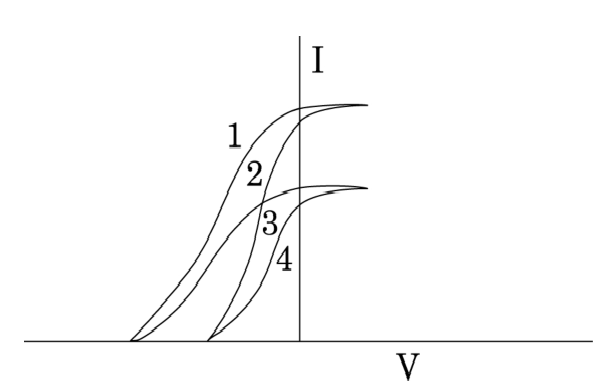
- 2View SolutionThe given graph shows the variation of photo-electric currently) with the applied voltage(V) for two different materials and for two different intensities of the incident radiations. Identify and explain using Einstein's photo electric equation the pair of curves that correspond to (i) different materials but same intensity of incident radiation (ii) different intensities but same materials.
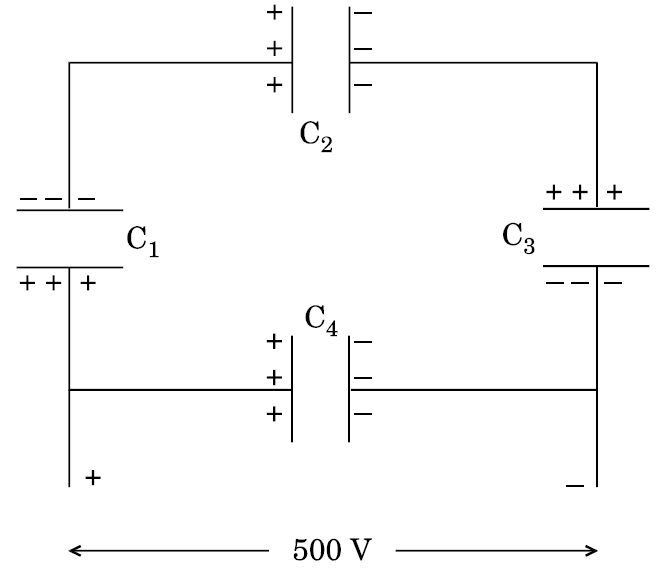
- 3A network of four 10 $\mu$F capacitors is connected to a 500 V supply as shown in the figure. Determine theView Solution
- equivalent capacitance of the network and
- charge on each capacitor
- 4View SolutionDefine the electric resistivity of a conductor.
Plot a graph showing the variation of resistivity with temperature in the case of a (a) conductor, (b) semiconductor.
Briefly, explain, how the difference in the behaviour of the two can be explained in terms of number density of charge carriers and relaxation time. - 5The instantaneous current in an ac circuit is $\text{i}=0.5\sin314\text{t},$ what is (i) rms value and (ii) frequency of the current.View Solution
- 6Half life of $^{238}\text{U}_{92}$against$\alpha$ decay is $4.5 \times 10^{9}$years. Calculate the activity of Ig sample of$^{238}\text{U}_{92}$? Given Avogadro's number $= 6 \times 10^{26}$atoms/kmol.View Solution
- 7View Solution
- Draw a schematic diagram of a reflecting telescope.
- State the advantages of reflecting telescope over refracting telescope.
- 8View SolutionSuppose the frequency of the source in the previous example can be varied. (a) What is the frequency of the source at which resonance occurs? (b) Calculate the impedance, the current, and the power dissipated at the resonant condition.
- 9Prove that the power dissipated in an ideal resistor connected to an ac source is $\frac{\text{V}^2_{\text{eff}}}{\text{R}}.$View Solution
- 10View Solution
- For a glass prism $(\mu =\sqrt{3} )$ the angle of minimum deviation is equal to the angle of the prism. Calculate the angle of the prism.
- Draw ray diagram when incident ray falls normally on one of the two equal sides of a right angled isosceles prism having refractive index $\mu = \sqrt{3} . $