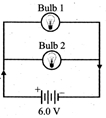
A $6.0\,volt$ battery is connected to two light bulbs as shown in figure. Light bulb $1$ has resistance $3\,ohm$ while light bulb $2$ has resistance $6\,ohm.$ Battery has negligible internal resistance. Which bulb will glow brighter?
AIEEE 2012, Diffcult


Download our appand get started for free
Experience the future of education. Simply download our apps or reach out to us for more information. Let's shape the future of learning together!No signup needed.*
Similar Questions
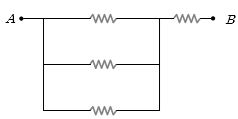
- 1If all the resistors shown have the value $2\, ohm$ each, the equivalent resistance over $AB$ isView Solution
- 2The heat produced by a $100\, watt$ heater in $2$ minute will be equal toView Solution
- 3The heat developed in an electric wire of resistance $R$ by a current $I$ for a time $t$ isView Solution
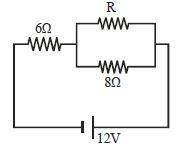
- 4In the circuit shown in figure, the power which is dissipated as heat in the $6\,\Omega $ resistor is $6\,W$. What is the value of resistance $R$ in the circuit? ................ $\Omega$View Solution
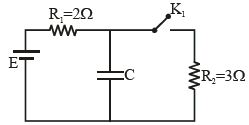
- 5In the circuit shown in the figure $K_1$ is open. The charge on capacitor $C$ in steady state is $q_1$. Now key is closed and at steady state charge on $C$ is $q_2$. The ratio of charges $q_1/q_2$ isView Solution
- 6If three bulbs $60\,W$, $100\,W$ and $200\,W$ are connected in parallel, thenView Solution
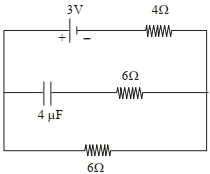
- 7In the network shown below, the charge accumulated in the capacitor in steady state will be ........... $\mu C$View Solution
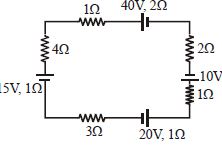
- 8View SolutionFind the current in the loop.
- 9Two resistances ${R_1}$ and ${R_2}$ are made of different materials. The temperature coefficient of the material of ${R_1}$ is $\alpha $ and of the material of ${R_2}$ is $ - \beta $. The resistance of the series combination of ${R_1}$ and ${R_2}$ will not change with temperature, if ${R_1}/{R_2}$ equalsView Solution
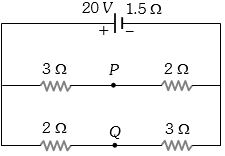
- 10If in the circuit shown below, the internal resistance of the battery is $1.5$ $\Omega$ and $V_P$ and $V_Q$ are the potentials at $P$ and $Q$ respectively, what is the potential difference between the points $P$ and $Q$View Solution