The heat produced by a $100\, watt$ heater in $2$ minute will be equal to
Easy
Download our app for free and get started
(a) Energy $ = P \times t = 100 \times 2 \times 60 = 12000\,J = 12 \times {10^3}J$

Download our appand get started for free
Experience the future of education. Simply download our apps or reach out to us for more information. Let's shape the future of learning together!No signup needed.*
Similar Questions
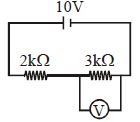
- 1In the circuit shown in figure, the resistance of voltmeter is $6\, k\Omega $. The voltmeter reading will be ................. $\mathrm{V}$View Solution
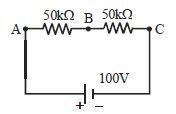
- 2In the adjacent shown circuit, a voltmeter of internal resistance $R$, when connected across $B$ and $C$ reads $\frac{{100}}{3}\,V$. Neglecting the internal resistance of the battery, the value of $R$ is ................. $k \Omega$View Solution
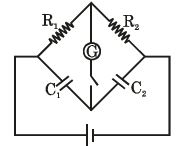
- 3View SolutionCircuit shown is in steady state, now when switch is closed, galvanometer shows no deflection, then correct relation is
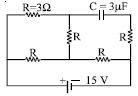
- 4In the circuit shown, the cell is ideal, with $emf$ $=$ $15$ $V$. Each resistance is of $3 $ $\Omega$ . The potential difference across the capacitor is.....$V$View Solution
- 5A uniform metallic wire has a resistance of $18\,\Omega $ and is bent into an equilateral triangle. Then, the resistance between any two vertices of the triangle is .................. $\Omega$View Solution
- 6$4$ bulbs marked $40\, W$, $250\, V$ are connected in series with $250\, V$ mains. The total power is ............. $W$View Solution
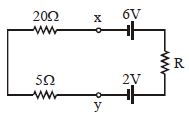
- 7The current flowing in the given circuit is $0.1\,A$ . The potential difference between the points $X$ and $Y$ is ................ $\mathrm{V}$View Solution
- 8View SolutionSpecific resistance of a conductor increases with
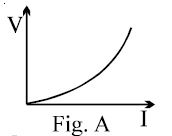
- 9The variation of current $(I)$ and voltage $(V)$ is as shown in figure $A$. The variation of power $P$ with current $I$ is best shown by which of the following graphView Solution
- 10The Kirchhooff's first law $\left(\sum i=0\right)$ and second law ( $\left.\sum i R=\sum E\right)$, where the symbols have their usual meanings, are respectively based onView Solution