Question
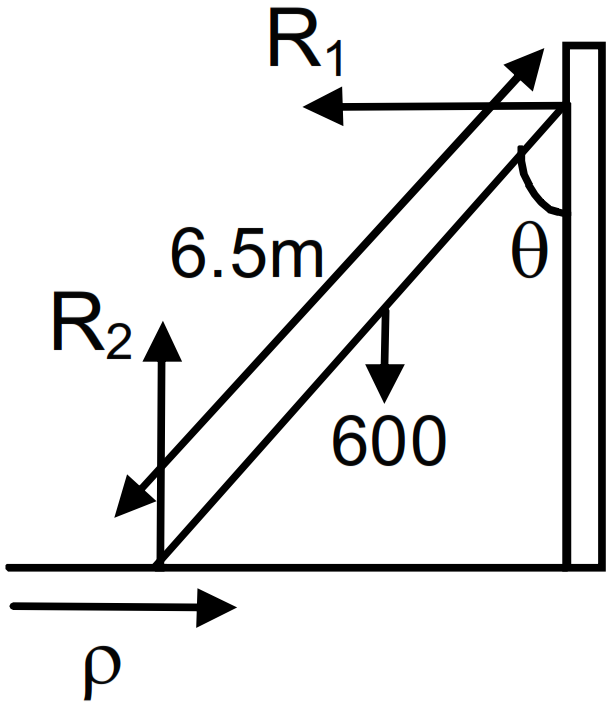
A 6.5m long ladder rests against a vertical wall reaching a height of 6.0m. A 60kg man stands half way up the ladder.
  1. Find the torque of the force exerted by the man on the ladder about the upper end of the ladder.
  2. Assuming the weight of the ladder to be negligible as compared to the man and assuming the wall to be smooth, find the force exerted by the ground on the ladder.
Answer


m = 60kg, ladder length = 6.5m, height of the wall = 6m
Therefore torque due to the weight of the body
  1. $\tau=\frac{600\times6.5}{2\sin\theta}=\text{i}$
$\Rightarrow\tau=\frac{600\times6.5}{2\times\sqrt{\big[1-\big(\frac{6}{6.5}\big)^2\big]}}$
$\Rightarrow\tau=735\text{N-m}$
  1. $\text{R}_2=\text{mg}=60\times9.8$
$\text{R}_1=\mu\text{R}_2$
$\Rightarrow6.5\text{R}_1\cos\theta=60\text{g}\sin\theta\times\frac{6.5}{2}$
$\Rightarrow\text{R}_1=60\text{g}\tan\theta=60\text{g}\times\Big(\frac{2.5}{12}\Big)\ \Big[$Because $\tan\theta=\frac{2.5}{6}\Big]$
$\Rightarrow\text{R}_1=\Big(\frac{25}{2}\Big)\text{g}=122.5\text{N}$

Need a full question paper?

Generate a complete, print-ready paper with questions like this in minutes — across 16+ boards, with answer keys.

Start Generating Free

Similar questions

State the law of conservation of angular momentum and illustrate it with the example of planetary motion.
Repeat the previous problem if the particle C is displaced through a distance x along the line AB.
A particle of mass m is projected from origin O with speed u at an angle with positive x-axis. Find the angular momentum of particle at any time t about O before the particle strikes the ground again.
A body of mass m falls from a height h on to the pan of a spring balance. The masses of the pan and spring are negligible. The spring constant of the spring is k. Having stuck to the pan the body starts performing harmonic oscillations in the vertical direction. Find the amplitude and energy of oscillation.
A family uses $8kW$ of power.
  1. Direct solar energy is incident on the horizontal surface at an average rate of $200W$ per square meter. If $20\%$ of this energy can be converted to useful electrical energy, how large an area is needed to supply $8kW$?
  2. Compare this area to that of the roof of a typical house.
(a) When a molecule (or an elastic ball) hits a ( massive) wall, it rebounds with the same speed. When a ball hits a massive bat held firmly, the same thing happens. However, when the bat is moving towards the ball, the ball rebounds with a different speed. Does the ball move faster or slower?
(b) When gas in a cylinder is compressed by pushing in a piston, its temperature rises. Guess at an explanation of this in terms of kinetic theory using (a) above.
(c) What happens when a compressed gas pushes a piston out and expands. What would you observe?
(d) Sachin Tendulkar used a heavy cricket bat while playing. Did it help him in anyway?
A plane electromagnetic wave is passing through a region. Consider (a) electric field (b) magnetic field (c) electrical energy in a small volume and (d) magnetic energy in a small volume. Construct the pairs of the quantities that oscillate with equal frequencies.
Suppose a tunnel is dug through the earth from one side to the other side along a diameter. Show that the motion of a particle dropped into the tunnel is simple harmonic motion. Find the time period. Neglect all the frictional forces and assume that the earth has a uniform density.
$G = 6.67 \times 10^{-11}Nm^2kg^{-2};$ density of earth = $5.51 \times 10^3kg m^{-3}$
What is adiabatic process? Establish the equation of state for this.
An adiabatic vessel of total volume V is divided into two equal parts by a conducting separator. The separator is fixed in this position. The part on the left contains one mole of an ideal gas (U = 1.5nRT) and the part on the right contains two moles of the same gas. Initially, the pressure on each side is p. The system is left for sufficient time so that a steady state is reached. Find,
  1. The work done by the gas in the left part during the process.
  2. The temperature on the two sides in the beginning.
  3. The final common temperature reached by the gases.
  4. The heat given to the gas in the right part.
  5. The increase in the internal energy of the gas in the left part.