A particle of mass m is projected from origin O with speed u at an angle with positive x-axis. Find the angular momentum of particle at any time t about O before the particle strikes the ground again.
Download our app for free and get started
Let particte is at Pat any instant, and its position vector is r. Then, $\text{r}=\text{x}\hat{\text{i}}+\text{y}\hat{\text{j}}$ Where, $\text{x}=\text{u}\cos\theta\text{ t}$ and $\text{y}=\text{u}\sin\theta\text{ t}-\frac{1}{2}\text{gt}^2$ and if v = velocity vector of particle at that instant. Then, $\text{r}=\text{x}\hat{\text{i}}+\text{y}\hat{\text{j}}$ Where, $\text{x}=\text{u}\cos\theta\text{ t}$ and $\text{y}=\text{u}\sin\theta\text{ t}-\frac{1}{2}\text{gt}^2$ d if v = velocity vector of particle at that instant.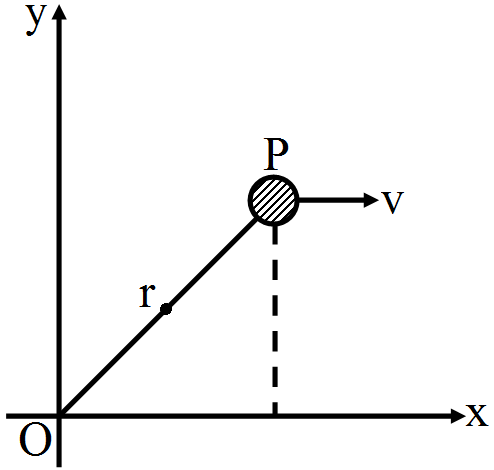
Then, $\text{v}=\text{v}_{\text{x}}\hat{\text{i}}+\text{v}_{\text{y}}\hat{\text{j}}$ Where, $\text{v}_{\text{x}}=\text{u}\cos\theta\text{ t}$ and $\text{v}_{\text{y}}=\text{u}\sin\theta\text{ t}-\text{gt}$ So, $\text{r}=\text{u}\cos\theta\hat{\text{i}}+\Big((\text{u}\sin\theta)\text{t}-\frac{1}{2}\text{gt}^2\Big)\hat{\text{j}}$and $\text{v}=\text{u}\cos\theta\hat{\text{i}}+(\text{u}\sin\theta-\text{gt})\hat{\text{j}}$
So, L = angular momentum of particle $=\text{m}(\text{r}\times\text{v})$ $=\text{m}\begin{vmatrix}\hat{\text{i}}&\hat{\text{j}}&\hat{\text{k}}\\\text{u}\cos\theta&\Big(\text{u}\sin\theta-\frac{1}{2}\text{gt}\Big)\text{t}&0\\\text{u}\cos\theta&(\text{u}\sin\theta-\text{gt})&0\end{vmatrix}$ $=-\frac{1}{2}\text{m}(\text{u}\cos\theta)\text{gt}^2.\hat{\text{k}}$ So, angular momentum is along z-axis.
Then, $\text{v}=\text{v}_{\text{x}}\hat{\text{i}}+\text{v}_{\text{y}}\hat{\text{j}}$ Where, $\text{v}_{\text{x}}=\text{u}\cos\theta\text{ t}$ and $\text{v}_{\text{y}}=\text{u}\sin\theta\text{ t}-\text{gt}$ So, $\text{r}=\text{u}\cos\theta\hat{\text{i}}+\Big((\text{u}\sin\theta)\text{t}-\frac{1}{2}\text{gt}^2\Big)\hat{\text{j}}$and $\text{v}=\text{u}\cos\theta\hat{\text{i}}+(\text{u}\sin\theta-\text{gt})\hat{\text{j}}$
So, L = angular momentum of particle $=\text{m}(\text{r}\times\text{v})$ $=\text{m}\begin{vmatrix}\hat{\text{i}}&\hat{\text{j}}&\hat{\text{k}}\\\text{u}\cos\theta&\Big(\text{u}\sin\theta-\frac{1}{2}\text{gt}\Big)\text{t}&0\\\text{u}\cos\theta&(\text{u}\sin\theta-\text{gt})&0\end{vmatrix}$ $=-\frac{1}{2}\text{m}(\text{u}\cos\theta)\text{gt}^2.\hat{\text{k}}$ So, angular momentum is along z-axis.

Download our appand get started for free
Experience the future of education. Simply download our apps or reach out to us for more information. Let's shape the future of learning together!No signup needed.*
Similar Questions
- 1View SolutionA sphere of a radius 10cm weighs 1kg, calculate the moment of inertia.
- About the diameter.
- About the tangent.
- 2A hollow sphere is released from the top of an inclined plane of inclination $\theta.$View Solution
- What should be the minimum coefficient of friction between the sphere and the plane to prevent sliding?
- Find the kinetic energy of the ball as it moves down a length 1 on the incline if the friction coefficient is half the value calculated in part (a).
- 3View SolutionTorques of equal magnitude are applied to a hollow cylinder and a solid sphere, both having the same mass and radius. The cylinder is free to rotate about its standard axis of symmetry, and the sphere is free to rotate about an axis passing through its centre. Which of the two will acquire a greater angular speed after a given time.
- 4In the HCl molecule, the separation between the nuclei of the two atoms is about $1.27\mathring{\text{A}}\big(1\mathring{\text{A}}= 10^{-10} \text{m}\big).$ Find the approximate location of the CM of the molecule, given that a chlorine atom is about 35.5 times as massive as a hydrogen atom and nearly all the mass of an atom is concentrated in its nucleus.View Solution
- 5View SolutionTorques of equal magnitude are applied to a hollow cylinder and a solid sphere, both having the same mass and radius. The cylinder is free to rotate about its standard axis of symmetry, and the sphere is free to rotate about an axis passing through its centre. Which of the two will acquire a greater angular speed after a given time.
- 6View SolutionA wheel in uniform motion about an axis passing through its centre and perpendicular to its plane is considered to be in mechanical (translational plus rotational) equilibrium because no net external force or torque is required to sustain its motion. However, the particles that constitute the wheel do experience a centripetal acceleration directed towards the centre.How do you reconcile this fact with the wheel being in equilibrium? How would you set a half-wheel into uniform motion about an axis passing through the centre of mass of the wheel and perpendicular to its plane? Will you require external forces to sustain the motion?
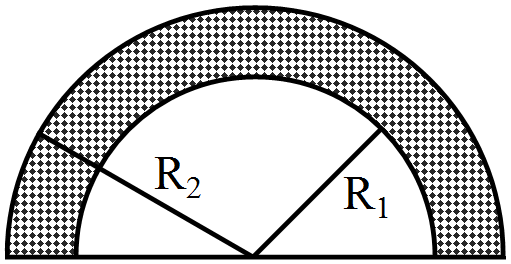
- 7Find the centre of mass of a uniform plate having semicircular inner and outer boundaries of radii $R_1$ and $R_2$.View Solution
- 8View SolutionA metre stick is balanced on a knife edge at its centre. When two coins, each of mass 5g are put one on top of the other at the 12.0cm mark, the stick is found to be balanced at 45.0cm. What is the mass of the metre stick?
- 9View SolutionA cylinder is suspended by two strings wrapped around the cylinder near each end, the free ends of the string being attached to hooks on the ceiling, such that the length of the cylinder is horizontal. From the position of rest, the cylinder is allowed to roll down as suspension strings unwind. Calculate: (i) the downward linear acceleration of the cylinder and (ii) tension in the strings. Mass of cylinder is 12kg.
- 10Separation of Motion of a system of particles into motion of the centre of mass and motion about the centre of mass: Show $\text{K}=\text{K}'+\frac{1}{2}\text{M}\text{V}^2$ where K' is the total kinetic energy of the system of particles, K′ is the total kinetic energy of the system when the particle velocities are taken with respect to the centre of mass and $\frac{\text{MV}^2}{2}$ is the kinetic energy of the translation of the system as a whole (i.e. of the centre of mass motion of the system). The result has been used in $\sec7.14$View Solution