A air bubble rises from bottom of a lake to surface. If its radius increases by $200 \%$ and atmospheric pressure is equal to water coloumn of height $H$. then depth of lake is ..... $H$
Medium
Download our app for free and get started
(d)
Let initial radius be $=r$
Final radius $=r+200 \%$ of $r$
$=3 r$
Atmospheric pressure $=\rho g H$
Let depth of the lake be $h$
So, pressure at the bottom of lake $=\rho g H+\rho g h$
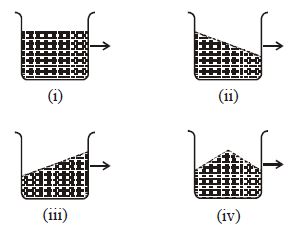
Using $P_1 V_1=P_2 V_2$
$\rho g H \times \frac{4}{3} \pi(3 r)^3=(\rho g H+\rho g h) \times \frac{4}{3} \pi r^3$
$\rho g H \times \frac{4}{3} \pi \times 27 r^3=(\rho g H) \frac{4}{3} \pi r^3+\rho g h \times \frac{4}{3} \pi r^3$
Solving this equation we get
$26 H=h$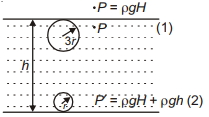

Download our appand get started for free
Experience the future of education. Simply download our apps or reach out to us for more information. Let's shape the future of learning together!No signup needed.*
Similar Questions
- 1The value of $g $ at a place decreases by $ 2\%.$ The barometric height of mercuryView Solution
- 2The pressure at the bottom of a tank of water is $3P$ where $P$ is the atmospheric pressure . If the water is drawn out till the level of water is lowered by one fifth., the pressure at the bottom of the tank will now beView Solution
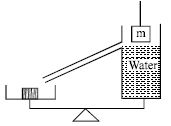
- 3View SolutionA pan balance has a container of water with an overflow spout on the right-hand pan as shown. It is full of water right up to the overflow spout. A container on the left-hand pan is positioned to catch any water that overflows. The entire apparatus is adjusted so that it’s balanced. A brass weight on the end of a string is then lowered into the water, but not allowed to rest on the bottom of the container. What happens next ?
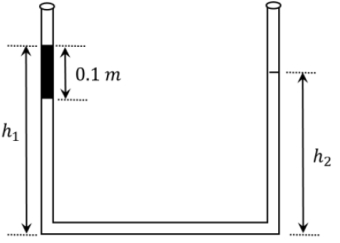
- 4An open-ended U-tube of uniform cross-sectional area contains water (density $10^3 kg m ^{-3}$ ). Initially the water level stands at $0.29 m$ from the bottom in each arm. Kerosene oil (a water-immiscible liquid) of density $800 kg m ^{-3}$ is added to the left arm until its length is $0.1 m$, as shown in the schematic figure below. The ratio $\left(\frac{h_1}{h_2}\right)$ of the heights of the liquid in the two arms is-View Solution
- 5Different processes are given in Column - $\mathrm{I}$ and its reasons are given in Column - $\mathrm{II}$. Match the appropriately.View Solution
Column - $\mathrm{I}$ Column - $\mathrm{II}$ $(a)$Rain drops moves downwards with constant velocity. $(i)$ Viscous liquids $(b)$ Floating clouds at a height in air. $(ii)$ Viscosity $(iiii)$ Less density - 6A pump draws water from a tank which is at $2.5\; m$ down from outlet and issues it from the end of a hose which the water is drawn. The cross sectional area is $10\; cm ^{2}$, and the water leaves the end of the hose at a speed of $5\; m / s$. What is the rate at which the pump is working ?View Solution
- 7A small spherical ball of radius $0.1 \,mm$ and density $10^{4} \,kg m ^{-3}$ falls freely under gravity through a a distance $h$ before entering a tank of water. If after entering the water the velocity of ball does not change and it continue to fall with same constant velocity inside water, then the value of $h$ wil be $m$. (Given $g =10 \,ms ^{-2}$, viscosity of water $=1.0 \times 10^{-5} \,N - sm ^{-2}$ )View Solution
- 8Water is flowing with a velocity of $2\,m/s$ in a horizontal pipe where cross-sectional area is $2 \times 10^{-2}\, m^2$ at pressure $4 \times 10^4\, pascal$. The pressure at cross-section of area $0.01\, m^2$ in pascal will beView Solution
- 9Some liquid is filled in a cylindrical vessel of radius $R$. Let $ F_1 $ be the force applied by the liquid on the bottom of the cylinder. Now the same liquid is poured into a vessel of uniform square crss-section of side $R$. Let $F_2$ be the force applied by the liquid on the bottom of this new vessel. Then:View Solution
- 10View SolutionA vessel containing water is moving with a constant speed towards right along a straight horizontal path. Which of the following diagrams represents the surface of liquid?