Question
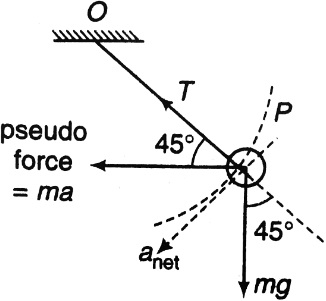
$A$ ball connected with string is released at an angle $45^o$ with the vertical as shown in figure. Then the acceleration of the box at this instant will be:

[Mass of the box is equal to mass of ball]

Answer

Let acceleration of box at this is $'a'$(towards right). $F B D$ of ball $w.r.t.$ box

Net force in $O P$ ditection is zero

$\therefore T+\frac{m a}{\sqrt{2}}=\frac{m g}{\sqrt{2}}$

$F B D$ of ball $w.r.t.$ ground

$T \cos 45^{\circ}=m a$

or $T=\sqrt{2} m a$

Substituting in Eq. $( i ),$ we get

$a=\frac{g}{3}$

Need a full question paper?

Generate a complete, print-ready paper with questions like this in minutes — across 16+ boards, with answer keys.

Start Generating Free

Similar questions

A spherical surface of radius of curvature $R$ separates air (refractive index $1.0$) from glass (refractive index $1.5$). The centre of curvature is in the glass. A point object $P$ placed in air is found to have a real image $Q$ in the glass. The line $PQ$ cuts the surface at a point $O$, and $PO = OQ$. The distance $PO$ is equal to
A potential difference is applied across the ends of a metallic wire. If the potential difference is doubled, then the drift velocity
A particle of mass $1\,kg$ is moving along $x-$ axis, where its velocity depends on $x-$ coordinate as $v = 2\sqrt x \,(m/s)$. Find the net force acting on the particle $2\,second$ after the start of motion ............ $N$
A tuning fork arrangement (pair) produces $4$ beats/sec with one fork of frequency $288\, cps$. A little wax is placed on the unknown fork and it then produces $2\; beats/sec$. The frequency of the unknown fork is  .... $cps$
A tank $5\, m$ high is half-filled with water and then is filled to the top with oil of density $0.85\, g/cm^3$. The pressure at the bottom of the tank, due to these liquids is ....... $g\, dyne/cm^2$
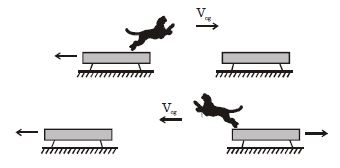
A strange cat with a mass $m_c$ is sitting at rest on the left plank of a pair of identical planks. Each plank has mass $m_s$ and they rest on frictionless ice. Suddenly, the cat leaps to the right plank, traveling with a horizontal speed $v_{cg}$ measured with respect to the ground. The instant the cat reaches the right plank, it turns around and leaps back to the left plank. The horizontal component of the cat’s speed is again $v_{cg}$ measured with respect to the ground. The final speed of right plank in terms of the masses of the cat and planks and the cat’s leaping speed is (The cat remains on the left plank after its return).
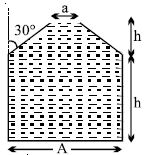
The vessel shown in the figure has two sections. The lower part is a rectangular vessel with area of cross-section $A$ and height $h$. The upper part is a conical vessel of height $h$ with base area $‘A’$ and top area $‘a’$ and the walls of the vessel are inclined at an angle $30^o$  with the vertical.A liquid of density $\rho$ fills both the sections upto a height $2h$. Neglecting atmospheric pressure. 
It is possible for a substance to coexist in all three phases in equilibrium, when the substance is at
In electromagnetic theory, the electric and magnetic phenomena are related to each other. Therefore, the dimensions of electric and magnetic quantities must also be related to each other. In the questions below, $[E]$ and $[B]$ stand for dimensions of electric and magnetic fields respectively, while $\left[\varepsilon_0\right]$ and $\left[\mu_0\right]$ stand for dimensions of the permittivity and permeability of free space respectively. $[L]$ and $[T]$ are dimensions of length and time respectively. All the quantities are given in $SI$ units.

($1$) The relation between $[E]$ and $[B]$ is

$(A)$ $[ E ]=[ B ][ L ][ T ]$  $(B)$ $[ E ]=[ B ][ L ]^{-1}[ T ]$  $(C)$ $[ E ]=[ B ][ L ][ T ]^{-1}$  $(D)$ $[ E ]=[ B ][ L ]^{-1}[ T ]^{-1}$

($2$) The relation between $\left[\varepsilon_0\right]$ and $\left[\mu_0\right]$ is

$(A)$ $\left[\mu_0\right]=\left[\varepsilon_0\right][ L ]^2[ T ]^{-2}$  $(B)$ $\left[\mu_0\right]=\left[\varepsilon_0\right][ L ]^{-2}[ T ]^2$   $(C)$ $\left[\mu_0\right]=\left[\varepsilon_0\right]^{-1}[ L ]^2[ T ]^{-2}$  $(D)$ $\left[\mu_0\right]=\left[\varepsilon_0\right]^{-1}[ L ]^{-2}[ T ]^2$

Give the answer or quetion ($1$) and ($2$)
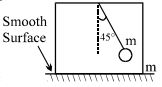
In a uniform magnetic field of $0.049 \mathrm{~T}$, a magnetic needle performs $20$ complete oscillations in $5$ seconds as shown. The moment of inertia of the needle is $9.8 \times 10^{-5} \mathrm{~kg} \mathrm{~m}^2$. If the magnitude of magnetic moment of the needle is $x \times 10^{-5} \mathrm{Am}^2$, then the value of ' $x$ ' is :