A potential difference is applied across the ends of a metallic wire. If the potential difference is doubled, then the drift velocity
Easy


Download our appand get started for free
Experience the future of education. Simply download our apps or reach out to us for more information. Let's shape the future of learning together!No signup needed.*
Similar Questions
- 1A potentiometer wire of length $100\, cm$ has a resistance of $10\, ohm.$ It is connected in series with a resistance and an accumulator of emf $2\,V$ and of negligible internal resistance. A source of emf $10\, mV$ is balanced against a length of $40\, cm$ of the potentiometer wire. What is the value of external resistance :- ................. $\Omega$View Solution
- 2A wire of length ' $r$ ' and resistance $100 \Omega$ is divided into $10$ equal parts. The first $5$ parts are connected in series while the next $5$ parts are connected in parallel. The two combinations are again connected in series. The resistance of this final combination is:View Solution
- 3The heating coils rating at $220\, volt$ and producing $50\, cal/sec$ heat are available with the resistances $55\,\Omega $ , $110\,\Omega$ , $220\,\Omega $ and $440\,\Omega $. The heater of maximum power will be of............. $\Omega$View Solution
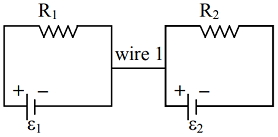
- 4In the circuit, wire $1$ is of negligible resistance. Then,View Solution
- 5View SolutionWatt-hour meter measures
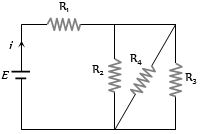
- 6In the circuit given $E = 6.0 \,V, R_1 = 100\, ohms, R_2 = R_3 = 50\, ohms, R_4 = 75\, ohms$. The equivalent resistance of the circuit, in $ohms$, isView Solution
- 7View SolutionThe example for non-ohmic resistance is
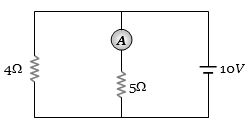
- 8if the internal resistance of the battery is $1\, ohm$, then what is the reading of ammeterView Solution
- 9View SolutionIn the circuit shown in the figure below, which of the following statement is incorrect ?
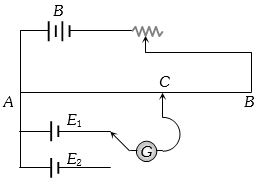
- 10The circuit shown here is used to compare the $e.m.f.$ of two cells ${E_1}$ and ${E_2}({E_1} > {E_2})$. The null point is at $C$ when the galvanometer is connected to ${E_1}$. When the galvanometer is connected to ${E_2}$, the null point will beView Solution