MCQ
A ball falls from a building and covers $5m$ in $10s.$ What is the acceleration?
  • $0.1\ m/ s^2$
  • B
    $0.2\ m/ s^2$
  • C
    $9.81\ m/ s^2$
  • D
    $10\ m/ s^2$

Answer

Correct option: A.
$0.1\ m/ s^2$
Assuming the ball falls with zero initial velocity, then according to the second equation of motion, $\text{s}=\text{ut}+\big(\frac{1}{2}\big)\text{at}^2=\big(\frac{1}{2}\big)\text{at}^{2}.$
When we put $t = 10s,$ we get $a = 0.1\ m/ s^2$.

Need a full question paper?

Generate a complete, print-ready paper with questions like this in minutes — across 16+ boards, with answer keys.
Start Generating Free

Similar questions

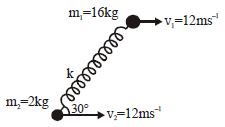
Two particles with mass $m_1$ = $16\ kg$ and $m_2$ = $2\ kg$ slide as unit with a common velocity of $12\ ms^{-1}$ on a level frictionless surface. Between them is a compressed massless spring with spring constant $k$ = $100\ Nm^{-1}$ . The spring, originally compressed by $25\ cm$ , is suddenly released, sending the two masses, which are connected to the spring, flying apart from each other. The orientation of the spring w.r.t. the initial velocity is shown in diagram. What is the relative velocity of separation in $ms^{-1}$ , after the particles lose contact? ................$m/s$
The maximum vertical height to which a man can throw a ball is $136\,m$. The maximum horizontal distance upto which he can throw the same ball is $.....\,m$
A block of mass $m$ is on an inclined plane of angle $\theta$. The coefficient of friction between the block and the plane is $\mu$ and $\tan \theta>\mu$. The block is held stationary by applying a force $\mathrm{P}$ parallel to the plane. The direction of force pointing up the plane is taken to be positive. As $\mathrm{P}$ is varied from $\mathrm{P}_1=$ $m g(\sin \theta-\mu \cos \theta)$ to $P_2=m g(\sin \theta+\mu \cos \theta)$, the frictional force $f$ versus $P$ graph will look like
The velocity of a body depends on time according to the equation $v=\frac{t^2}{10}+20$. The body is undergoing
For nuclei with $A > 100:$
  1. The binding energy of the nucleus decreases on an average as $A$ increases.
  2. The binding energy per nucleon decreases on an average as $A$ increases.
  3. If the nucleus breaks into two roughly equal parts, energy is released.
  4. If two nuclei fuse to form a bigger nucleus, energy is released.
Spherical balls of radius $ 'r'$  are falling in a viscous fluid of viscosity '$\eta$' with a velocity $ 'v'. $ The retarding viscous force acting on the spherical ball is
A cubical block of mass M and edge a slides down a rough inclined plane of inclination $\theta$ with a uniform velocity. The torque of the normal force on the block about its centre has a magnitude:
Fundamental frequency of an open pipe of length $0.5 m$ is equal to the frequency of the first overtone of a closed pipe of length $l$. The value of $l_c$ is $(m)$
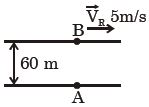
A man is crossing a river flowing with velocity of $5\, m/s$. He reaches a point directly across at a distance of $60\, m$ in $5\, sec$. His velocity in still water should be........$m/s$
An ideal gas expands in such a way that $PV^2 =$ constant throughout the process.