MCQ 11 Mark
Select the correct statements for a particle going on a straight line:
- A
If the position and velocity are in opposite directions, the particle is moving towards the origin.
- B
It the acceleration and velocity are in opposite directions, the particle is slowing down.
- C
If the velocity is zero for a time interval, the acceleration is zero at any moment within that time interval.
- ✓
If the velocity is zero at any instant, then the acceleration must also be zero at that instant.
AnswerCorrect option: D. If the velocity is zero at any instant, then the acceleration must also be zero at that instant.
a. If the position and velocity are in opposite directions, the particle is moving towards the origin.
b. It the acceleration and velocity are in opposite directions, the particle is slowing down.
c. If the velocity is zero for a time interval, the acceleration is zero at any moment within that time interval.
View full question & answer→MCQ 21 Mark
What will be the velocity v/s time graph of a ball falling from a height before hitting the ground look like?
- ✓
A straight line with positive slope
- B
A straight line with negative slope
- C
A straight line with zero slope
- D
AnswerCorrect option: A. A straight line with positive slope
a. A straight line with positive slope
Explanation:
As the ball falls down, its velocity increases. This is because of the acceleration due to gravity. Hence the graph looks like a straight line with positive slope. The first equation of motion verifies this.
View full question & answer→MCQ 31 Mark
Which of the following is not a vector quantity?
MCQ 41 Mark
An object may have:
$i.$ varying speed without having varying velocity.
$ii.$ varying velocity without having varying speed.
$iii.$ non-zero acceleration without having varying velocity.
$iv.$ non-zero acceleration without having varying speed.
- A
$i$ and $ii$ are correct.
- B
$ii$ and $iii$ are correct.
- ✓
$ii$ and $iv$ are correct.
- D
AnswerCorrect option: C. $ii$ and $iv$ are correct.
$II$ and $IV$ are correct.
Explanation:
Speed is a scalar quantity while velocity is a vector quantity.
An object can have constant speed but velocity will change since velocity is a vector quantity.
Without having a varying speed non - zero acceleration.
Uniform circular motion is an example of options $B$ and $D$
View full question & answer→MCQ 51 Mark
Two particles $A$ and $B$ are moving in a straight line with the same speed. Which of the following statement (s) is/ are correct for the relative motion of the two particles?
- A
The relative velocity $V_{AB}$ Or $V_{BA}$ is zero. Only if they are moving in the same direction.
- B
If the particles are moving in opposite direction, the magnitude of $V_{AB}$ Or $V_{BA}$ is twice, then the magnitude of velocity of $A$ or that of $B.$
- C
The relative velocity $V_{AB}$ Or $V_{BA}$ is always zero.
- ✓
Both $(a)$ and $(b).$
AnswerCorrect option: D. Both $(a)$ and $(b).$
$d.$ Both $(a)$ and $(b).$
View full question & answer→MCQ 61 Mark
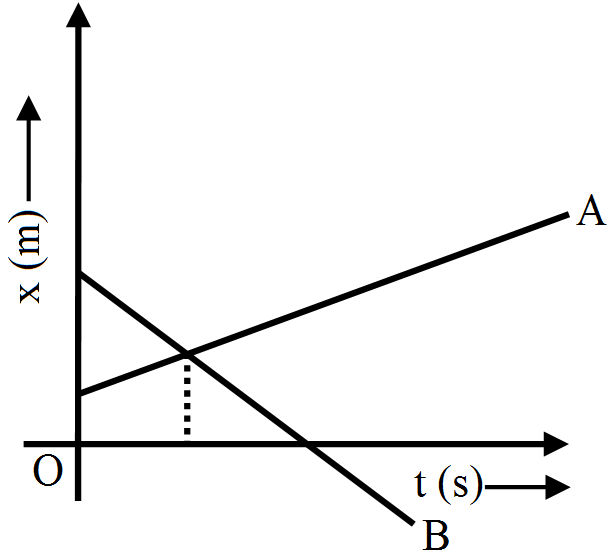
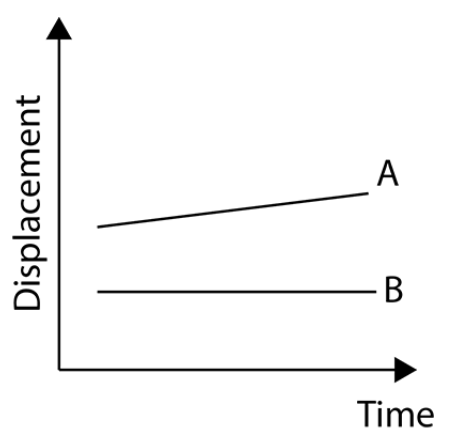
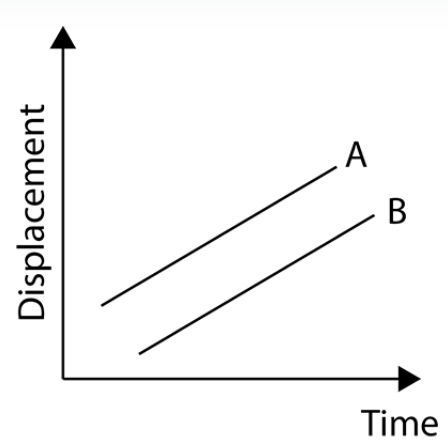
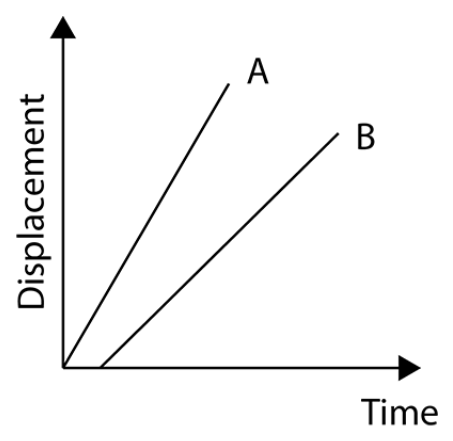
The relative velocity $V_{BA}$ Or $V_{AB}$ is zero for two particles moving along $x-$axis uniformly. The position$-$time graph for this situation will be:
- ✓
Straight lines parallel but inclined to time axis.
- B
Straight lines parallel and also parallel to time axis.
- C
Straight lines intersecting each other at some point.
- D
Curves and not straight lines.
AnswerCorrect option: A. Straight lines parallel but inclined to time axis.
View full question & answer→MCQ 71 Mark
The variation of quantity $A$ with quantity $B$, plotted in Fig. describes the motion of a particle in a straight line. 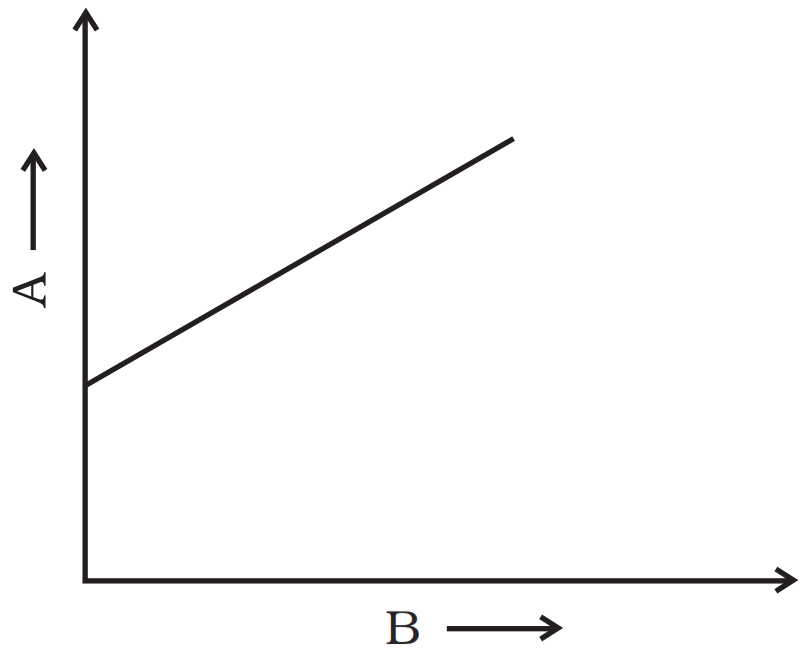
- A
Quantity $B$ may represent time.
- ✓
Quantity $A$ is velocity if motion is uniform.
- C
Quantity $A $ is displacement if motion is uniform.
- D
Quantity $A$ is velocity if motion is uniformly accelerated.
AnswerCorrect option: B. Quantity $A$ is velocity if motion is uniform.
$a.$ Quantity $B$ may represent time.
$b.$ Quantity $A$ is displacement if motion is uniform.
$c.$ Quantity $A$ is velocity if motion is uniformly accelerated.
Explanation:
If $B$ represents velocity then graph become (the $v-t$ graph is a straight line so it is uniformly accelerated motion, so motion is not uniform. Verifies option $(a), (d).$ If $B$ represents time and $A$ represents displacement, then graph become $(s - t)$ graph. Here $s - t $ graph is a straight line which represents uniform motion, so verifies the option $(c).$
View full question & answer→MCQ 81 Mark
The displacement of an object at any instant is given by $ x = 30 + 20t^2$ , where $x$ is in metres and $ t$ in seconds. The acceleration of the object will be:
- ✓
$40\ ms^{-2}$
- B
$50\ ms^{-2}$
- C
$30 \ ms ^{-2}$
- D
$0$
AnswerCorrect option: A. $40\ ms^{-2}$
$a. \ 40\ ms^{-2}$
View full question & answer→MCQ 91 Mark
If the velocity of a body does not change, its acceleration is:
Answera. Zero
Explanation:
Acceleration of a body is defined as the rate of change of the velocity of the body.
Now since the velocity doesn't change at all, the rate of change will be zero.
So, acceleration $= 0$
View full question & answer→MCQ 101 Mark
A car starts from rest from origin $O$ and continues to move till point $C$ as shown in the graph. Select the correct statement about the motion of car as shown in the graph. 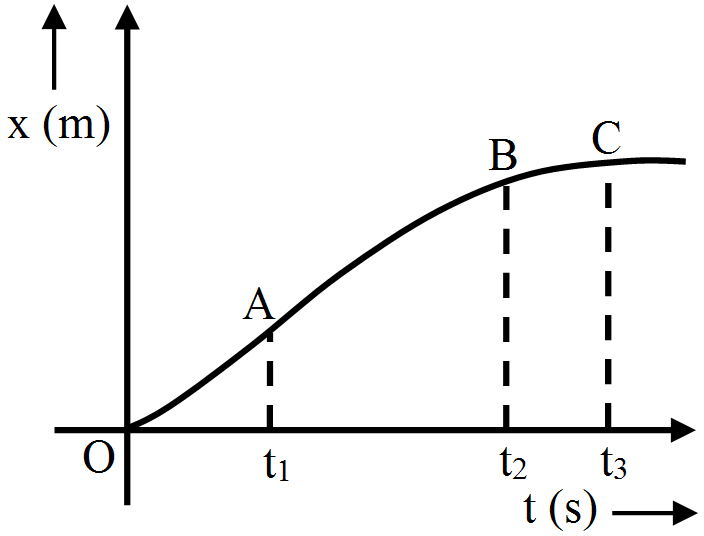
- A
Part $AB$ represents non-uniform motion.
- ✓
At instant time $t = t_2$, brakes must have been applied.
- C
At $t= t_3$, the car must have accelerated.
- D
AnswerCorrect option: B. At instant time $t = t_2$, brakes must have been applied.
$b.$ At instant time $t = t_2$, brakes must have been applied.
View full question & answer→MCQ 111 Mark
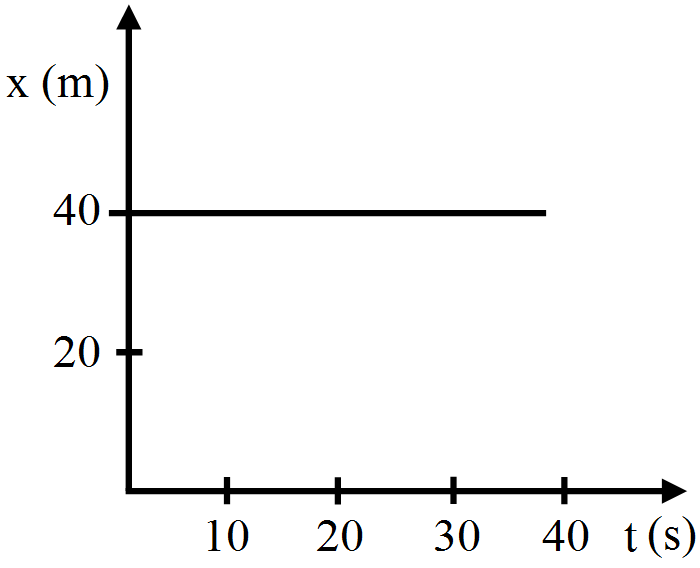
Distance$-$time graph of a body at rest is:
AnswerCorrect option: A. Parallel to time$-$axis.
View full question & answer→MCQ 121 Mark
Which of the following statement must always be true?
$I.$ If an objects acceleration is zero, then its speed must remain constant.
$II.$ If an objects acceleration is constant, then it must move in a straight line.
$III.$ If an objects speed remains constant, then its acceleration must be zero.
- A
$I$ and $III$ only
- ✓
$I$ only
- C
$III$ only
- D
$II$ and $II$ only
AnswerCorrect option: B. $I$ only
Explanation: $(B)$ $I$ only
Acceleration is the rate of change of speed of the object. Thus when acceleration is zero, the speed of object remains constant.
Acceleration of an object moving in a circular path is $\frac{{v}^2}{{R}}.$ Thus an object with constant acceleration may not move in a straight line.
Again in case of circular path, the speed remains same, but acceleration is finite.
View full question & answer→MCQ 131 Mark
An observer finds the magnitudes of the acceleration of two bodies to be the same. This necessary implies that the two bodies.
- A
Are at rest with respect to each other.
- B
Are at rest or move with constant velocities with respect to each other.
- C
Are accelerated with respect to each other.
- ✓
May be at rest, moving with constant velocities or accelerated with respect to each other.
AnswerCorrect option: D. May be at rest, moving with constant velocities or accelerated with respect to each other.
Case $1:$
Both the bodies are moving with same velocity. Thus they are rest w.r.t each other but they have same acceleration.
Case $2:$
Both the bodies are moving with different constant velocities. Hence both are moving with constant w.r.t to each other and yet they can have the same acceleration.
Case $3:$
Both are moving with different velocities but in opposite direction with same acceleration.
Acceleration of $1$ w.r.t $2,$ $a_{12} = a−(−a) = 2a$
Hence both are accelerating w.r.t each other, although having same acceleration.

View full question & answer→MCQ 141 Mark
The displacement of a particle is represented by the following equation $s = 2t^3 + 7t^2 + 5t + 8$ where $s$ is in metres and $t$ in seconds. The acceleration of the particle at $t = 1\ s$ is:
- A
$18 \ m/s^2$
- ✓
$32 \ m/s^2$
- C
- D
$14 \ m/s^2$
AnswerCorrect option: B. $32 \ m/s^2$
$b. 32\ m/s ^2$
Explanation:
$\text{s}=3\text{t}^3+7\text{t}^2+5\text{t}+8;$
$\text{v}=\frac{\text{ds}}{\text{dt}}=9\text{t}^2+14\text{t}+5$
Acceleration, $\text{a}=\frac{\text{dv}}{\text{dt}}=18\text{t}+14$
$\therefore (\text{a})_{\text{t}=1}=18\times1+14$
$=32\text{m/s}^2$
View full question & answer→MCQ 151 Mark
The velocity of a body can change:
- A
If its acceleration is zero.
- ✓
If its acceleration is non-zero.
- C
Both $A \ and\ B$
- D
AnswerCorrect option: B. If its acceleration is non-zero.
$b.$ If its acceleration is non - zero.
Explanation:
Acceleration is defined as change of velocity in unit time. So if acceleration is zero, there is no change of velocity, the body is moving with a constant velocity.
View full question & answer→MCQ 161 Mark
A body is started from rest with acceleration $2\ m/ s^2$ till it attains the maximum velocity then retards to rest with $3\ m/ s^2$. If total time taken is $10$ second then maximum speed attained is:
- ✓
$12\ m/ s$
- B
$8\ m/ s$
- C
$6\ $m/ s$
- D
$4\ m/ s$
AnswerCorrect option: A. $12\ m/ s$
$a. \ 12\ m/ s$
View full question & answer→MCQ 171 Mark
Among the four graphs Fig. there is only one graph for which average velocity over the time intervel $(0, T )$ can vanish for a suitably chosen $T.$ Which one is it?
AnswerWe need to identify the graph in which there is one displacement for different timings. it means that these displacements would be in opposite directions and when we add these opposite displacements, net displacement would be zero or average velocity would be zero. This thing is only possible in the graph $(b).$
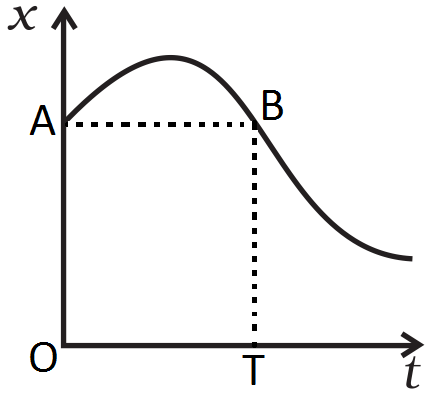
If we draw a line parallel to time axis from the point $(A)$ on the graph at $t = 0$ sec. This line can intersect graph again at $B.$ At this point, the change in displacement $(O - T)$ time is zero i.e., displacement at $A$ and $B$ are equal so as the change in displacement is zero so the average velocity of body vanishes to zero. View full question & answer→MCQ 181 Mark
A person travelling on a straight line moves with a uniform velocity $v_1$ for some time and with uniform velocity $v_2$ for the next equal time. The average velocity is given by:
- ✓
$\text{v}=\frac{\text{v}_1+\text{v}_2}{2}$
- B
$\text{v}=\sqrt{\text{v}_1\text{v}_2}$
- C
$\frac{2}{\text{v}}=\frac{1}{\text{v}_1}+\frac{1}{\text{v}_2}$
- D
$\frac{1}{\text{v}}=\frac{1}{\text{v}_1}+\frac{1}{\text{v}_2}$
AnswerCorrect option: A. $\text{v}=\frac{\text{v}_1+\text{v}_2}{2}$
$a.\ \text{v}=\frac{\text{v}_1+\text{v}_2}{2}$
Explanation:
Velocity is uniform in both cases; that is, acceleration is zero.
We have:
$\text{d}_1=\text{v}_1\text{t}$ and $\text{d}_2=\text{v}_2\text{t}$
Total displacement, $\text{d = d}_1+\text{d}_2$
Total time, $\text{t = t + t = 2t}$
$\therefore$ Average velocity, $\text{v}=\frac{\text{d}_1+\text{d}_2}{2\text{t}}=\frac{\text{v}_1+\text{v}_2}{2}$
View full question & answer→MCQ 191 Mark
A cyclist moving on a circular track of radius $40\ m $ completes half a revolution in $40\ s.$ Its average velocity is:
- A
- ✓
$2\ \text{ms}^{-1}$
- C
$4\pi\ \text{ms}^{-1}$
- D
$8\pi\ \text{ms}^{-1}$
AnswerCorrect option: B. $2\ \text{ms}^{-1}$
$b. \ 2\text{ms}^{-1}$
Explanation:
Average velocity $=\frac{\text{Displacement}}{\text{Time taken}}=\frac{2\text{R}}{\text{t}}$
$=\frac{2\times40}{40}=2\text{ms}^{-1}$
View full question & answer→MCQ 201 Mark
Pick the correct statements:
AnswerCorrect option: A. Average speed of a particle in a given time is never less than the magnitude of the average velocity.
$a.$ Average speed of a particle in a given time is never less than the magnitude of the average velocity.
$b.$ It is possible to have a situation in which $\Big|\frac{\text{d}\vec{\text{v}}}{\text{dt}}\Big|\neq0$ but $\frac{\text{d}}{\text{dt}}|\vec{\text{v}}|=0.$
$c.$ The average velocity of a particle is zero in a time interval. It is possible that the instantaneous velocity is never zero in the interval.
Explanation:
$a.$ Average speed of a particle in a given time is never less than the magnitude of the average velocity.
$b.$It is possible to have a situation in which $\Big|\frac{\text{d}\vec{\text{v}}}{\text{dt}}\Big|\neq0$ but $\frac{\text{d}}{\text{dt}}|\vec{\text{v}}|=0.$
$c.$ The average velocity of a particle is zero in a time interval. It is possible that the instantaneous velocity is never zero in the interval.
Example, the motion of a particle on a circular track with a constant speed.
Average velocity $=\frac{\text{Displacement}}{\text{Total time}}$
$\text{Displacement}\leq\text{Distance}$
$\therefore\text{Average velocrty}\leq\text{Average speed}$
In uniform circular motion, speed is constant but velocity is not.
$\text{i.e.},\Big|\frac{\text{d}\vec{\text{v}}}{\text{dt}}\Big|\neq0$ but $\frac{\text{d}}{\text{dt}}=|\vec{\text{v}}|=0$ which proves case $(b)$
$d.$In one complete circle of uniform motion, average velocity is zero. Instantaneous velocity is never zero in the interval.
View full question & answer→MCQ 211 Mark
A spring with one end attached to a mass and the other to a rigid support is stretched and released.
- ✓
Magnitude of acceleration, when just released is maximum.
- B
Magnitude of acceleration, when at equilibrium position, is maximum.
- C
Speed is maximum when mass is at equilibrium position.
- D
Magnitude of displacement is always maximum whenever speed is minimum.
AnswerCorrect option: A. Magnitude of acceleration, when just released is maximum.
$a. $ Magnitude of acceleration, when just released is maximum.
$b.$ Speed is maximum when mass is at equilibrium position.
Explanation:
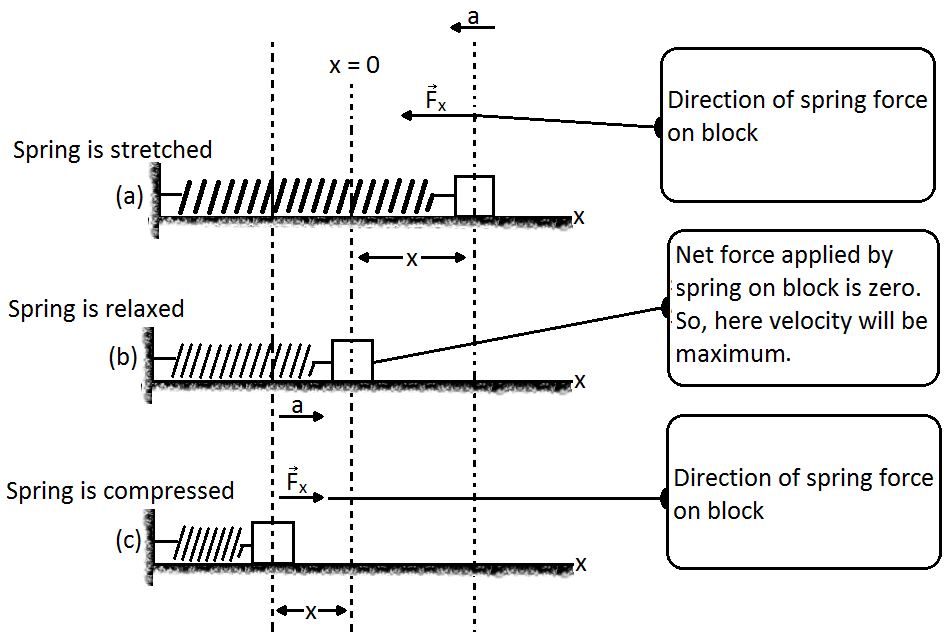
As shown in the figure above when spring is stretched by length x, restoring force will be $F = -kx$ $(-ve$ sigh shows that the force is always is the direction opposite to displacement $x).$ Then the potential energy of the stretched spring.
$=\text{PE}=\frac{1}{2}\text{kx}^2$
The restoring force is central, hence when particle is released it will execute Simple Harmonic Motion about equilibrium position.
Acceleration will be $\text{a}=\frac{\text{F}}{\text{m}}=\frac{\text{-kx}}{\text{m}}$
At equilibrium position, $\text{x}=0\Rightarrow\text{a}=0$
Hence, when just released $\text{x}=\text{x}_\text{max}$
Hence, acceleration is maximum. Thus option $(a)$ is correct.
At equilibrium whole $PE$ will be converted to $KE$, so $KE$ will be maximum and hence, speed will be maximum. Thus option $(c)$ is correct. View full question & answer→MCQ 221 Mark
The changes in displacement in three consecutive instances are $5m, 4m, 11m,$ the total time taken is $5s.$ What is the average velocity in $m/ s?$
Answer$b.\ 4$
Explanation:
The total change in displacement $= 20m.$
Total time taken $= 5s.$ Average velocity $=$ total change in displacement/total time taken $=\frac{20}{5}=4\text{m}/\ \text{s}.$
View full question & answer→MCQ 231 Mark
A car is moving with a velocity of $30\ ms^{-1}$. On applying the brakes, the velocity decreases to $15\ ms^{-1}$ in $2s.$ The acceleration of the car is:
- A
$+7.5\ ms^{-2}$
- B
$-7.7\ ms^{-2}$
- ✓
$-75\ ms^{-2}$
- D
$+15ms^{-2}$
AnswerCorrect option: C. $-75\ ms^{-2}$
$c. \ -75ms^{-2}$
View full question & answer→MCQ 241 Mark
An object thrown vertically upwards with a velocity of $25\ m/ s$ takes $4\ sec$ to reach the thrower. What is displacement of the object?
- A
$100\ m$
- B
$180\ m$
- ✓
$0\ m$
- D
$120\ m$
AnswerCorrect option: C. $0\ m$
$c. \ 0m$
Explanation:
Displacement is the minimum distance between the initial and final position of an object If a ball thrown from point $A$ reaches point $B$ and then return to point $A,$ then a displacement of the ball becomes zero as it returns to its initial position.
View full question & answer→MCQ 251 Mark
Identify one dimensional motion out of the following:
- A
A honey bee dancing in air.
- B
A teacher writing on a blackboard.
- ✓
A scooterist speeding on a level road.
- D
AnswerCorrect option: C. A scooterist speeding on a level road.
$c. $ A scooterist speeding on a level road.
View full question & answer→MCQ 261 Mark
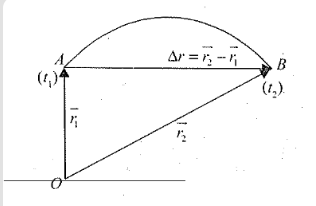
Which of the following statements regarding motion of particle is true ?
- A
The motion between $A$ and $B$ is known.
- B
The motion between $A$ and $B$ is erratic.
- ✓
The motion between $A$ and $B$ may have been steady or erratic.
- D
The motion between $A$ and $B$ is steady.
AnswerCorrect option: C. The motion between $A$ and $B$ may have been steady or erratic.
$c. $ The motion between $A$ and $B$ may have been steady or erratic.
Explanation:
The motion between $A$ and $B$ is steady if the velocity of the particle is constant and erratic if it is variable. From the question it is not clear what happens with the particle during the motion so we cannot say whether the particle is in erratic or steady motion.
View full question & answer→MCQ 271 Mark
Which of the following terms does not go well with the motion of a bus on a crowded road.
Answer$a.$ Uniform velociity
Explanation:
On a crowded road, depending on traffic conditions, the bus driver has to change its speed and direction of motion many times.
The driver will have to frequently apply brakes as well. He might also have to accelerate the bus with different rates.
So, the velocity changes both by magnitude and direction. Thus, uniform velocity is not attained in this case.
View full question & answer→MCQ 281 Mark
Which of the following types of motion cannot describe the motion of a clock’s hands?
AnswerThe hands of a clock move in a circular manner. Hence, the motion exhibited is circular motion. Moreover, it happens periodically, so it is also periodic motion. But its is not rectilinear motion.
View full question & answer→MCQ 291 Mark
In the arrangement shown in figure, the ends $P$ and $Q$ of an inextensible string move downwards with uniform speed $u$. Pulleys $A$ and $B$ are fixed. The mass $M$ moves upwards with a speed: 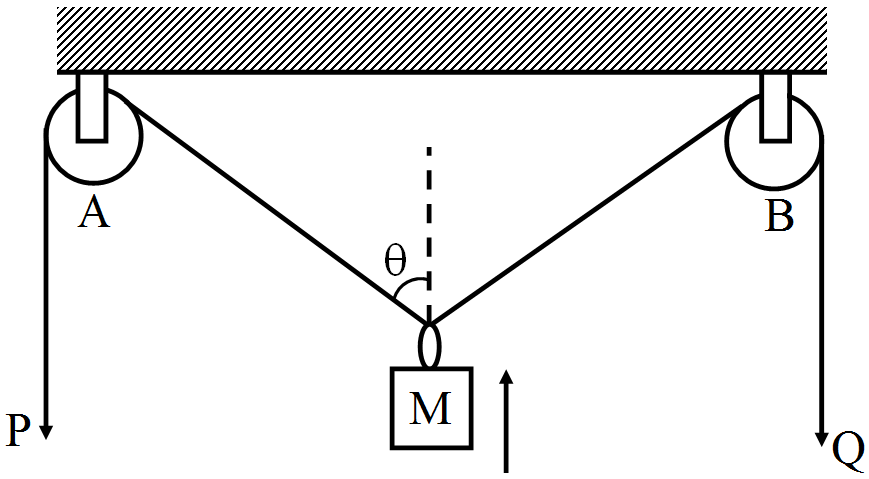
AnswerCorrect option: B. $\frac{\text{u}}{\cos\theta}$
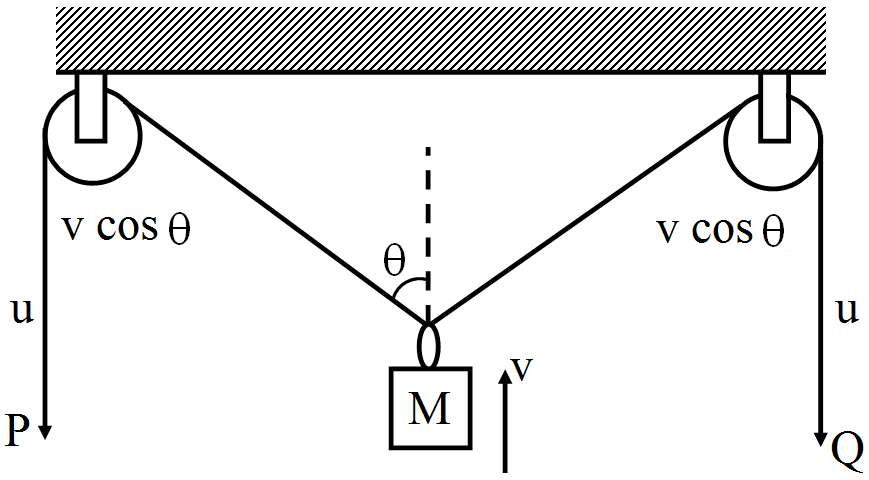
Along the string, the velocity of each object is the same.
$2\text{v}\cos(\theta)=2\text{u}$
$\text{v}=\frac{\text{u}}{\cos(\theta)}$ View full question & answer→MCQ 301 Mark
A stone is dropped from a certain height and at the same time another stone is thrown horizontally from the same height which one will reach the ground earlier:
AnswerSince the initial vertical velocity of both the stones is zero and both are accelerated vertically downwards by equal acceleration, hence they reach earth simultaneously.
View full question & answer→MCQ 311 Mark
Newtons law are not valid in:
AnswerCorrect option: A. Both inertial as well as non $-$ inertial frame of reference.
Newton's Law is only valid in inertial frame of reference. If there is a non $-$ inertial frame of reference then it won't be valid.
View full question & answer→MCQ 321 Mark
The displacement x of a particle varies with time according to the relation $\text{x}=\frac{\text{a}}{\text{b}}(1-\text{e}^{-\text{bt}}).$ The:
- A
At $t=\frac{1}{\text{b}},$ the displacement of the particle is nearly $\Big(\frac{2}{3}\Big)\Big(\frac{\text{a}}{\text{b}}\Big).$
- B
The particle cannot reach a point at a distance $x$ from its starting position if $\text{x}>\frac{\text{a}}{\text{b}}.$
- C
The velocity and acceleration of the particle at $ t = 0$ are $a$ and $-ab$ respectively.
- ✓
The particle will come back to its starting point as $\text{t}\rightarrow\infty.$
AnswerCorrect option: D. The particle will come back to its starting point as $\text{t}\rightarrow\infty.$
$a. $ $\text{At t}=\frac{1}{\text{b}},$ the displacement of the particle is nearly $\Big(\frac{2}{3}\Big)\Big(\frac{\text{a}}{\text{b}}\Big).$
$b. $ The particle cannot reach a point at a distance x from its starting position if $\text{x}>\frac{\text{a}}{\text{b}}.$
$c. $ The velocity and acceleration of the particle at $t = 0$ are $a$ and $-ab$ respectively.
View full question & answer→MCQ 331 Mark
Displacement between two points is $. . . . . .$
Answer$a.$ The shortest path
Explanation:
Displacement between two points is the shortest path between them. It is always less than or equal to the distance between them. Displacement can never be greater than distance.
View full question & answer→MCQ 341 Mark
When person moves in the coordinate system from $A (0, 0)$ to $B (5, 10),$ to $C (8, 6),$ what is the displacement covered?
- ✓
$10$ units
- B
$5$ units
- C
$7$ units
- D
$15$ units
AnswerCorrect option: A. $10$ units
$a.$ $10$ units
Explanation:
The displacement is the distance between the final and the initial location. Here the final location is $C$ and the initial is $A.$ We can solve this by using distance between two points method.
$AC = \sqrt {(8 – 0)^2) + (6 – 0)^2 }= \sqrt {100} = 10 \ units.$
View full question & answer→MCQ 351 Mark
A bomb is released from a horizontal flying aeroplane. The trajectory of bomb as observed from ground is:
Answer$a. $ A parabola
Explanation:
When thrown from aeroplane, it will have velocity in horizontal direction.
Thus angle between velocity and acceleration (i.e. gravity) is neither $0$ nor $180$ so, it wil be pprojectile motion (i.e. parabola in shape).
View full question & answer→MCQ 361 Mark
What can you say about the motion of an object if its speed-time graph is a straight line parallel to the time axis?
- A
Object is moving with uniform acceleration
- ✓
Object is moving with uniform speed
- C
- D
AnswerCorrect option: B. Object is moving with uniform speed
$b.$ Object is moving with uniform speed
Explanation:
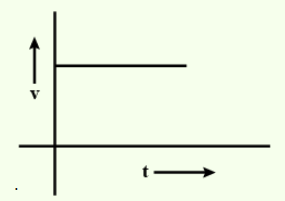
If the speed-time graph is a straight line parallel to the time axis it means that on changing time speed remains constant. View full question & answer→MCQ 371 Mark
Find the odd one out and give the reason: speed, distance, mass, velocity:
MCQ 381 Mark
In which of the following states does a body possess kinetic energy?
- A
- ✓
- C
When placed on a platform
- D
Answer$b.$ Motion
Explanation:
The body moves in the state of motion. Hence it has a velocity and so kinetic energy. Kinetic energy $\big(\frac{1}{2}\big)\text{mv}^2.$
View full question & answer→MCQ 391 Mark
If you decide to launch a ball vertically to a friend located $45\ m$ above you who can catch it. What is the minimum launch speed you can use?
- A
$4.5\ m/ s$
- B
$1.50\ m/ s$
- C
$45\ m/ s$
- ✓
$29.7\ m/ s$
AnswerCorrect option: D. $29.7\ m/ s$
$d.\ 29.7\ m/ s$
Explanation:
Given that,
Distance $s = 45m$
Initial velocity $u = 0$
We know that,
By using equation of motion
$v^2 = u^2 + 2as$
$v^2 = 0 + 2 \times 9.8 \times 45$
$v^2 = 882\ m/ s$
$v = 29.7\ m/ s$
Hence, the minimum speed is $29.7\ m/ s$
View full question & answer→MCQ 401 Mark
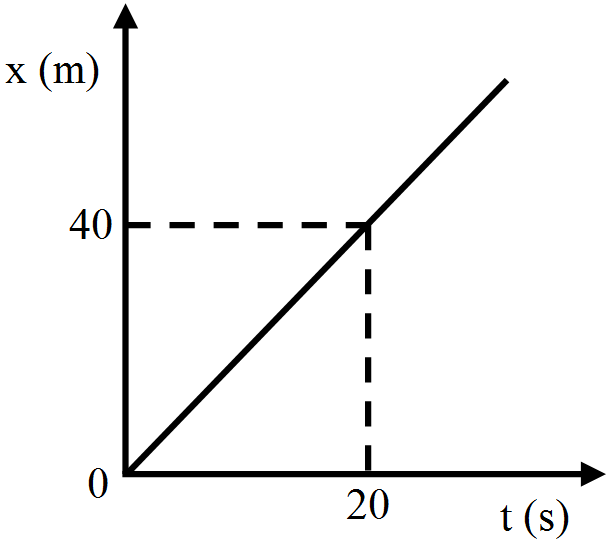
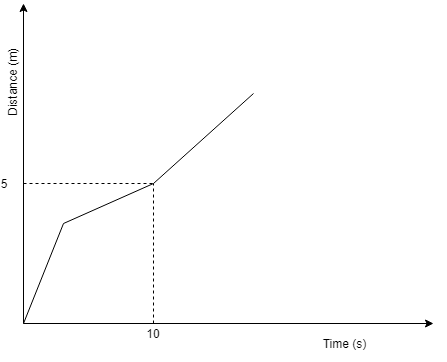
What is the velocity for a body following the graph below at $10s?$
- A
$1m/ s$
- B
$2m/ s$
- ✓
$0.5m/ s$
- D
$0.1m/ s$
AnswerCorrect option: C. $0.5m/ s$
At time $= 10s,$ the distance covered is $5m.$
Velocity $=$ distance/ time.
Hence, velocity $v$ at $10\text{s}=\frac{5}{10}=0.5\text{m}/\text{s}.$
View full question & answer→MCQ 411 Mark
A man of mass $40\ kg$ is standing on a uniform plank of mass $60\ kg$ lying on horizontal frictionless ice. The man walks from one end to the other end of the plank. the distance walked by the man relative to ice is $($given length of plank $= 5m)$
Answer$\text{d}=\frac{\text{mL}}{\text{m}_1+\text{m}_2}$
$\frac{40\times5\text{m}}{100}=2\text{m}$
View full question & answer→MCQ 421 Mark
A man of mass 60kg and a boy of mass 30kg are standing together on frictionless ice surface. If they push each other apart man moves away with a speed of 0.4m/ s relative to ice. After 5sec they will be away from each other at a distance of.
Answer$c. \ 6.0m$
Explanation:
The man and the boy move in opposite directions.
Momentum of man = momentum of boy
$60 \times 0.4 = 30 \times v$
or velocity of the boy $v = 0.8\ ms^{-1}$
$\therefore$ Relative velocity $= 0.4 + 0.8 = 1.2\ ms^{-1}$
$\therefore$ Distance between them in $5\ sec = 1.2 \times 5 = 6.0m.$
View full question & answer→MCQ 431 Mark
A ball is bouncing elastically with a speed $1\ m/s$ between walls of a railway compartment of size $10m$ in a direction perpendicular to walls. The train is moving at a constant velocity of $10\ m/s $ parallel to the direction of motion of the ball. As seen from the ground,
- ✓
The direction of motion of the ball changes every $10$ seconds.
- B
Speed of ball changes every $10$ seconds.
- C
Average speed of ball over any $20$ second interval is fixed.
- D
The acceleration of ball is the same as from the train.
AnswerCorrect option: A. The direction of motion of the ball changes every $10$ seconds.
$b.$ Speed of ball changes every $10$ seconds.
$c.$ Average speed of ball over any $20$ second interval is fixed.
$d.$ The acceleration of ball is the same as from the train.
Explanation:
As the motion is observed from ground, time to strike ball with walls will be after every $10$ seconds. As, the ball is moving with very small speed in the moving train,the direction of ball is same as that of train. Hence direction of motion of ball does not change with respect to observer on Earth.
But, speed of ball changes after collision so option $(a)$ is incorrect and $(b)$is correct.
As speed of ball is uniform so average speed at any time remain same or $1\ m/s$ with respect to train or ground. So option $(c)$ is correct.
Speed of ball changes when it strike to wall initial speed of ball in the direction of moving train with respect to ground $\text{V}_\text{TG}=10+1=11\text{m/s}.$
Speed of ball after collision with side of train $= VBG$ (opposite to the direction of train) $= 10 - 1 = 9\ m/s.$
Change in velocity on collision will be in magnitude $= 11 - 9 = 2\ m/s$. So magnitude of acceleration on both walls of compartment is same but direction will be opposite.
Hence, right option are $(b, c, d).$
View full question & answer→MCQ 441 Mark
A body will have uniform acceleration if its:
- A
Speed changes at uniform rate
- ✓
Velocity changes at uniform rate
- C
Speed changes at non - uniform rate
- D
Velocity remains constant
AnswerCorrect option: B. Velocity changes at uniform rate
$b.$ Velocity changes at uniform rate
Explanation:
If the velocity of an object changes at a uniform rate, then the acceleration that causes the change in velocity is called uniform acceleration or constant acceleration.
For example, the force of gravity imparts an acceleration uniformly which is called acceleration due to gravity.
View full question & answer→MCQ 451 Mark
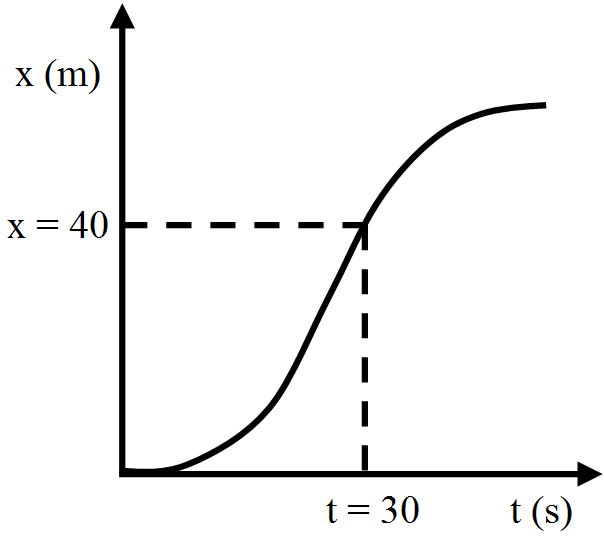
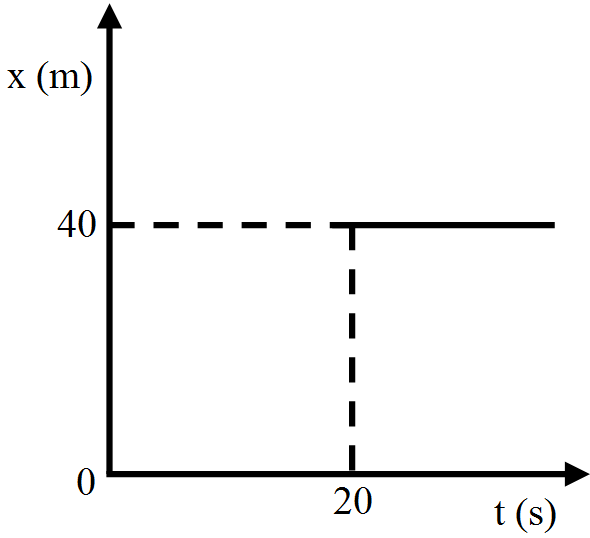
Figure shows the displacement-time graph of a particle moving on the $X-$axis.
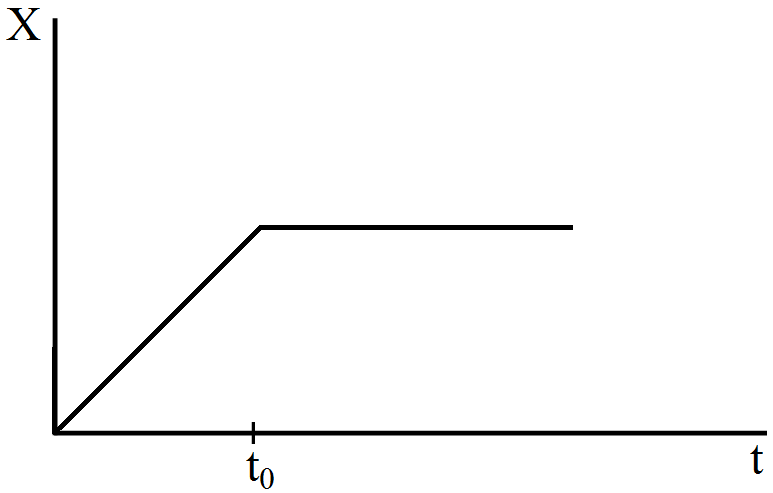
AnswerCorrect option: D. The particle moves at a constant velocity up to a time to, and then stops.
$d.$ The particle moves at a constant velocity up to a time to, and then stops.
Explanation:
The slope of the x-t graph gives the velocity. In the graph, the slope is constant from $t = 0$ to $ t = t_0$, so the velocity is constant. After $t = t_0$, the displacement is zero; i.e., the particle stops.
View full question & answer→MCQ 461 Mark
A car is moving in a spiral starting from the origin with uniform angular velocity. What can be said about the instantaneous velocity?
- ✓
- B
- C
- D
It does not depend on time
Answer$a.$ It increases with time
Explanation:
This type of motion can be called circular motion with increasing radius. As the radius increases, the tangential velocity increases $(v = rw).$ Now, as there is only one velocity present, the speed will be equal to the magnitude of the tangential velocity.
View full question & answer→MCQ 471 Mark
A graph of $x$ versus $t$ is shown in Fig. Choose correct alternatives from below:
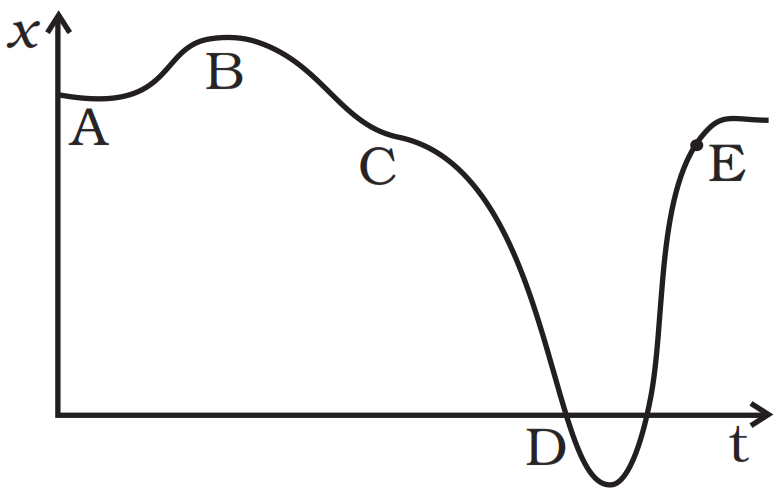
- A
The particle was released from rest at $t = 0.$
- B
At $C,$ the velocity and the acceleration vanish.
- C
Average velocity for the motion between $A$ and $D$ is positive.
- ✓
The speed at $D$ exceeds that at $E.$
AnswerCorrect option: D. The speed at $D$ exceeds that at $E.$
$a.$ The particle was released from rest at $t = 0.$
$c.$ At $C,$ the velocity and the acceleration vanish.
$d.$ $D$ The speed at $D$ exceeds that at $E.$
Explanation:
Main concept used: Slope of $x - t$ graph gives $\text{v}=\frac{\text{dx}}{\text{dt}}$
At A graph $(x - t)$ is parallel to the time axis, so $\frac{\text{dx}}{\text{dt}}$ is zero or particle is at rest. After A, slope $\frac{\text{dx}}{\text{dt}}$ increases, so velocity increases. Verifies option $(a).$
Tangent at $B$ and $C$ is a graph $(x - t),$ that is parallel to the time axis, so $\frac{\text{dx}}{\text{dt}}=0$ or $v = 0.$
It implies that acceleration $a = 0$ so it discards option $(b)$ and verifies the option $(c).$
From graph the slope at $D$ is greater than at $E$. So speed at $D$ is greater than at $E.$
Verifies the option $(e).$ Velocity at $A$ is Zero as$ x - t$ parallel to time axis so average velocity at $A$ is zero.
At $D$ displacement or slope is negative. So, the average velocity at $D$ is negative not positive discards option $(d).$
View full question & answer→MCQ 481 Mark
An object is sliding down on an inclined plane. The velocity changes at a constant rate from $10\ cm/s$ to $15\ cm/s$ in $2$ seconds. What is its acceleration?
- A
$5\ cm/ s^2$$
- B
$7.5\ cm/ s^2$
- ✓
$2.5\ cm/ s^2$
- D
$12.5\ cm/ s^2$
AnswerCorrect option: C. $2.5\ cm/ s^2$
$c.\ 2.5\ cm/ s^2$
Explanation:
$\text{a}=\frac{\text{v}-\text{u}}{\text{t}}=\frac{15-10}{2}=2.5\text{cm}/\text{s}^2$
View full question & answer→MCQ 491 Mark
An object while moving may not have:
AnswerCorrect option: A. Variable speed but constant velocity.
View full question & answer→MCQ 501 Mark
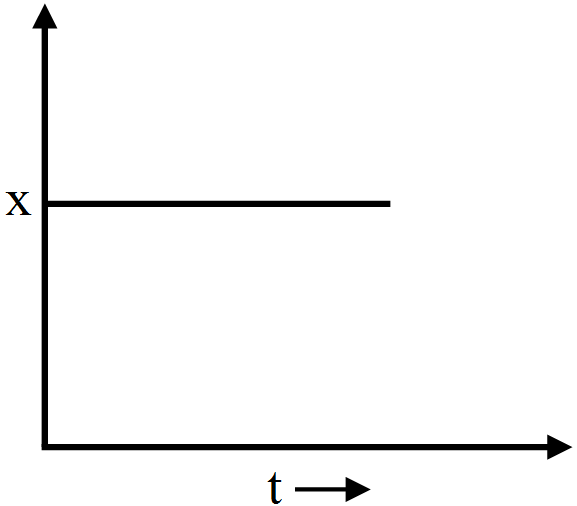
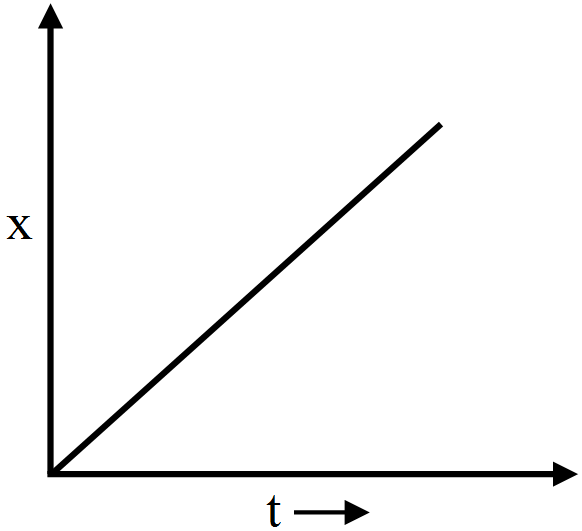
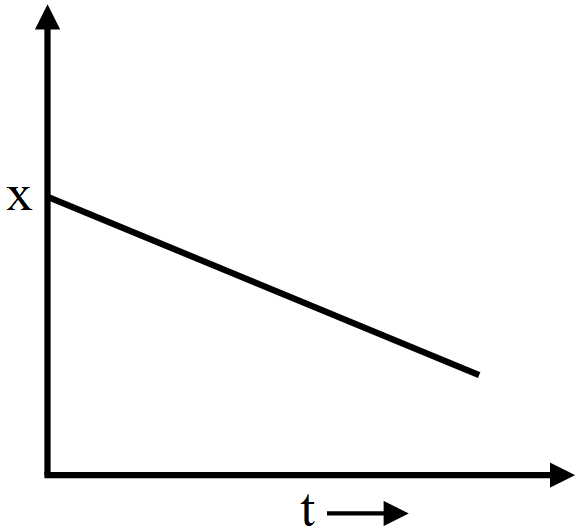
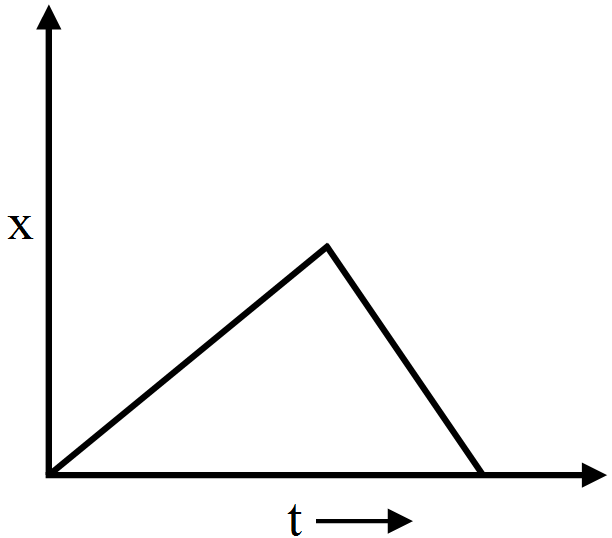
The $x-t$ graph representing an object at rest is:
View full question & answer→MCQ 511 Mark
A body thrown vertically up with a velocity $'u'$ reaches the maximum height $'h'$ after $'T'$ second. The correct statement among the following is:
- A
At a height $\frac{\text{h}}{2}$ from the ground its velocity is $\frac{\text{u}}{2}.$
- B
At a time $T$ its velocity is $'u'.$
- ✓
At a time $ '2T$' its velocity is $-u.$
- D
At a time $2T$ its velocity is $-6u.$
AnswerCorrect option: C. At a time $ '2T$' its velocity is $-u.$
$c. $ At a time $'2T'$ its velocity is $-u.$
Explanation:
Time taken by the body to reach the maximum height is given as $T$ and the velocity of the body at the time of throw is $u$ (upwards).
After further time $T,$ the body reaches to the ground having same velocity $u$ in the downward direction as that of initial velocity at the time of throw.
Thus, at the instant $2T,$ the velocity of the body is $−u$ (where minus sign represents the velocity to be in downward direction).
View full question & answer→MCQ 521 Mark
The velocity-time plot for a particle moving on a straight line is shown in the figure:
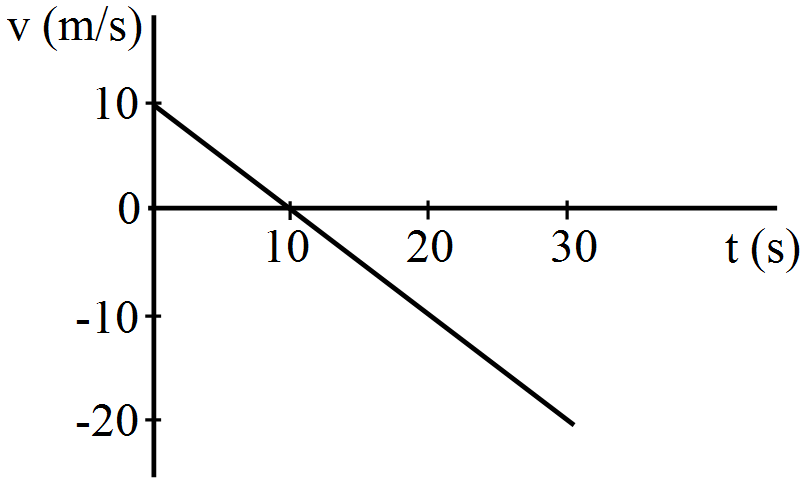
AnswerCorrect option: A. The particle has a constant acceleration.
$a.$ The particle has a constant acceleration.
$d.$ The average speed in the interval $0$ to $10\ s$ is the same as the average speed in the interval $10\ s$ to $20\ s.$
Explanation:
$a. $ The slope of the $v-t$ graph gives the acceleration. For the given graph, the slope is constant. So, acceleration is constant.
$b. $ From $0$ to $10$ seconds, velocity is in positive direction and then in negative direction. This means that the particle turns around at $t = 10s.$
$c. $ Area in the $ v-t$ curve gives the distance travelled by the particle.
Distance travelled in positive Direction $\neq$ Distance travelled in negative direction
$\therefore\text{Displacement}\neq\text{Zero}$
$d.$ The area of the v-tgraph from $t = 0s$ to $t = 10s$ is the same as that from $t = 10s$ to $t = 20s$.
So, the distance covered is the same. Hence, the average speed is the same.
View full question & answer→MCQ 531 Mark
Which of the following is the correct formula for average velocity?
- A
$\text{v}=\frac{\text{dx}}{\text{dt}}$
- ✓
$\text{v}=\frac{\text{x}}{\text{t}}$
- C
$\text{v}=\text{xt}$
- D
$\text{v}=\frac{\text{t}}{\text{x}}$
AnswerCorrect option: B. $\text{v}=\frac{\text{x}}{\text{t}}$
$b.$ $\text{v}=\frac{\text{x}}{\text{t}}$
Explanation:
The correct formula is $\text{v}=\frac{\text{x}}{\text{t}}.$ Average velocity is total change in displacement divided by total change in time. $\text{v}=\frac{\text{dx}}{\text{dt}}$ is the formula for instantaneous velocity.
View full question & answer→MCQ 541 Mark
Acceleration of a particle which is at rest at $x = 0 $ is $\vec{\text{a}}=(4-2\text{x})\hat{\text{i}}.$ Select the correct alternative(s):
- A
Maximum speed of the particle is $4$ units.
- ✓
Particle further comes to rest at $x = 4.$
- C
Particle oscillates about $x = 2.$
- D
Particle will continuously accelerate along the $x-$axis.
AnswerCorrect option: B. Particle further comes to rest at $x = 4.$
$b.$ Particle further comes to rest at $x = 4.$
$c.$ Particle oscillates about $x = 2.$
View full question & answer→MCQ 551 Mark
Mark the correct statements for a particle going on a straight line:
- A
If the velocity and acceleration have opposite sign, the object is slowing down.
- B
If the position and velocity have opposite sign, the particle is moving towards the origin.
- ✓
If the velocity is zero at an instant, the acceleration should also be zero at that instant.
- D
If the velocity is zero for a time interval, the acceleration is zero at any instant within the time interval.
AnswerCorrect option: C. If the velocity is zero at an instant, the acceleration should also be zero at that instant.
$a.$ If the velocity and acceleration have opposite sign, the object is slowing down.
$b.$ If the position and velocity have opposite sign, the particle is moving towards the origin.
$d.$ If the velocity is zero for a time interval, the acceleration is zero at any instant within the time interval.
Explanation:
$a.$ Acceleration is given by
$-\text{a}=\frac{\text{dv}}{\text{dt}}$
$-\text{a}<0$
$\Rightarrow\frac{\text{dv}}{\text{dt}}<0$
$\Rightarrow\text{V}_{\text{final}}<\text{V}_{\text{initial}}$
$b.$ If the position and velocity have opposite signs, the particle moves towards the origin. It can be explained by following figure:
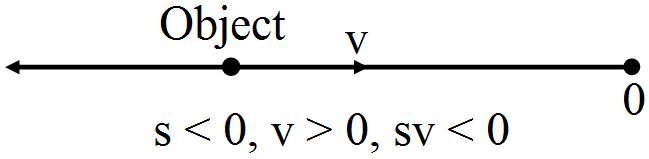
Object is moving toward the origin.
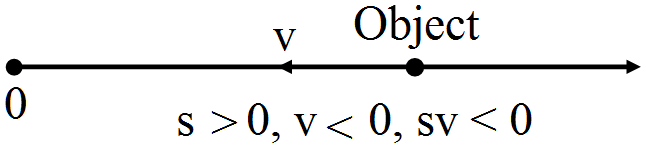
Object is moving toward the origin.
$c.$ If the velocity is zero in a certain time interval, then the change in the velocity in that time interval will also be zero. As acceleration is rate of change of velocity, it will also be zero at an instant in that time interval. View full question & answer→MCQ 561 Mark
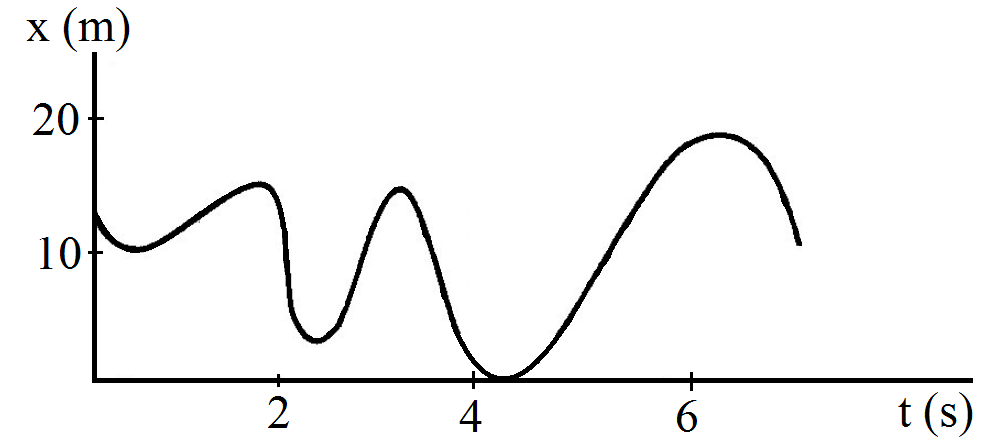
Figure shows the position of a particle moving on the $X-$axis as a function of time.
- ✓
The particle has come to rest $6$ times.
- B
The maximum speed is at $t = 6s.$
- C
The velocity remains positive for $t = 0$ to $t = 6s.$
- D
The average velocity for the total period shown is negative.
AnswerCorrect option: A. The particle has come to rest $6$ times.
$a.$ The particle has come to rest $6$ times.
Explanation:
$a.$ The slope of the x-tgraph gives the velocity. Here, 6 times the slope is zero. So, the particle has come to rest 6 times.
$b.$ As the slope is not maximum at $t = 6s,$ the maximum speed is not at $t = 6s.$
$c.$ As the slope is not positive from $t = 0s$ to $t = 6s,$ the velocity does not remain positive.
$d.$ Average velocity $\frac{\text{Total displacement}}{\text{Total time taken}}=\frac{\text{x final}-\text{x initial}}{\text{t}}$
For the shown time $(r = 6s),$ the displacement of the particle is positive. Therefore, the average velocity is positive.
View full question & answer→MCQ 571 Mark
A driver takes $0.20s$ to apply the brakes after he sees a need for it. This is called the reaction time of the driver. If he is driving a car at a speed of $54km/ h$ and the brakes causes a deceleration of $6.0 m/ s^2$, find the distance traveled by the car after he sees the need to put the brakes on.
- ✓
$18.63m$
- B
$20m$
- C
$26.85m$
- D
$27.67m$
AnswerCorrect option: A. $18.63m$
$a.\ 18.63m$
View full question & answer→MCQ 581 Mark
How does the displacement v/s time graph of a uniformly accelerated motion look like?
Answer$b.$ A parabola
Explanation:
Here we use the second equation of motion. $\text{s}=\text{ut}+\big(\frac{1}{2}\big)\text{at}^2.$ In a uniformly accelerated motion, the acceleration remains constant.
Therefore, the equation for displacement becomes the equation of a parabola.
View full question & answer→MCQ 591 Mark
Find the magnitude of constant acceleration (in $m/ s^2$) needed to allow a car to accelerate in a straight line from a speed of zero to a speed of $30\ m/ s$ in $5\ s:$
Answer$b.\ 6$
Explanation:
Here acceleration, $\text{a}=\frac{\text{dv}}{\text{dt}}=\frac{30-0}{5}=\text{6}\text{m}/\text{s}^2.$
View full question & answer→MCQ 601 Mark
The area under the velocity time graph between any two instants $t = t_1$ and $t = t_2$ gives the distance covered in a time $\Delta\text{t}=\text{t}_2-\text{t}_1:$
- A
Only if the particle moves with a uniform acceleration.
- B
Only if the particle moves with a uniform velocity.
- C
Only if the particle moves with an acceleration increasing at a uniform rate.
- ✓
In all cases irrespective of whether the motion is one of uniform velocity, or of uniform acceleration or of variable acceleration.
AnswerCorrect option: D. In all cases irrespective of whether the motion is one of uniform velocity, or of uniform acceleration or of variable acceleration.
$d.$ In all cases irrespective of whether the motion is one of uniform velocity, or of uniform acceleration or of variable acceleration.
View full question & answer→MCQ 611 Mark
In a uniformly accelerated motion, the speed varies from $0$ to $20m/ s$ in $4s.$ What is the average speed during the motion?
- ✓
$10m/ s$
- B
$20m/ s$
- C
$0m/ s$
- D
$15m/ s$
AnswerCorrect option: A. $10m/ s$
$a. \ 10m/ s$
Explanation:
From first equation of motion we have, $v = u + at,$ which implies that $a = 5\ m/s^2$.
From second equation of motion we have $\text{s}=\text{ut}+\big(\frac{1}{2}\big)\text{at}^2,$ which implies that
$s = 40m.$
Average speed $=\frac{\text{s}}{\text{t}}=\frac{40}{4}=10\text{m}/\ \text{s}.$
View full question & answer→MCQ 621 Mark
If a car at rest accelerates uniformly to a speed of $144\ km/ h$ in $20s$, it covers a distance of:
- ✓
$400m$
- B
$1440\ m$
- C
$2880\ m$
- D
AnswerCorrect option: A. $400m$
$a.\ 400m$
View full question & answer→MCQ 631 Mark
Free $^{238}U$ nuclei kept in a train emit alpha particles. When the train is stationary and a uranium nucleus decays, a passenger measures that the separation between the alpha particles and the recoiling nucleus becomes $x,$ in t time after the decay. If a decay takes places, when the train is moving at a uniform speed $v$, the distance between the alpha particle and the recoiling nucleus at a time $t$ after the decay, as measured by the passenger will be:
- A
$x + vt$
- B
$x − vt$
- ✓
$x$
- D
Depends on the directions of the train
Answer$c.\ x$
Explanation:
Train is moving with constant velocity $v.$
There won't be any relative velocity change between alpha particle and uranium.
Hence, the distance will still be $x.$
View full question & answer→MCQ 641 Mark
In which coordinate system do we use distance from origin and to angles to define the position of a point in space?
Answer$c.$ Spherical
Explanation:
In Spherical system, distance from the center, the angle with the $X$ axis, and the angle with the $Z$ axis are used to define the position of a point. These are respectively represented by $R,$ $\theta$ and $\phi.$
View full question & answer→MCQ 651 Mark
Two cars OF SAME LENGTH move in the same direction along parallel roads. One of them is a $100\ m$ long travelling with a velocity of $7.5\ ms^{−1}.$ How long will it take for the first car to overtake the second car?
View full question & answer→MCQ 661 Mark
What kind of motion is rectilinear motion?
AnswerRectilinear motion happens along a straight line.
A straight line is one dimensional.
Hence, rectilinear motion is one dimensional.
View full question & answer→MCQ 671 Mark
A particle moves along the $X-$axis as $x = u(t - 2s) + a(t - 2s)^2$.
- A
The initial velocity of the particle is $u.$
- B
The acceleration of the particle is $a.$
- ✓
The acceleration of the particle is $2a.$
- D
At $t = 3s$ particle is at the origin.
AnswerCorrect option: C. The acceleration of the particle is $2a.$
$c. $ The acceleration of the particle is $2a..$
Explanation:
Initial velocity $=\Big|\frac{\text{dx}}{\text{dt}}\Big|_{\text{t} = 0}$
$\frac{\text{dx}}{\text{dt}}=\text{u}+2\text{a}(\text{t}-2\text{s})$
$\Big|\frac{\text{dx}}{\text{dt}}\Big|_{\text{t}=0}=\text{u}-4\text{as}\neq\text{u}$
Acceleration $=\frac{\text{d}^2\text{x}}{\text{dt}^2}=2\text{a}$
At $t = 2s,$
$x = u(2s - 2s) + a(2s - 2s)^2 = 0 \ (origin)$
View full question & answer→MCQ 681 Mark
The rate of change of velocity of an object with respect to time is called ..........
Answer$c.$ Acceleration
Explanation:
Acceleration is the rate of change of the velocity of an object with respect to time. Accelerations are vector quantities.
The orientation of an object's acceleration is given by the orientation of the net force acting on that object.
acceleration $\frac{\text{Change in the velociity}}{\text{time}}$
View full question & answer→MCQ 691 Mark
Mark the correct statements:
- ✓
The magnitude of the velocity of a particle is equal to its speed.
- B
The magnitude of average velocity in an interval is equal to its average speed in that interval
- C
It is possible to have a situation in which the speed of a particle is always zero but the average speed is not zero.
- D
It is possible to have a situation in which the speed of the particle is never zero but the average speed in an interval is zero.
AnswerCorrect option: A. The magnitude of the velocity of a particle is equal to its speed.
$a.$ The magnitude of the velocity of a particle is equal to its speed.
Explanation:
$a.$ Velocity being a vector quantity has magnitude as well as direction, and magnitude of velocity is called speed.
$b.$ Average velocity $=\frac{\text{Total displacement}}{\text{Total time taken}}$
Average speed $=\frac{\text{Total distance travelled}}{\text{Total time taken}}$
$\text{Distance}\geq\text{Displacement}$
$\therefore\text{Average speed}\geq\text{Average velocity}$
The magnitude of average velocity in an interval is not always equal to its average speed in that interval.
$c.$ If speed is always zero, then the distance travelled is always zero. Hence, the total distance travelled and the average speed will be zero.
$d.$ If the speed of a particle is never zero, the distance travelled by the particle is never zero. Hence, the average speed will not be zero.
View full question & answer→MCQ 701 Mark
What happen to the instantaneous velocity in a non - uniformly accelerated motion?
- ✓
- B
- C
It varies as the acceleration
- D
Answer$a.$ It increases
Explanation:
The instantaneous velocity will increase with time. If the motion is accelerated, no matter if the acceleration is constant, or variable, the instantaneous velocity will increase. Variation of acceleration describes how to change in velocity is changing.
View full question & answer→MCQ 711 Mark
In case of a freely falling body, the ratio of kinetic energy at the end of the third second increase in kinetic energy in the next three seconds is:
- A
$1 : 1$
- B
$1 : 2$
- ✓
$1 : 3$
- D
$1 : 9$
AnswerCorrect option: C. $1 : 3$
$c.\ 1 : 3$
View full question & answer→MCQ 721 Mark
The coordinates of object with respect to a frame of reference at $t = 0$ are $(-1, 0, 3).$ If $t = 5\ s,$ its coordinates are $(-1, 0, 4),$ then the object is in:
AnswerCorrect option: A. Motion along $z-$axis.
$a.$ Motion along $z-$axis.
Explanation:
Given, at $t = 0\ s,$ position of an object is $(-1, 0, 3)$ and at $t = 5\ s,$ its coordinate is $(-1, 0, 4).$
So, there is no change in $x$ and $y-$coordinates, while $z-$coordinate changes from $3$ to $4.$ So, the object is in motion along $z-$axis.
View full question & answer→MCQ 731 Mark
Which of the following statements is true for a car moving on the road?
- A
With respect to the frame of reference attached to the ground, the car is at rest.
- ✓
With respect to the frame of reference attached to the person sitting in the car, the car is at rest.
- C
With respect to the frame of reference attached to the person outside the car, the car is at rest.
- D
AnswerCorrect option: B. With respect to the frame of reference attached to the person sitting in the car, the car is at rest.
For a car in motion, if we describe this event w.r.t. a frame of reference attached to the person sitting inside the car, the car will appear to be at rest as the person inside the car $($observer$)$ is also moving with same velocity and in the same direction as car.
View full question & answer→MCQ 741 Mark
The time after which they are closet to each other:
- A
$\frac{1}{3}\text{s}$
- B
$\frac{8}{3}\text{s}$
- C
$\frac{1}{5}\text{s}$
- ✓
$\frac{8}{5}\text{s}$
AnswerCorrect option: D. $\frac{8}{5}\text{s}$
$d. \frac{8}{5}\text{s}$
View full question & answer→MCQ 751 Mark
Which one of the following relations is true?
- A
Distance $>$ Displacement
- B
Distance $<$ Displacement
- ✓
Distance $>=$ Displacement
- D
Distance $<=$ Displacement
AnswerCorrect option: C. Distance $>=$ Displacement
$c.$ Distance $>=$ Displacement
Explanation:
Displacement is the shortest distance between two points. Hence displacement $ <=$ distance or vice versa. If the path followed is the path of shortest distance or displacement, then displacement $=$ distance.
View full question & answer→MCQ 761 Mark
When an object is accelerated:
- A
Its direction must be constant
- ✓
Its velocity is necessarily changing
- C
- D
Its speed is necessarily changing
AnswerCorrect option: B. Its velocity is necessarily changing
$b.$ Its velocity is necessarily changing
Explanation:
Acceleration is the time rate of change of velocity.
View full question & answer→MCQ 771 Mark
A stone is released with acceleration $'a'$ from an upwardy moving left. Find out the acceleration and direction of the stone.
- ✓
- B
$(g + a)$ in downward direction.
- C
$(g - a)$ in upward direction.
- D
$g$ in downward direction.
Answer$a.$ A in upward direction.
View full question & answer→MCQ 781 Mark
A man runs at a speed of $4.0\ m/ s$ to overtake a standing bus. When he is 6.0m behind the door $(at t = 0),$ then bus moves forward and continues with a constant acceleration of $1.2\ m/ s^2$. The man shall access the door at time t equal to:
- A
$5.2s$
- ✓
$4.3s$
- C
$2.3s$
- D
The man shall never gain the door
AnswerCorrect option: B. $4.3s$
$b. \ 4.3\ s$
Explanation:
Suppose the man gets the bus after time t from the start of the bus.
Then the man needs to cover the distance BY bus $+ 6$ meter to catch the Bus
so the distance by man, $XM = 4\times t$ should be equal to $6\text{m}+\frac{1}{2}\text{at}^2$ or $4t = 6 + 0.6t^2$on solving it we get $t = 4.38\ sec$
Just employ the Shridharchcarya Formula $\text{t}= \frac{-\text{b}\pm\sqrt{\text{b}^2-4\text{ac}}}{2\text{a}}$
Where $t$ is root of at$^2+ bt + c = 0$
View full question & answer→MCQ 791 Mark
The rate of change of velocity is:
MCQ 801 Mark
A body starts from rest and moves with uniform acceleration for $3\ s.$ It then decelerates uniformly for $2\ s.$ and stops. If the deceleration is $3 \ ms^{-2}$ the maximum velocity of the body is$. . . ms^{-1}$
Answer$c.\ 6$
Explanation:
Velocity will be maximum before the deceleration starts.
Given Final Velocity $v = 0,$ acceleration $a = −3ms^{-2}$ and time $t = 3s,$
Let maximum velocity is $u_{max}$,
Using $v = u + at$
$⇒ 0 = u_{max} −3 \times 2$
$⇒ u_{max} = 6ms^{-1}$
View full question & answer→MCQ 811 Mark
What is the rate of change of rate of change of displacement of a body?
AnswerThe rate of change of displacement of a body is velocity.
The rate of change of rate of displacement of a body, or rate of change of velocity is acceleration.
View full question & answer→MCQ 821 Mark
Velocity $-$ time graph of a body with uniform velocity is a straight line:
- ✓
Parallel to $x -$ axis
- B
Parallel to $y -$ axis
- C
Inclined to $x -$ axis
- D
Inclined to $y -$ axis
AnswerCorrect option: A. Parallel to $x -$ axis
Velocity $-$ time graph of an object moving with uniform velocity. The slope of a Velocity–time graph of an object moving in rectilinear motion with uniform velocity is straight line and parallel to $x -$ axis when velocity is taken along $y -$ axis and time is taken along $x -$ axis.
View full question & answer→MCQ 831 Mark
A stone is just released from the window of a moving train moving along a horizontal straight track. When observed by a person on the ground, the stone will hit the ground following a:
AnswerThe stone will follow the motion of a projectile, because:
It has a initial horizontal velocity, which is same as that of the train. it acquires a vertical component under the force of gravity.
Since it has a constant speed on horizontal direction and a constant acceleration in vertical direction, the trajectory is parabolic.
View full question & answer→MCQ 841 Mark
Which of the following types of motion can be used for describing the motion of a car on a straight road?
AnswerThe motion of a car on straight road is happening along a straight line. Hence the motion can be called rectilinear as rectilinear motion happens along a straight line. Rest all are non rectilinear motions.
View full question & answer→MCQ 851 Mark
The body will speed up if $.............$
- ✓
Velocity and acceleration are in same direction.
- B
Velocity and acceleration are in opposite direction.
- C
Velocity and acceleration are in perpendicular direction.
- D
AnswerCorrect option: A. Velocity and acceleration are in same direction.
A body will speed up if both velocity and acceleration are in same direction. If they are in opposite directions it results in slowing down the motion. And if they are perpendicular then there will be no effect on magnitude of velocity.
View full question & answer→MCQ 861 Mark
The velocity of a truck changes form $3\ m/ s$ to $5\ m/ s$ in $5\ s.$ What is the acceleration in $m/s^2$?
Answer$a.\ 0.4$
Explanation:
Acceleration is the rate of change of velocity. Here, the velocity changes form $3\ m/ s$ to $5\ m/ s$ in $5\ s.$
Hence, acceleration $=\frac{(5-3)}{5}=0.4\text{m}/\text{s}^2.$
View full question & answer→MCQ 871 Mark
Which of the following can be used to describe how fast an object is moving along with the direction of motion at a given instant of time?
AnswerInstantaneous velocity describes the velocity of an object at a given time instant.
Average speed is the speed at which the object travels throughout the time period and not an instant.
Speed is a scalar quantity; hence it cannot show the direction of motion.
View full question & answer→MCQ 881 Mark
- A
Varying speed without having varying velocity.
- B
Varying velocity without having varying speed.
- C
Nonzero acceleration without having varying speed.
- ✓
$B$ and $C$
AnswerCorrect option: D. $B$ and $C$
Velocity and acceleration are vector quantities that can be changed by changing direction only $($keeping magnitude constant$).$
View full question & answer→MCQ 891 Mark
Two stones are dropped down simultaneously from different heights. At the starting time, the distance between them is $30\ cm.$ After $1\ s,$ the distance between the two stones will be $(g = 10\ ms^{-2}).$
- A
$10\ cm$
- B
$20\ cm$
- ✓
$30\ cm$
- D
$0\ cm$
AnswerCorrect option: C. $30\ cm$
$c. 10\ cm$
Explanation:
After $2\ s$ or any difference in seconds, separation will be $30\ cm$ only as both bodies covers same distance for same time interval under gravity.
View full question & answer→MCQ 901 Mark
A particle of mass $'m'$ moving with a velocity $v$ strikes a stationary particle of mass $2m$ and sticks to it. The speed of the system will be:
- A
$\frac{\text{v}}{2}$
- B
$2\text{v}$
- ✓
$\frac{\text{v}}{3}$
- D
$3\text{v}$
AnswerCorrect option: C. $\frac{\text{v}}{3}$
$c.\ \frac{\text{v}}{3}$
View full question & answer→MCQ 911 Mark
A stone is dropped into well in which the level of water is at a distance $h$ below the top of well. If $y$ is the velocity of sound, the time $T$ after which the splash is heard is given by:
- A
$\text{T}=\frac{2\text{h}}{\text{v}}$
- ✓
$\text{T}=\sqrt{\frac{2\text{h}}{\text{g}}}+\frac{\text{h}}{\text{v}}$
- C
$\text{T}=\sqrt{\frac{2\text{h}}{\text{v}}}+\frac{\text{h}}{\text{g}}$
- D
$\text{T}=\sqrt{\frac{\text{h}}{2\text{g}}}+\frac{2\text{h}}{\text{v}}$
AnswerCorrect option: B. $\text{T}=\sqrt{\frac{2\text{h}}{\text{g}}}+\frac{\text{h}}{\text{v}}$
$b.\ \text{T}=\sqrt{\frac{2\text{h}}{\text{g}}}+\frac{\text{h}}{\text{v}}$
Explanation:
$\text{T}=\text{t}_1+\text{t}_2=\sqrt{\frac{2\text{h}}{\text{g}}}+\frac{\text{h}}{\text{v}}$
View full question & answer→MCQ 921 Mark
Consider two observers moving with respect to each other at a speed $v$ along a straight line. They observe a block of mass $m$ moving a distance $l$ on a rough surface. The following quantities will be same as observed by the two observers.
AnswerCorrect option: D. Acceleration of the block
Acceleration of the block is same in both frames as they are only moving in different velocities $($but constant$).$
$KE$ is dependent of $v_{rel}$. Work done on block by forces changes as position vector changes differently in each frame.
View full question & answer→MCQ 931 Mark
A balloon is going upwards with velocity $12\ m/sec.$ It releases a packet when it is at a height $65\ m$ from the ground. How much time the packet will take to reach the ground? $(g = 10m/s^2):$
- ✓
$5\ sec$
- B
$6\ sec$
- C
$7\ sec$
- D
$8\ sec$
AnswerCorrect option: A. $5\ sec$
$a.\ 5 \ sec$
Explanation:
As $\text{s}=\text{ut}+\frac{1}{2}\text{at}^2$
$\therefore 65=-12\text{t}+\frac{1}{2}\times10\times\text{t}^2$
$=-12\text{t}+5\text{t}^2$
$5\text{t}^2-12\text{t}-65=0$
On solving, $t = 10s$ or $-26s$
View full question & answer→MCQ 941 Mark
A ball dropped from some height coves half of its total during the last second of its free fall. Find:
- ✓
- B
- C
Speed with which it strikes the ground.
- D
View full question & answer→MCQ 951 Mark
Velocity at the top of vertical journey under gravity when a body is projected upward with velocity $1000\ m/ s$ is:
- ✓
- B
$10\ m/ s$
- C
$100\ m/ s$
- D
$1000\ m/ s$
Answera. Zero
Explanation:
As body goes upwards, due to gravitational force the body will stop at the maximum height and fall towards the ground.
Hence, the velocity at the maximum height is zero.
$v_m = 0\ m/ s$
View full question & answer→MCQ 961 Mark
An iron sphere of mass 10kg has the same diameter as an aluminium sphere of mass is $3.5\ kg.$ Both spheres are dropped simultaneously from a tower. When they are $10\ m$ above the ground, the have the same:
Answer$a. $ Acceleration
Explanation:
Momentum, potential energy and kinetic energy depend on the mass of the object; as well as on some other factors. But acceleration, in this case, is the acceleration due to gravity; which does not depend on mass or velocity.
View full question & answer→MCQ 971 Mark
A car moves for $60\ s$ covering a distance of $3600\ m$ with zero initial velocity. What is the acceleration in $m/ s^2?$
Answer$a.\ 2$
Explanation:
Here we will use the second equation of motion, $\text{s}=\text{ut}+\big(\frac{1}{2}\big)\text{at}^2.$
Here,$ u = 0, s = 3600, t = 60s.$
On solving, we will get $a = 2 m/s^2.$
View full question & answer→MCQ 981 Mark
How long will a train, running at a speed of $45\ kmph$ cross a standing man, given the length of the train is $450\ m\ ?$
- A
$100\ sec$
- B
$150\ sec$
- C
$50\ sec$
- ✓
$36\ sec$
AnswerCorrect option: D. $36\ sec$
$d. \ 36\ sec$
View full question & answer→MCQ 991 Mark
A body released from the top of alls through a height of $5\ m$ during the first second of its fall and $35\ m$ during the last second of its fall. The height of the tower is:
- ✓
$80\ m$
- B
$60\ m$
- C
$40\ m$
- D
$20\ m$
AnswerCorrect option: A. $80\ m$
$a.80\ m$
View full question & answer→MCQ 1001 Mark
For ordinary terrestrial experiments, the observer in an inertial frame in the following cases is:
AnswerCorrect option: B. A driver in a sports car moving with a. constant high speed of $200kmh^{-1}$ on a straight road.
$b.$ A driver in a sports car moving with a. constant high speed of $200kmh^{-1}$ on a straight road.
Explanation:
$A$ and $D$ options experience centripetal acceleration. $C$ experience linear acceleration and a inertial frame $n =$ must be non $-$ accelerating.
$B$ is non $-$ accelerating hence correct answer.
View full question & answer→MCQ 1011 Mark
A ball is thrown up in the sky. After reaching a height, the ball falls back. What can be said about the average velocity?
AnswerThe average velocity is zero. The ball covers positive displacement when it goes up and negative displacement when it comes down. Hence the total displacement is zero.
Therefore, the average velocity is zero.
View full question & answer→MCQ 1021 Mark
A stone is allowed to fall freely from rest. The ratio of the time taken to fall through the first meter and the second meter distance is:
- A
$\sqrt{2}-1$
- ✓
$\sqrt{2}+1$
- C
$\sqrt{2}$
- D
$\text{None of these}$
AnswerCorrect option: B. $\sqrt{2}+1$
View full question & answer→MCQ 1031 Mark
In one dimensional motion, instantaneous speed $v$ satisfies $0\le\text{v}<\text{v}_0.$
- A
The displacement in time $T$ must always take non$-$negative values.
- ✓
The displacement $x$ in time $T$ satisfies $\text{v}_0\text{ T}<\text{x}<\text{v}_0\text{ T}.$
- C
The acceleration is always a non$-$negative number.
- D
The motion has no turning points.
AnswerCorrect option: B. The displacement $x$ in time $T$ satisfies $\text{v}_0\text{ T}<\text{x}<\text{v}_0\text{ T}.$
Key concept: Instantaneous speed: It is the speed of a particle at a particular instant of time. When we say “speed”, it usually means instantaneous speed.
The instantaneous speed is average speed for infinitesimally small time interval $($i.e., $\Delta>0).$
Thus, Instantaneous speed $\text{v}=\DeclareMathOperator*{\median}{\text{lim}} \median\limits_{\Delta\text{t}\rightarrow0}\frac{\Delta\text{s}}{\Delta\text{t}}=\frac{\text{ds}}{\text{dt}}$
As instantaneous speed is less than maximum speed.
Then either the velocity is increasing or it is decreasing.
For maximum and minimum displacement we have to keep in mind the magnitude and direction of maximum velocity.
As maximum velocity in positive direction is $v_0$, magnitude of maximum velocity in opposite direction is also $v_0$.
Maximum displacement in one direction $=\text{v}_0\text{T}$ Maximum displacement in opposite directions $=-\text{v}_0\text{T}$
Hence, $-\text{v}_0\text{T}<\text{x}<\text{v}_0\text{T}.$
View full question & answer→MCQ 1041 Mark
A ball of mass $0.2\ kg$ is thrown vertically upwards by applying a force by hand. If the hand moves $0.2m$ which applying the force and the ball goes upto $2m$ height further, find the magnitude of the force. Consider $g = 10\ m/ s^2$
Answer$(i)\ v^2= u^2 + 2ay$
$0 = v^2 - 2(g)2$
$(ii)\ v^2 = 0 + 2a(0.2)$
$a = 100$
$(iii)\ F = ma = 0.2 \times 100 = 20N$
View full question & answer→MCQ 1051 Mark
A uniformly accelerated body has $..........$
AnswerSince the body is accelerated, the speed and velocity will vary.
Momentum depends on velocity;
hence the momentum will also vary.
The force remains constant as $F = ma.$
View full question & answer→MCQ 1061 Mark
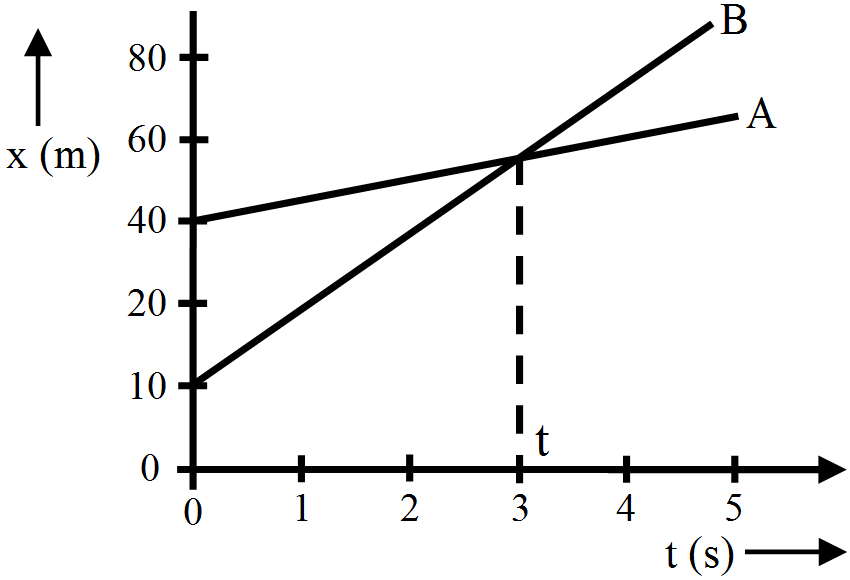
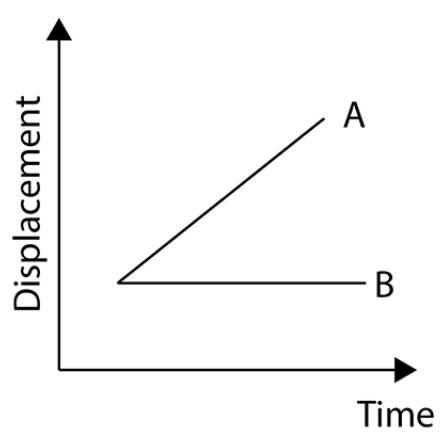
The average velocities of the objects $A$ and $B$ are $V_A$ and $V_B$, respectively. The velocities are related such that $V_A>V_B$. The position$-$time graph for this situation can be represented as:
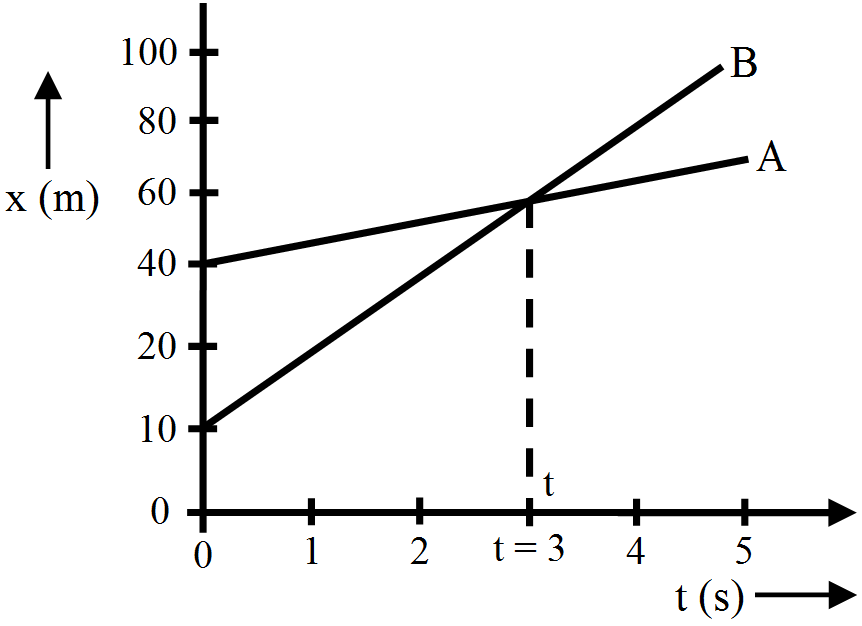
AnswerSince, the velocities of the particles are positive, the slope of the straight line in $(x-t)$ graph must be positive. Since, $V_A>V_B$, the slope of straight line representing $A$ must be greater than the slope of the straight line representing $B$
i.e., graph representing $A$ is more steeper. Even though, $A$ starts with lower value of position coordinate than $B$, it overtakes, $B$ at $t = 3s.$
View full question & answer→MCQ 1071 Mark
A stone is released from an elevator going up with an acceleration a. The acceleration of the stone after the release is:
- A
$a$ upward.
- B
$(g - a)$ upward.
- C
$(g - a)$ downward.
- ✓
$g$ downward.
AnswerCorrect option: D. $g$ downward.
Gravity is the only force acting on the stone when it is released. And, we know that gravity is always in the downward direction.
View full question & answer→MCQ 1081 Mark
A stone falls from a balloon that is descending at a uniform rate of $12m/ s.$ the displacement of the stone from the point of release $10\sec$ is:
- ✓
$490m$
- B
$510m$
- C
$610m$
- D
$725m$
AnswerCorrect option: A. $490m$
View full question & answer→MCQ 1091 Mark
A gun is fired at a target. At the moment of firing, the target is released and allowed to fall freely under gravity. Then the bullet:$($Assume zero air resistance$)$
- A
Misses the target by passing above it
- ✓
- C
Misses the target by passing below it
- D
AnswerInitial vertical component of the velocities $($in downward direction$)$ of both the bullet and the target are zero.
So, the bullet and the target fall down by equal amount and thus the bullet hits the target.
View full question & answer→MCQ 1101 Mark
A ball is thrown from rear end of the compartment of train to the front end which is moving at a constant horizontal velocity. An observer $A$ sitting in compartment and another observer $B$ standing on the ground draw the trajectory. They will have:
- A
Equal horizontal and equal vertical ranges.
- ✓
Equal vertical ranges but different horizontal ranges.
- C
Different vertical ranges but equal horizontal ranges.
- D
Different vertical ranges and different horizontal ranges.
AnswerCorrect option: B. Equal vertical ranges but different horizontal ranges.
In vertical direction, ball has zero initial velocity but same value of $g$ w.r.t observer $A\ \&\ B$,
so they will draw trajectory of equal vertical range But along horizontal direction, for observer $A,$ ball is moving with velocity at which it is thrown w.r.t. train while for $B$, it is moving with a velocity equal to train $+$ velocity at which it is thrown w.r.t groundtrain.
View full question & answer→MCQ 1111 Mark
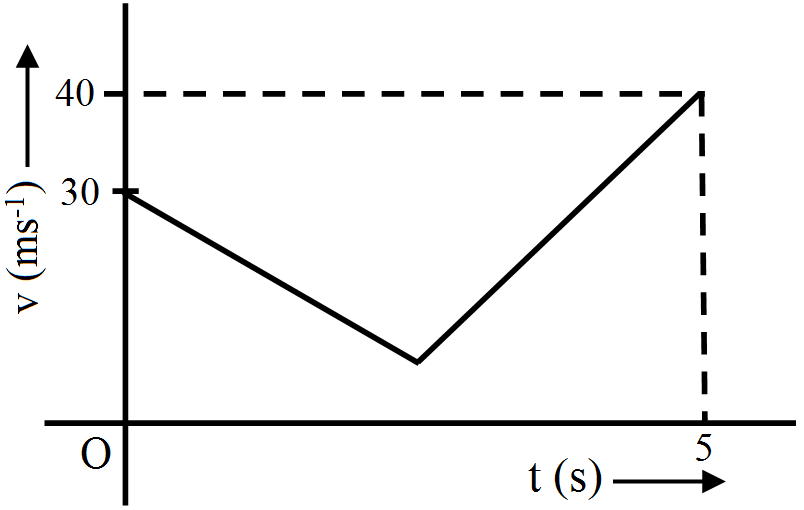
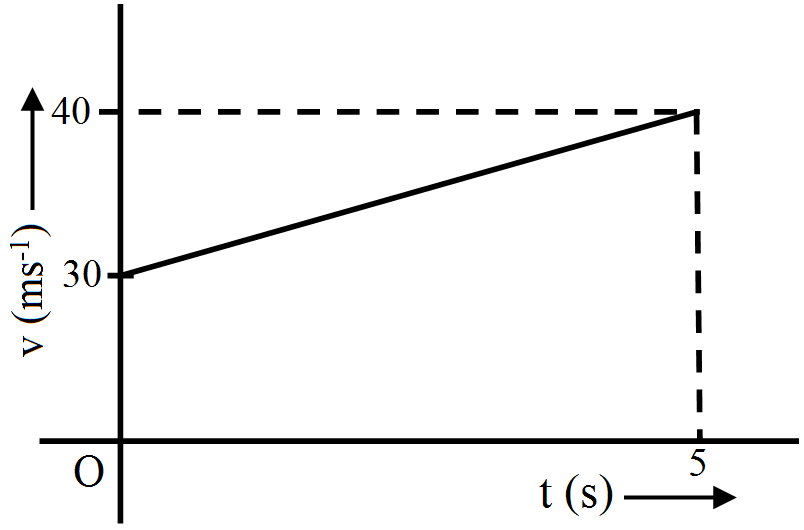
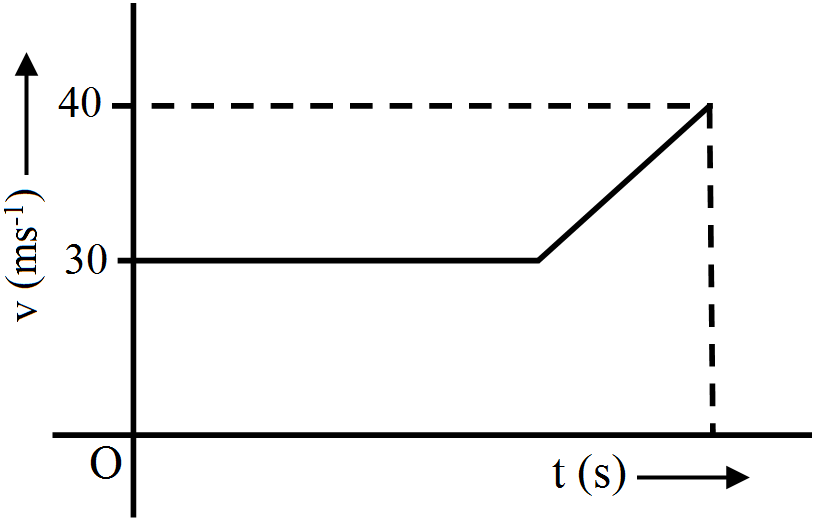
An object is moving with an initial velocity of $30ms^{-1}$ with uniform acceleration. The velocity of object increases to $40ms^{-1}$ in next $5s.$ The $v-t$ graph which least represents this situation is:
View full question & answer→MCQ 1121 Mark
Figure shows the $V−T$ graph for two particles $P$ and $Q$. The relative velocity of $P$ w.r.t. $Q$ is: 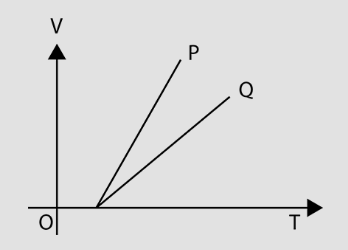
AnswerThe difference in velocities is increasing with time as both of them have more constant but different acceleration.
View full question & answer→MCQ 1131 Mark
Two particle $P$ and $Q$ are initially $40m$ apart $P$ behind $Q$. Particle $P$ starts moving with a uniform velocity $10m/ s$ towards $Q.$ Particle $Q$ starting from rest has an acceleration $2ms^2$ in the direction of velocity of $P.$ Then the minimum distance between $P$ and $Q$ will be: 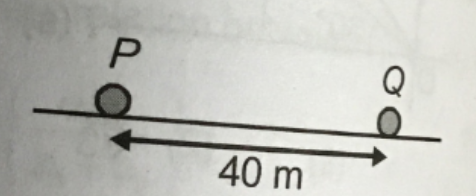
View full question & answer→MCQ 1141 Mark
A vehicle travels half the distance $L$ with speed $V_1$ and the other half with speed $V_2$, then its average speed is:
- A
$\frac{\text{v}_1+\text{v}_2}{2}$
- B
$\frac{2\text{v}_1+\text{v}_2}{\text{v}_1+\text{v}_2}$
- ✓
$\frac{2\text{v}_1\text{v}_2}{\text{v}_1+\text{v}_2}$
- D
$\frac{\text{L}(\text{v}_1+\text{v}_2)}{\text{v}_1\text{v}_2}$
AnswerCorrect option: C. $\frac{2\text{v}_1\text{v}_2}{\text{v}_1+\text{v}_2}$
View full question & answer→MCQ 1151 Mark
If, in the following diagram, distance between each circle is $1$ unit, what is the displacement between $A$ and $B?$ 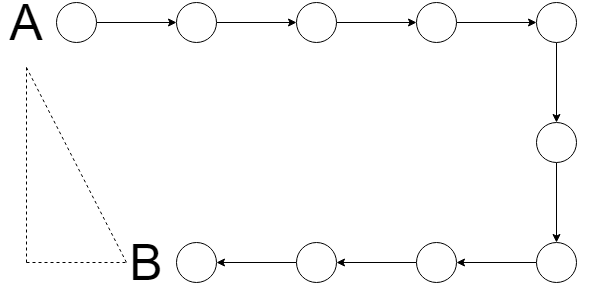
- A
$5$ units
- ✓
Square root $(5)$ units
- C
$2$ units
- D
$1$ unit
AnswerCorrect option: B. Square root $(5)$ units
The vertical distance between $A$ and $B$ is of $2$ units and the horizontal distance is $1$ unit.
Hence, to calculate the displacement, we can make a right$-$angled triangle as shown and can find the distance $(AB)$ by Pythagoras theorem.
Distance $(AB) =$ Square root $(22 + 12) =$ Square root $(5).$
View full question & answer→MCQ 1161 Mark
From a $200m$ high tower, one ball is thrown upwards with speed of $10m/ s$ and another is thrown vertically downwards at the same speed simultaneously. The time difference of their reaching the ground will be nearest to:
AnswerThe ball thrown upward will have zero velocity in $1s.$ It returns back to thrown point in another $1s$ with the same velocity as second.
Thus the difference will be $2s.$
View full question & answer→MCQ 1171 Mark
A particle moving with a uniform acceleration travels $24$ metre and $64$ metre in first two consecutive intervals of $4$ seconds each. Its initial velocity is:
- ✓
$1m/ \sec.$
- B
$2m/ \sec.$
- C
$5m/ \sec.$
- D
$10m/ \sec.$
AnswerCorrect option: A. $1m/ \sec.$
$24=\text{u}\times4+\frac{1}{2}\text{a}\times4^2$
$=4\text{u}+8\text{a}$
$6=\text{u}+2\text{a}$
$(24+64)=\text{u}\times8+\frac{1}{2}\text{a}\times8^2$
$=8\text{u}+32\text{a}$
$11=\text{u}+4\text{a}$
On solving $(i)$ and $(ii),$ we get $u = 1m/s$
View full question & answer→MCQ 1181 Mark
A ship is moving due east with a velocity of $12 m/ \sec.$ A truck is moving across on the ship with a velocity of $4m/\sec.$ A monkey is climbing a vertical pole mounted on the truck, with a velocity of $3m/ \sec.$ Find the velocity of the monkey, as observed by a man on the shore. $(m/ \sec).$
View full question & answer→MCQ 1191 Mark
A stone is released from a hot air balloon which is rising steadily with a velocity of $4ms^{-1}.$ The velocity of the stone at the end of $3s$ after it is released is $......... ms^{-1}$
- A
$29.4$
- ✓
$25.4$
- C
$32.5$
- D
$62.7$
AnswerCorrect option: B. $25.4$
Let the upward direction to be negative.
Initial velocity of stone $u = -4m/s$
Acceleration of the stone $a = g = 9.8m/s^2$
Velocity of stone $v = u + at$
$\therefore v = -4 + 9.8 \times 3 = 25.4m/ s$
View full question & answer→MCQ 1201 Mark
The displacement of a car is given as $- 240m.$ Here, negative sign indicates:
AnswerCorrect option: A. Direction of displacement.
View full question & answer→MCQ 1211 Mark
Which of the following vehicles is undergoing a deacceleration?
- A
A car driving straight to the east on a road at a constant speed.
- B
A truck rounding a corner at a constant speed.
- ✓
A van slowing down as it approaches a stop sign.
- D
AnswerCorrect option: C. A van slowing down as it approaches a stop sign.
A object is said to have an acceleration if it changes its velocity either by increasing its speed, decreasing its speed or changing the direction of its velocity.
Since the car and the truck move with constant speed,
thus they have zero acceleration.
But the van is slowing down its speed,
thus it has deacceleration.
View full question & answer→MCQ 1221 Mark
A hollow iron ball $(A)$ and a solid iron ball $(B)$ and cricket ball $(C)$ are dropped from the same height. Which among the three balls reaches the ground first? Assuming there is no resistance due to air.
- A
$A$
- B
$B$
- C
$C$
- ✓
All the three balls reaches ground simultaneously.
AnswerCorrect option: D. All the three balls reaches ground simultaneously.
Since all the balls have have zero velocity initially and they experience equal acceleration due to gravity and travel equal distance.
Thus all the balls take equal time to reach the ground.
View full question & answer→MCQ 1231 Mark
Three particles start from origin at the same time with a velocity $2ms^{-1}$ along positive $x-$axis the second with a velocity $6ms^{-1}$ aling negative $y -$ axis. Find the velocity of the third particle along $x = y$ line so that the three particles may always lie in a straight line:
- A
$-3\sqrt{3}$
- ✓
$3\sqrt{2}$
- C
$-3\sqrt{2}$
- D
$2\sqrt{2}$
AnswerCorrect option: B. $3\sqrt{2}$
View full question & answer→MCQ 1241 Mark
Which of the following are obtained by dividing total displacement by total time taken?
AnswerThe average velocity is obtained by dividing total displacement by total time taken.
Instantaneous velocity is calculated at an instant and not over a period of time.
Speed is distance divided by time. Velocity is said to be uniform when velocity at every instant is equal to the average velocity.
View full question & answer→MCQ 1251 Mark
A parachutist after bailing out falls $50m$ without friction. When parachute opens, it decelerate at $2m/ s^2.$ He reaches the ground with a speed of $3m/ s.$ At what height, did he bail out nearly.
- ✓
$298m$
- B
$111m$
- C
$91m$
- D
$182m$
AnswerCorrect option: A. $298m$
View full question & answer→MCQ 1261 Mark
A ball is thrown up, it reaches a maximum height and then comes down. If $t_1(t_2 > t_1)$ are the times that the ball takes to be at a particular height then the time taken by the ball to reach the highest point is:
- A
$(\text{t}_1+\text{t}_2)$
- B
$(\text{t}_1-\text{t}_2)$
- C
$\frac{(\text{t}_2-\text{t}_1)}{2}$
- ✓
$\frac{(\text{t}_2+\text{t}_1)}{2}$
AnswerCorrect option: D. $\frac{(\text{t}_2+\text{t}_1)}{2}$
Let $s$ be the height of a particular point where the ball crosses in time $t_1$ and $t_2$ seconds while going upwards and coming downwards.
If $u$ is the initial velocity of projection of ball, then
$\text{s}=\text{ut}_1-\frac{1}{2}\text{gt}^2_1=\text{ut}_2-\frac{1}{2}\text{gt}^2_2$
$\text{u}(\text{t}_2-\text{t}_1)=\frac{1}{2}\text{g}(\text{t}^2_2-\text{t}_1)$
$\text{u}=\frac{1}{2}\text{g}(\text{t}_2+\text{t}_1)$
If $T$ is the time taken by ball to reach to its highest point then using the relation $v = u + at,$ we have $0 = u + (-g)T$
$\text{T}=\frac{\text{u}}{\text{g}}=\frac{1}{2}\frac{\text{g}(\text{t}_2+\text{t}_1)}{\text{g}}$
$=\frac{1}{2}(\text{t}_2+\text{t}_1)$
View full question & answer→MCQ 1271 Mark
A car starts from rest and has an acceleration $a = 1\ m/ s^2.$ A truck is moving with a uniform velocity of $6\ m/ s.$ At what distance will the car overtake the truck? direction $($at $t = 0$ both start their motion in the same direction from the same position$)$
AnswerAt the moment when the car will be overtaking the truck their velocitis will be same.
So suppose after t second from the start of the motion the car overtake the truck then the velocity of the car at that moment will be $v = 0 + at = t \times 1\ m/ s^2= t\ m/ s$ and the velocity of the truck at that moment will be $u = 6\ m/ s($constant$)$ both should be same
i.e $u = v$ or $6 = t$ or $t = 6$ second so the distance covered by truck
i.e car because both will be at same place ast that point of time in this time will be $s = vt = 6 \times 6 = 36$ meter
View full question & answer→MCQ 1281 Mark
A particle is dropped from a tower. It is found that it travels $55m$ in the last second of its journey. Then height of the tower is $(g = 10\ m/s^2g = 10\ m/s^2)?$
- A
$125m$
- ✓
$180m$
- C
$100m$
- D
$55m$
AnswerCorrect option: B. $180m$
View full question & answer→MCQ 1291 Mark
In case of a moving body:
- A
Displacement $ > $ distance.
- B
Displacement $ < $ distance.
- C
Displacement $\geq$ distance.
- ✓
Displacement $\leq$ distance.
AnswerCorrect option: D. Displacement $\leq$ distance.
View full question & answer→MCQ 1301 Mark
A bullet is fired from the cart vertically at the same instant cart begins to accelerate forward. Which of the following best describes the subsequent motion of the bullet?
- A
The bullet goes up and then straight back down into the cart.
- B
The bullet goes up and lands in front of the cart.
- ✓
The bullet goes up and lands behind the cart.
- D
The bullet stops in the air as the cart is accelerating and "floats" until the cart stops accelerating.
AnswerCorrect option: C. The bullet goes up and lands behind the cart.
As the bullet is fired vertically upwards, thus the bullet does not have velocity in horizontal forward direction and hence it has zero horizontal displacement.
Also the cart has acceleration in forward direction, thus the cart has finite displacement in forward direction.
Hence the bullet goes up and lands behind the cart.
View full question & answer→MCQ 1311 Mark
A lift is coming from $8^{th}$ floor and is just about to reach $4^{th}$ floor. Taking ground floor as origin and positive direction upwards for all quantities, which one of the following is correct?
- ✓
$x < 0, v < 0, a > 0.$
- B
$x > 0, v < 0, a < 0.$
- C
$x > 0, v < 0, a > 0.$
- D
$x > 0, v > 0, a < 0.$
AnswerCorrect option: A. $x < 0, v < 0, a > 0.$
Key concept: The time rate of change of velocity of an object is called acceleration of the object.
It is a vector quantity. Its direction is same as that of change in velocity $($Not of the velocity$).$
In the table: Possible ways of velocity change.
|
When only direction of velocity changes.
|
When only magnitude of velocity changes.
|
When both magnitude and direction of velocity change.
|
|
Acceleration perpendicular to velocity.
|
Acceleration parallel or antiparallel to velocity.
|
Acceleration has two components-one is perpendicular to velocity and another parallel or antiparallel to velocity.
|
|
E.g.: Uniform circular motion
|
E.g.: Motion under gravity.
|
E.g.: Projectile motion.
|
Here we will take upward direction positive. As. the lift is coming in downward direction, the displacement will be negative. We have to see whether the motion is accelerating or retarding.
We know that due to downward motion displacement will be negative. When the lift reaches $4^{th}$ floor and is about to stop velocity is decreasing with time, hence motion is retarding in nature.
Thus, $x < 0; a > 0.$
As displacementisinnegativedirection, velocity will also be negative, i.e. $v < 0.$
The motion of lift will be shown like this.
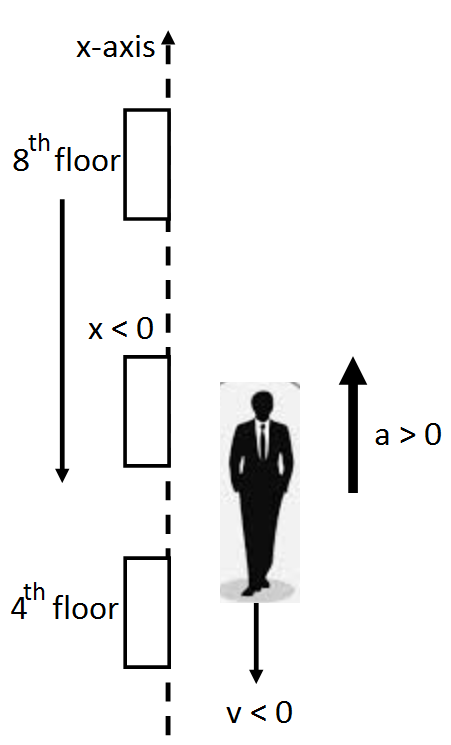
View full question & answer→MCQ 1321 Mark
A balloon starts rising from the ground with an acceleration of $1.25\ m/s^2.$ After $8$ seconds, a stone is released from the balloon. The stone will $($use $g = 10\ m/s^2):$
- A
Cover a distance of $40m.$
- B
Have displacement of $50m.$
- ✓
Reach the ground in $4$ second.
- D
Begin to move downward after being released.
AnswerCorrect option: C. Reach the ground in $4$ second.
Taking upward motion of balloon for $8$ seconds; we have
$u = 0; a = 1.25\ m/s^2; t = 8 s; v = ?; s = ?.$
Here $v = u + at = 0 + 1.25 \times 8 = 10\ m/s$
$\text{s}=\text{ut}+\frac{1}{2}\text{at}^2$
$=0+\frac{1}{2}\times1.25\times8^2=40\text{m}$
Taking downward motion of released stone from balloon at height $40m$ we have,
$a = -10\ m/s; a = 10\ m/s^2; s = 40m; t = ?$
As, $\text{s}=\text{ut}+\frac{1}{2}\text{at}^2$
so, $40=-10\text{t}+\frac{1}{2}\times10\times\text{t}^2$
or $t^2 - 2t - 8 = 0$ On solving $t = 4s.$
View full question & answer→MCQ 1331 Mark
A person travelling on a straight line moves with a uniform velocity $v_1$ for a distance $x$ and with a uniform velocity $v-2$ for the next equal distance. The average velocity $v$ is given by:
- A
$\text{v}=\frac{\text{v}_1+\text{v}_2}{2}$
- B
$\text{v}=\sqrt{\text{v}_1\text{v}_2}$
- ✓
$\frac{2}{\text{v}}=\frac{1}{\text{v}_1}+\frac{1}{\text{v}_2}$
- D
$\frac{1}{\text{v}}=\frac{1}{\text{v}_1}+\frac{1}{\text{v}_2}$
AnswerCorrect option: C. $\frac{2}{\text{v}}=\frac{1}{\text{v}_1}+\frac{1}{\text{v}_2}$
Velocity is uniform in both cases; that is, acceleration is zero.
$\text{x = v}_1\text{t}_1$
$\Rightarrow\text{t}_1=\frac{\text{x}}{\text{v}_1}$
$\text{x = v}_2\text{t}_2$
$\Rightarrow\text{t}_2=\frac{\text{x}}{\text{v}_2}$
Total displacement, $\text{x}'=\text{2x}$
Total time, $\text{t}=\text{t}_1+\text{t}_2$
$\therefore$ Average velocity, $\text{v}=\frac{\text{x}'}{\text{t}}=\frac{2\text{v}_1\text{v}_2}{\text{v}_1+\text{v}_2}$
$\Rightarrow\frac{2}{\text{v}}=\frac{1}{\text{v}_1}+\frac{1}{\text{v}_2}$
View full question & answer→MCQ 1341 Mark
What happens to the average velocity when a body falls under gravity with terminal velocity?
AnswerWhen the body is moving with terminal velocity, the velocity does not change. It means that equal displacement is being covered in equal time intervals. Hence the average velocity remains constant.
View full question & answer→MCQ 1351 Mark
The sign (+ve or -ve) of the average velocity depends only upon:
- ✓
The sign of displacement.
- B
The initial position of the object.
- C
The final position of the object.
- D
AnswerCorrect option: A. The sign of displacement.
Explanation:
Since, average velocity, $\text{v}=\frac{\Delta \text{x}}{\Delta \text{t}}=\frac{\text{Displacement}}{\text{Time interval}}$
Thus, average velocity depends on the displacement and hence it depends on the sign of the displacement.
View full question & answer→MCQ 1361 Mark
A stone is thrown with an initial speed of $4.9\ m/s$ from a bridge in vertically upward direction. It falls down in water after $2$ seconds. The height of the bridge is:
- A
$4.9m$
- ✓
$9.8m$
- C
$19.8m$
- D
$24.7m$
AnswerCorrect option: B. $9.8m$
Talking vertical downward motion of stone, we have
$u = -4.9\ m/s, a = 9.8\ m/s^2, t = 2s. s = ?$
Now, $\text{s}=\text{t=ut}+\frac{1}{2}\text{at}^2$
$=-4.9\times2+\frac{1}{2}\times9.8\times2^2$
$=9.8\text{m}$
View full question & answer→MCQ 1371 Mark
According to the following graph, what happens to the distance covered by the body from $0 -10$ minutes?
- ✓
- B
- C
It first increases and then decreases
- D
It first decreases and then increases
AnswerWe know that distance traveled by an object is the area under it speed time graph.
Now, in this case, as the area under the speed$-$time graph is increasing from $0 - 10$ minutes.
So, the distance will keep on increasing from $0 - 10$ minutes.
View full question & answer→MCQ 1381 Mark
The displacement of a particle is given by $x = (t - 2)^2$ where $x$ is in metres and $t$ in seconds. The distance covered by the particle in first $4$ seconds is:
- A
$4m.$
- ✓
$8m.$
- C
$12m.$
- D
$16m.$
AnswerKey concept: Instantaneous velocity : Instantaneous velocity is defined as the rate of change of position vector of particles with time at a certain instant of time.
Instantaneous velocity $\vec{\text{v}}=\DeclareMathOperator*{\median}{\text{lim}} \median\limits_{\Delta\text{t}\rightarrow0}\frac{\Delta\vec{\text{r}}}{\Delta\text{t}}=\frac{\text{d}\vec{\text{r}}}{\text{dt}}$
Instantaneous acceleration $=\vec{\text{a}}=\DeclareMathOperator*{\median}{\text{lim}} \median\limits_{\Delta\text{t}\rightarrow0}\frac{\Delta\vec{\text{v}}}{\Delta\text{t}}=\frac{\text{d}\vec{\text{v}}}{\text{dt}}$
By definition $\vec{\text{a}}=\frac{\text{d}\vec{\text{v}}}{\text{dt}}=\frac{\text{d}^2\vec{\text{x}}}{\text{dt}^2}\Big[\text{As}\ \vec{\text{v}}=\frac{\text{d}\vec{\text{x}}}{\text{dt}}\Big]$
i.e., if $x$ is given as a function of time, second time derivative of displacement gives acceleration.
In such type of problems we have to analyze whether the motion is accelerating or retarding. When acceleration is parallel to velocity, velocity of particle increases with time, i.e. motion is accelerated. And when acceleration is anti$-$parallel to velocity, velocity of particle decreases with time, i.e. motion is retarded. During retarding journey, particle will stop in between.
According to the problem, displacement of the particle is given as a function of time.
$\text{x}=(\text{t}-2)^2$
By differentiating this equation w.r.t. time we get velocity of the particle as a function of time.
$\text{v}=\frac{\text{dx}}{\text{dt}}=\frac{\text{d}}{\text{dt}}(\text{t}-2)^2=2(\text{t}-2)\text{m/s}$
If we again differentiate this equation w.r.t. time we will get acceleration of the particle as a function of time.
Acceleration, $\text{a}=\frac{\text{dv}}{\text{dt}}=\frac{\text{d}}{\text{dt}}[2(\text{t}-2)]$
$=2[1-0]=2\text{m/s}^2$
When $\text{t}=0;\ \ \text{v}=-4\text{m/s}$
$\text{t}=2\text{s};\ \ \text{v}=0\text{m/s}$
$\text{t}=4\text{s};\ \ \ \text{v}=4\text{m/s}$
That means particle starts moving towards negative axis, then $at = 0,$ with a speed $4\ m/s,$ at $t = 2$ it stops and start coming backward.
At $t = 4$ its speed is $+4\ m/s.$
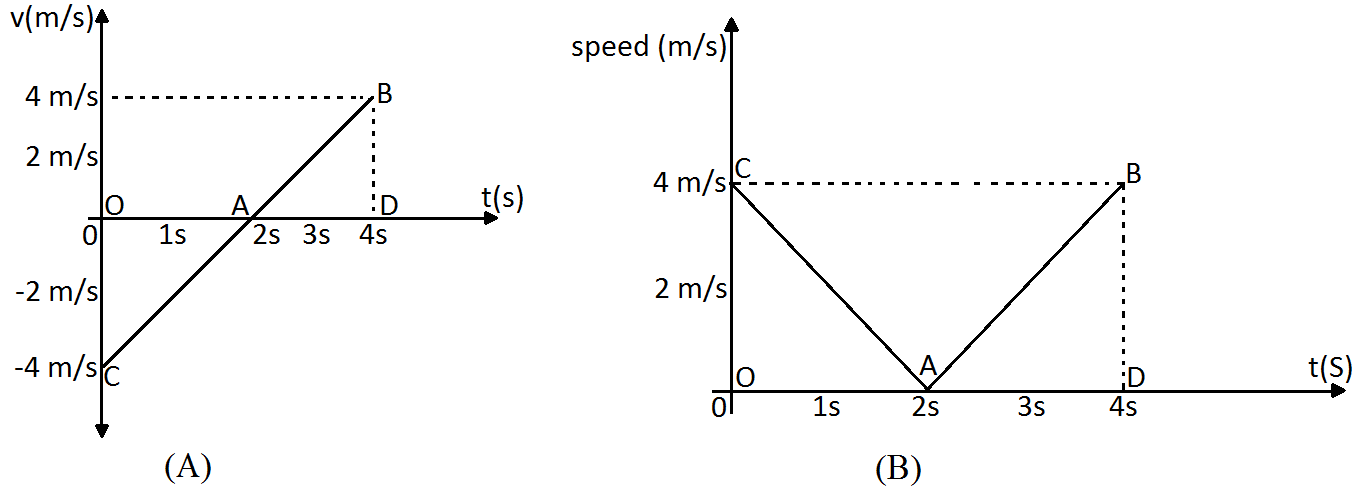
$v - t$ graph is shown in graph $(a)$ and speed$-$time graph of the same situation is shown in graph $(b).$
Distance travelled $=$ Area of the speed$-$time graph
$=$ area $\text{OAC} +$ area $\text{ABD}$
$=\frac{4\times2}{2}+\frac{1}{2}\times2\times4$
$=8\text{m}$ View full question & answer→MCQ 1391 Mark
When a body is in the state of complete rest, what kind of energy does it possess?
AnswerWhen the body is in the state of rest, there is no motion.
Hence there is no kinetic energy, hence the total energy of the body is stored as its potential energy.
The total energy is the sum of kinetic and potential energies.
View full question & answer→MCQ 1401 Mark
A particle is found to be at rest when seen from a frame $S_1$ and moving with a constant velocity when seen from another frame $S_2.$ Mark out the possible options.
AnswerCorrect option: A. Both the frames are inertal.
View full question & answer→MCQ 1411 Mark
An airplane must reach a take of speed of $80\ m/ s$ in a $1000m$ long runway. What minimum constant acceleration is required$? ($in $m/ s^2):$
AnswerHere, initial velocity is $u = 0\ m/ s ($as airplane starts from rest$)$
Final velocity is $v = 80\ m/ s$ and distance traveled, $S = 1000m.$
Let a be the required acceleration.
Using formula $v^2 − u^2 = 2aS,$
$(80)^2 − 0^2= 2a(1000)$
So, we get $a = 3.2\ m/ s^2$
View full question & answer→MCQ 1421 Mark
A ball falls from a building and covers $5m$ in $10s.$ What is the acceleration?
- ✓
$0.1\ m/ s^2$
- B
$0.2\ m/ s^2$
- C
$9.81\ m/ s^2$
- D
$10\ m/ s^2$
AnswerCorrect option: A. $0.1\ m/ s^2$
Assuming the ball falls with zero initial velocity, then according to the second equation of motion, $\text{s}=\text{ut}+\big(\frac{1}{2}\big)\text{at}^2=\big(\frac{1}{2}\big)\text{at}^{2}.$
When we put $t = 10s,$ we get $a = 0.1\ m/ s^2$.
View full question & answer→MCQ 1431 Mark
A car is moving around a tree in a circular path. What can be said about the average velocity?
AnswerExplanation:
Take any point on the circular path. The car moves in a circle and hence will come back to the same point after a definite time interval.
Therefore, the displacement is 0. Hence, the average velocity is zero.
View full question & answer→MCQ 1441 Mark
Which of the following statements is incorrect?
AnswerCorrect option: C. The kinematic equations for uniform acceleration can be applied in case of uniform circular motion.
The kinematic equations for uniform acceleration do not apply in case of uniform circular motion because in this case the magnitude of acceleration is constant but its direction is changing.
View full question & answer→MCQ 1451 Mark
The velocity $-$ time graph below represents the velocity of a toy train as it moves north and south with velocity near the middle of the vertical axis. During which, Interval$(s)$ is the toy train speeding up?
AnswerCorrect option: B. $0$ to $A$ and $D$ to $E$
The toy train will speed up if the rate of change of velocity will increases with respect to time.
Therefore, the train will speed up in the intervals $0$ to $A$ and $D$ to $E.$
View full question & answer→MCQ 1461 Mark
Rana moves with uniform velocity on a bike. He throws a stone in air, the stone falls:
MCQ 1471 Mark
The graph predicts the condition of:
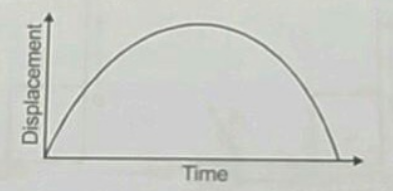
- A
Body is undergoing positive acceleration.
- ✓
Body is undergoing negative acceleration.
- C
- D
AnswerCorrect option: B. Body is undergoing negative acceleration.
View full question & answer→MCQ 1481 Mark
A stone is thrown vertically up from a bridge with velocity $3\ ms^{-1}$ if it strikes the water under the bridge after $2s,$ the bridge is at a height of $(g = 10\ m/s^2)$
View full question & answer→MCQ 1491 Mark
A ball is thrown up in the sky, at what position will the instantaneous speed be minimum?
- A
- B
- ✓
Halfway through the whole trajectory
- D
After covering one fourth of the whole trajectory
AnswerCorrect option: C. Halfway through the whole trajectory
When the ball rises up, there will be a point where it will be in the state of instantaneous rest.
At the this position the speed of the ball will be $0.$
Speed is maximum at the initial and final points.
View full question & answer→MCQ 1501 Mark
Which one of the following represents the displacement time graph of two objects $A$ and $B$ moving with zero relative speed?
AnswerIf relative speed $= 0$ then velocity of $A =$ velocity of $B.$
So displacement time graphs of $A$ and $B$ must have same slope $($other than zero$).$
View full question & answer→MCQ 1511 Mark
A body falling from a high Minaret travels $40m$ in the last $2$ seconds of its fall to ground. Height of Minaret in metres is: $($take $g = 10\ m/ s^2)$
AnswerTaking the height of minaret is $H$ and time taken by body to fall from top to bottom be $T.$
$\therefore\text{H}=\big(\frac{1}{2}\big)\text{g}\text{T}^2.....(1)$
In last two second body travels a distance of $40m,$
hence ein $(T - 2)\sec$ body will travel $(H - 40)m.$
$(\text{H}-40)=\big(\frac{1}{2}\big)\text{g}(\text{T}-2)^2.....(2)$
$\therefore$ solving $(1)$ and $(2),$
$T = 3\sec, H = 45m$
View full question & answer→MCQ 1521 Mark
A particle has a velocity $u$ towards east at $t = 0.$ Its acceleration is towards west and is constant. Let $x_A$ and $x_B$ be the magnitude of displacements in the first $10$ seconds and the next $10$ seconds:
AnswerCorrect option: D. The information is insufficient to decide the relation of $x_A$ with $x_B$.
As velocity and acceleration are in opposite directions, velocity will become zero after some time $(t)$ and the particle will return.
$\therefore0=\text{u}-\text{at}$
$\Rightarrow\text{t}=\frac{\text{u}}{\text{a}}$
Because the value of acceleration is not given, we cannot say that the particle will return after/ before $10$ seconds.
View full question & answer→MCQ 1531 Mark
Which of the following best define the acceleration of a particle:
- ✓
The rate of change of velocity.
- B
Only experienced during a change of direction.
- C
Only experienced during a change of speed.
- D
Calculated by multiplying speed by velocity.
AnswerCorrect option: A. The rate of change of velocity.
Acceleration is defined as the rate of change of velocity.
acceleration $a =\frac{\text{change in velocity}}{\text{time interval}}$
Hence, any change in the speed or direction would cause a change in velocity, and hence will produce acceleration.
View full question & answer→MCQ 1541 Mark
If the velocity of a particle is $v = At + Bt^2,$ where $A$ and $B$ are constants, then the distance travelled by it in $1s$ is:
- A
$3\text{A}+7\text{B}$
- B
$\frac{3}{2}\text{A}+\frac{7}{3}\text{B}$
- ✓
$\frac{\text{A}}{2}+\frac{\text{B}}{3}$
- D
$\frac{3}{2}\text{A}+4\text{B}$
AnswerCorrect option: C. $\frac{\text{A}}{2}+\frac{\text{B}}{3}$
View full question & answer→MCQ 1551 Mark
Average speed of a car between points $A$ and $B$ is $20\ m/s$, between $B$ and $C$ is $15\ m/s,$ between $C$ and $D$ is $10\ m/s$. What is the average speed between $A$ and $D$, if the time taken in the mentioned sections is $20s, 10s$ and $5s$ respectively?
- ✓
$17.14\ m/s$
- B
$15\ m/s$
- C
$10\ m/s$
- D
$45\ m/s$
AnswerCorrect option: A. $17.14\ m/s$
Average speed is the total distance divided by total time taken.
Total displacement $(d = vt) = 20 \times 20 + 15 \times 10 + 10 \times 5 = 600m.$
Total time $= 20 + 10 + 5 = 35s$.
Therefore, average speed $=\frac{600}{35}=17.14\text{m}/\ \text{s}.$
View full question & answer→MCQ 1561 Mark
The gradient of velocity $v/s$ time graph is equal to $...........$
AnswerThe gradient or slope of any graph tells us the value of its differential at that point.
Since acceleration is the differential of velocity with respect to time, the gradient is equal to the acceleration.
View full question & answer→MCQ 1571 Mark
If the time of acceleration is $t_1$, then the speed of the car at $t = t_1$ is:
- ✓
$2t_1$
- B
$t_1$
- C
$> 2t_1$
- D
$< 2t_1$
AnswerCorrect option: A. $2t_1$
View full question & answer→MCQ 1581 Mark
A man throws balls with the same speed vertically upwards one after the other at an interval of $2$ second. What should be the speed of the throw so that more than two balls are in sky at any time? $($Given $g = 9.8\ m/ s^2)$
AnswerCorrect option: D. Only with speed $19.6\ m/ s.$
View full question & answer→MCQ 1591 Mark
A body $X$ is projected upwards with a velocity of $98\ ms^{-1}$, after $4s,$ a second body $Y$ is also projected upwards with the same $Y$ is also projected upwards with the same initial velocity. Two bodies will meet after:
AnswerLet $t$ second be the time of flight of the first body after meeting,
then $(t − 4)$ second will be the time of flight of the second body.
Since, $h_1 = h_2$
$\therefore98\text{t}-\frac{1}{2}\text{gt}^2=98(\text{t}-4)\text{g}(\text{t}-4)^2$
On solving, $t = 12s.$
View full question & answer→MCQ 1601 Mark
Consider the motion of the tip of the minute hand of a clock. In one hour:
- A
The displacement is zero.
- B
The average velocity is zero.
- C
The average speed is zero.
- ✓
$A$ and $B$
AnswerCorrect option: D. $A$ and $B$
Displacement is zero because the initial and final positions are the same.
$\text{Average velocity}=\frac{\text{Displacement}}{\text{Total time}} =0$
$\text{Distance covered}=2\pi\text{r}\neq0$
$\text{Average speed}=\frac{\text{Distance travelled}}{\text{Total time taken}}\neq0$
View full question & answer→MCQ 1611 Mark
$A$ and $B$ start walking towards each other from the opposite ends of a $15\ km$ long straight road, at a speed of $5\ km/ hr$ and $7\ km/ hr$ respectively. How far apart will they be after one hour?
- A
$2\ km$
- ✓
$3\ km$
- C
$5\ km$
- D
$7\ km$
AnswerCorrect option: B. $3\ km$
$x_A = v_At = 5 \times 1 = 5\ km$
$x_B = v_Bt = 7 \times 1 = 7\ km$
Total distance covered $= 12\ km$
Distance between $A$ and $B$ at time $t = 1h$
$15 − 12 = 3\ km$
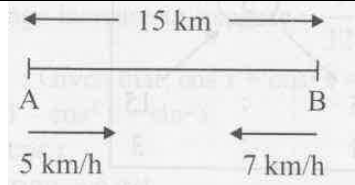
View full question & answer→MCQ 1621 Mark
Area under velocity time graph represents:
MCQ 1631 Mark
The driver of an express train suddenly sees the red light signal $50m$ ahead and applies the brakes. If the average deceleration during braking is $10.0\ ms^{-2}$ and the reaction time of the driver is $0.75\sec$, the minimum speed at which the train should be moving so as not to cross the red signal is:
- A
$27\ km/ hr$
- ✓
$144\ km/ hr$
- C
$72\ km/ hr$
- D
$83\ km/ hr$
AnswerCorrect option: B. $144\ km/ hr$
Let, Displacement of Train in $0.75\sec$ will be
$S_1 = ut = 0.75u m$
where, $u -$ initial velocity of train.
$v^2 = u^2 + 2aS$
$v = 0\ ms^{−1,} S = 50 − S_1$
$u^2− 2 \times 10 \times (50 − 0.75u) = 0$
solving for $u$ we get
$u = 144\ km/ hr$
View full question & answer→MCQ 1641 Mark
A man throws ball into the air one after the other. Throwing one when other is at the highest point. How high the balls rise if he throws twice a second?
- A
$2.45m$
- ✓
$1.225m$
- C
$19.6m$
- D
$4.9m$
AnswerCorrect option: B. $1.225m$
The time taken by each ball to go from starting point to highest point, $\text{t}=\frac{1}{2}\text{sec},$
which is equal to time taken by each ball to fall back to starting point $\Big(=\frac{1}{2}\text{sec}\Big).$
$\therefore \text{s}\times9.8\times\Big(\frac{1}{2}\Big)^2$
$=\frac{9.8}{8}\text{m}$
$=1.225\text{m}$
View full question & answer→MCQ 1651 Mark
The object is released from rest under gravity at $y = 0$. The equation of motion which correctly expresses the above situation is:
- A
$\text{v} = -9.8\text{t ms}^{-1}$
- B
$\text{v} = (9.8 - 9.8\text{t)m/s}$
- ✓
$\text{v}^2 = -19.6\text{y}^2 \text{m}^2\text{s}^{-2}$
- D
$\text{v}^2=(\text{v}^2_0+29.6\text{y})\text{m}^2/\text{s}^2$
AnswerCorrect option: C. $\text{v}^2 = -19.6\text{y}^2 \text{m}^2\text{s}^{-2}$
For free fall, $v_0 = 0, a = -g = -9.8\ ms^{-1}$
The equations of motion are
$v = -9.8t\ ms^{-1} ($using $v = v_0 + at)$
$v^2 = 2(-9.8)y ($using $\text{v}^2=\text{v}^2_0+2\text{ay})$
$= -19.6y\ m^2s^{-2}$
View full question & answer→MCQ 1661 Mark
A ball is thrown upwards with a velocity of $25\ m/s.$ What is the time taken by the ball to return to the thrower $(g = 10\ m/s^2)$
- ✓
$5\sec$
- B
$2.5\sec$
- C
$3\sec$
- D
$4.2\sec$
AnswerCorrect option: A. $5\sec$
Initial velocity of the ball final velocity $= 0\ m/ s$
acceleration due to gravity $(g) = −10\ m/ s^2 ($upward motion$)$
By using the formula,
$v = u + at$
$O = 25 + (−10) \times t$
$10t = 25$
$t = 2.5\sec.$
The time taken for upward journey is equal to the time taken for downward journey.
Therefore, total time taken by the ball $= 2.5 + 2.5 = 5\sec$.
View full question & answer→MCQ 1671 Mark
An object starts from rest and moves with uniform acceleration $a.$ The final velocity of the particle in terms of the distance $x$ covered by it is given as:
AnswerCorrect option: A. $\sqrt{2\text{ax}}$
View full question & answer→MCQ 1681 Mark
The velocity of a particle is zero at $t = 0$.
$A.$ The acceleration at $t = 0$ must be zero.
$B.$ The acceleration at $t = 0$ may be zero.
$C.$ If the acceleration is zero from $t = 0$ to $t = 10s,$ the speed is also zero in this interval.
$D.$ If the speed is zero from $t = 0$ to $t = 10s$ the acceleration is also zero in this interval.
- A
$A$ and $B$
- B
$B$ and $C$
- ✓
$B, C$ and $D$
- D
AnswerCorrect option: C. $B, C$ and $D$
- Acceleration will be zero only when the change in velocity is zero.
- Since the acceleration is zero from $t= 0s$ to $t = 10s,$ change in velocity is $0.$
Velocity in this interval $=$ Initial velocity $= 0$
Also,
Speed in this interval $=$ Initial speed $= 0$
- From $t = 0s$ to $t = 10s$, speed is zero.
Here, velocity is zero and initial velocity is zero.
So, the change in velocity is zero;
i.e., acceleration is zero. View full question & answer→MCQ 1691 Mark
A body freely falling from the rest has a velocity $v$ after his falls through a height $h.$ The distance, it has to fall down further for its velocity to become double, is:
AnswerHint: Apply third equation of motion.
Explanation:
Step 1 - Use third equation of motion
If a body falls freely so its initial velocity is $u = 0$
Acceleration is $a = −g$ and displacement $s = −h$
After travelling distance $h$ velocity becomes $v.$
So $v^2 = u^2 + 2as$
$\Rightarrow v^2 = 0 + 2(−g)(−h) = 2gh.......(1)$
Step 2 - Calculate distance when velocity becomes double
After travelling distance $h_1$,velocity becomes double
i.e.$2v.$
Again apply third equation of motion
$(2v)^2 = v^2 + 2(−g)(−h1)$
$\Rightarrow 4v^2 = v^2 + 2gh_1.......(2)$
Step 3 - Solve above equations to obtain answer
Put value from equation $(1)$
$4(2gh) = (2gh) + 2gh_1$
$\Rightarrow 2gh_1 = 6gh$
$\Rightarrow h_1 = 3h$
View full question & answer→MCQ 1701 Mark
A car is travelling in the north direction. To stop, it produces a deceleration of $60\ m/ s^2$. Which of the following is a correct representation for the deceleration?
- A
$60\ m/ s^2$ Northwards
- ✓
$60\ m/ s^2$ Southwards
- C
$60\ m/ s^2$ Eastwards
- D
$60\ m/ s^2$ Westwards
AnswerCorrect option: B. $60\ m/ s^2$ Southwards
Deceleration always acts in the direction opposite to the direction of motion.
Magnitude of deceleration is $60\ m/ s^2$ and it acts in the direction opposite to North.
Hence the answer is $60\ m/ s^2$ Southwards.
View full question & answer→MCQ 1711 Mark
How many variables are required to define the position of a body in space?
AnswerIn space we require a minimum of $3$ variables to describe the position of a body, namely $x, y,$ and $z ($in Cartesian system$)$. There are also systems other than Cartesian Coordinate system to do this like Cylindrical system, Spherical or Radial system.
View full question & answer→MCQ 1721 Mark
The trajectory of an object is defined as $x = (t - 4)^2$, what is the velocity at $t = 5?$
AnswerThe function for velocity can be derived by differentiating the equation with respect to $t.$
$v = 2(t - 4)$ is the required function.
When $t = 5, v = 2(5 - 4) = 2.$
View full question & answer→MCQ 1731 Mark
Which of the following is the correct formula for finding distance $(d)$ between two points $(x_1,y_1)$ and $(x_2, y_2)$?
- A
$d^2=(x_2-x_1)^2+(y_2-y_1)^2$
- B
$d^4 = (x_2 - x_1)^2 + (y_2 - y_1)^2$
- ✓
$d^3 = (x_2 - x_1)^2 + (y_2 - y_1)^2$
- D
$d = (x_2 - x_1)^2 + (y_2 - y_1)^2$
AnswerCorrect option: C. $d^3 = (x_2 - x_1)^2 + (y_2 - y_1)^2$
The correct answer is $d_2 = (x_2 - x_1)^2 + (y_2 - y_1)^2$.
This expression can be found out using Pythagoras theorem in Cartesian coordinate system.
Build a right$-$angle triangle with sides parallel to the axes and the hypotenuse joining the two points to construct the right$-$angle triangle.
View full question & answer→MCQ 1741 Mark
An object starts $5m$ from origin and moves with an initial velocity of $5\ ms^{-1}$ and has an acceleration of $2\ ms^{-2}$. After $10\sec,$ the object is how far from the origin?
- A
$150m$
- B
$145m$
- ✓
$155m$
- D
$55m$
AnswerCorrect option: C. $155m$
Displacement in $10$ seconds is $\text{ut}+\frac{\text{at}^2}{2}$
$=5\times10+2\times\frac{10^2}{2}$
$=150\ \text{meter}$
Final position is initial position $+$ displacement $5 + 150 = 155$ meter
View full question & answer→MCQ 1751 Mark
Wind is blowing west to east along two parallel tracks. Two trains moving with same speed in opposite directions have the steam track of one double then other. The speed of each train is:
- A
- B
- ✓
Three times that of wind.
- D
AnswerCorrect option: C. Three times that of wind.
Let $u$ and $v$ be the speed of train and wind respectively.
The speed of steam track of train moving in the direction of wind $= u - v.$
The speed of steam track of train moving in the opposite direction of wind $= u + v$
As per question, $(u + v) = 2(u - v)$
$u = 3v$
View full question & answer→MCQ 1761 Mark
A stone is dropped into the water from a bridge $44.1m$ above the water. another stone is thrown vertically downward $1$second later. both strike the water simultaneously. then initial speed of the second stone is: 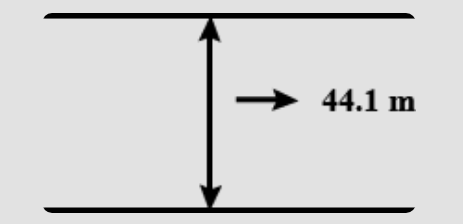
- A
$24.5\ ms^{-1}$
- B
$4.9\ ms^{-1}$
- C
$9.8\ ms^{-1}$
- ✓
$12.25\ ms^{-1}$
AnswerCorrect option: D. $12.25\ ms^{-1}$
View full question & answer→MCQ 1771 Mark
The expression for displacement is $x = \sin(5t).$ The expression for acceleration is $...........$
- ✓
$5\sin(5t)$
- B
$25\cos(5t)$
- C
$-25\sin(5t)$
- D
$-5\cos t(5t)$
AnswerCorrect option: A. $5\sin(5t)$
Acceleration $=\frac{\text{dv}}{\text{dt}}=\frac{\text{d}^2\text{x}}{\text{dt}^2}.$
The velocity $(v)$ can be expressed as, $\text{v}=\frac{\text{dx}}{\text{dt}}=5\cos(5\text{t}).$
Hence acceleration $(a)$ becomes, $\text{a}=\frac{\text{dv}}{\text{dt}}= -25\sin(5\text{t}).$
View full question & answer→MCQ 1781 Mark
A body is moving with velocity $1\ m/ s$ at a height $3m$ from the ground. What will be its speed at height $2m$ from the ground?
- ✓
$4.54\ m/ s$
- B
$1\ m/ s$
- C
$6\ m/ s$
- D
$5.32\ m/ s$
AnswerCorrect option: A. $4.54\ m/ s$
View full question & answer→MCQ 1791 Mark
A particle moves along a straight line as $s = u(t - 2) + a(t - 2)^2$
- A
The acceleration of the particle is $'a\ '.$
- B
The initial velocity of the particle is $'v\ '.$
- C
At $t = 2s,$ the particle is at rest.
- ✓
The acceleration of the particle is $'2a\ '.$
AnswerCorrect option: D. The acceleration of the particle is $'2a\ '.$
View full question & answer→MCQ 1801 Mark
For a stationary object at $x = 40m,$ the position$-$time graph is:
View full question & answer→MCQ 1811 Mark
The accelerated motion of a body changes due to change in:
AnswerThe accelerated motion of a body changes due to a change in speed, direction of motion, velocity.
As acceleration posses magnitude and direction. Its magnitude changes by a change in speed, velocity, and direction can be changed by the direction of motion and velocity.
View full question & answer→MCQ 1821 Mark
The slope of the straight line connecting the points corresponding to $(v_2, t_2)$ and $(v_1, t_1)$ on a plot of velocity versus time gives:
View full question & answer→MCQ 1831 Mark
The displacement of a particle is given as function of time as $x = t^2+ 2t.$ How much displacement is covered in the first $5$ seconds?
- A
$5$ units
- ✓
$35$ units
- C
$40$ units
- D
$0$ units
AnswerCorrect option: B. $35$ units
The displacement covered in the first five seconds can be obtained by putting $t = 5$ in the equation.
Therefore, $x = 55 + 2(5) = 25 + 10 = 35.$
Hence the answer is $35$ units.
View full question & answer→MCQ 1841 Mark
At a metro station, a girl walks up a stationary escalator in time $t_1$. If she remains stationary on the escalator, then the escalator take her up in time $t_2$. The time taken by her to walk up on the moving escalator will be:
- A
$\frac{(\text{t}_1+\text{t}_2)}{2}.$
- B
$\frac{\text{t}_1\text{t}_2}{(\text{t}_2-\text{t})}.$
- ✓
$\frac{\text{t}_1\text{t}_2}{(\text{t}_2+\text{t}_1)}.$
- D
$\text{t}_1-\text{t}_2.$
AnswerCorrect option: C. $\frac{\text{t}_1\text{t}_2}{(\text{t}_2+\text{t}_1)}.$
Let $L$ be the length of the escalator.
Velocity of girl w.r.t. ground $\text{v}_\text{g}=\frac{\text{L}}{\text{t}_1}$
Velocity of escalator w.r.t. ground $\text{v}_\text{e}=\frac{\text{L}}{\text{t}_2}$
Effective Velocity of girl on moving escalator with respect to ground
$=\text{v}_\text{g}+\text{v}_\text{e}=\frac{\text{L}}{\text{t}_1}+\frac{\text{L}}{\text{t}_2}$
$=\text{L}\Big[\frac{1}{\text{t}_1}+\frac{1}{\text{t}_2}\Big]$
$\text{v}_\text{ge}=\text{L}\Big[\frac{\text{t}_1+\text{t}_2}{\text{t}_1\text{t}_2}\Big]$
$\therefore$ Time $t$ taken by girl on moving escalator in going up the distance $L$ is
$\text{t}=\frac{\text{distance}}{\text{speed}}=\frac{\text{L}}{\text{L}\Big(\frac{\text{t}_1+\text{t}_2}{\text{t}_1\text{t}_2}\Big)}=\frac{\text{t}_1\text{t}_2}{\text{t}_1+\text{t}_2}$
Hence, verifies the option $(c).$
View full question & answer→MCQ 1851 Mark
An elevator is going down with a constant acceleration. A coin dropped from a point $1.8m$ above the elevator floor takes one second to reach the floor. The magnitude of the acceleration of the the elevator in $ms^{-2}$ is: Given: $g = 10\ ms^{-2}$
View full question & answer→MCQ 1861 Mark
A truck requires $3\text{Hrs,}$ to complete a journey of $150\ km,$ what is the average speed?
- ✓
$50\ km/ hr$
- B
$25\ km/ hr$
- C
$15\ km/ hr$
- D
$10\ km/ hr$
AnswerCorrect option: A. $50\ km/ hr$
Average speed is defined as total distance divided by total time.
The total distance is $150\ km$ and total time taken is $3\text{Hrs,}$
therefore average speed $=\frac{150}{3}=50\text{km}/\ \text{hr}.$
View full question & answer→MCQ 1871 Mark
A particle is forced to move on a straight line path. It returns to the starting point after $10$ seconds. The total distance covered by the particle during this time is $20m.$ Which of the following statements is false regarding the motion of the particles?
AnswerCorrect option: D. The displacement of the particle is $20m.$
When a particle while moving returns to its initial position after a certain time, then its displacement in that time is zero. Its average velocity $\Big(=\frac{\text{displacement}}{\text{times}}\Big)$ is also zero.
But its Average speed $=\frac{\text{Total distance travelled}}{\text{Time taken}}$
$=\frac{20}{10}$
$=2.0\text{ms}^{-1}$
View full question & answer→MCQ 1881 Mark
An aeroplane is flying in a horizontal direction at $600\ km/ hr$ at a height of $6\ kms$ and is advancing towards a point which is exactly over a target on earth. At that instant the pilot releases a ball which on descending the earth strike the target. The falling ball appears$-$
- A
To the pilot in the aeroplane, as falling along a parabolic path.
- B
To a person standing near the target, as falling exactly vertical.
- ✓
To a person standing near the target, as describing a parabolic path.
- D
To the pilot sitting in the aeroplane, as falling in a zigzag path.
AnswerCorrect option: C. To a person standing near the target, as describing a parabolic path.
Since pilot is moving with same horizontal velocity as the ball so for him it appears to be falling exactly vertical.
To the person near the target it is like any other horizontal projectile from above the ground so it will be parabolic.
View full question & answer→MCQ 1891 Mark
Number of primary equations of motion is $............$
AnswerThere are primarily $3$ equations of motion.
These are $v = u + at,$
$\text{s}=\text{ut}+\big(\frac{1}{2}\big)\text{at}^2$ and $v^2= u^2 + 2as.$
View full question & answer→MCQ 1901 Mark
Which of the following statement is correct?
- A
Average speed $ > $ Instantaneous speed.
- B
Average speed $ >= $ Instantaneous speed.
- ✓
Average speed $ <= $ Instantaneous speed.
- D
Average speed $ < $ Instantaneous speed.
AnswerCorrect option: C. Average speed $ <= $ Instantaneous speed.
Average speed is the ratio of total distance to total time. Instantaneous speed is the ratio of instantaneous change in distance to instantaneous change in time. Average speed can be equal to instantaneous speed but is usually less than that.
View full question & answer→MCQ 1911 Mark
Acceleration of a body is given by $\frac{\text{dv}}{\text{dt}}=4-2\text{v}.$ The body started from rest $t = 0.$ Then:
AnswerCorrect option: A. The acceleration of the body is initially $+ ve$ but after some time it becomes negative.
Given that,
Acceleration, $\text{a}=\frac{\text{dv}}{\text{dt}}=4-2\text{t}.$
At $t = 0s, a = 4\ m/ s^2$
At $t = 1s, a =2\ m/ s^2$
At $t = 2s, a = 0$
At $t = 3s, a = 4 − 6 = −2\ m/ s^2$
Hence, the acceleration of the body is initially positive but after some time it becomes negative.
View full question & answer→MCQ 1921 Mark
For the one$-$dimensional motion, described by $\text{x}=\text{t}-\sin\text{t}.$
- A
$x (t) > 0$ for all $t > 0.$
- B
$v (t) > 0$ for all $t > 0.$
- C
$v (t)$ lies between $0$ and $3.$
- ✓
$A$ and $C$
AnswerCorrect option: D. $A$ and $C$
Position of the particle is given as a function of time
i.e. $\text{x}=\text{t}-\sin\text{t}$ By differentiating this equation w.r.t. time we get velocity of the particle as a function of time.
Velocity $\text{v}=\frac{\text{dx}}{\text{dt}}=\frac{\text{d}}{\text{dt}}[\text{t}-\sin\text{t}]=1-\cos\text{t}$
If we again differentiate this equation w,r,t, time we will get will get acceleration of the particle as a function of time.
Acceleration $\text{a}=\frac{\text{dv}}{\text{dt}}=\frac{\text{d}}{\text{dt}}[1-\cos\text{t}]=\sin\text{t}$
As acceleration $a > 0$ for all $t > 0$
Hence, $x(t) > 0$ for all $t > 0$
Velocity $\text{v}=1-\cos\text{t}$
When, $\cos\text{t}-1,$ velocity $v = 0$
$\text{v}_\text{max}=1-(\cos\text{t})_\text{min}=1-(-1)=2$
$\text{v}_\text{min}=1-(\cos\text{t})_\text{max}=1-1=0$
Hence, $v$ lies between $0$ and $2.$
Acceleration $\text{a}=\frac{\text{dv}}{\text{dt}}=-\sin\text{t}$
When $t = 0; x = 0, v = 0, a = 0$
When $\text{t}=\frac{\pi}{2}; x =$ positive, $v = 0, a = -1 ($negative$)$
When $\text{t}=2\pi,\text{x}=0,\text{v}=0,\text{a}=0$
View full question & answer→MCQ 1931 Mark
When the distance travelled by a body is directly proportional to the time, the body is said to have a:
MCQ 1941 Mark
The velocity of a ship varies with time as $v = 5t^3$. What is the acceleration at $t = 2?$
AnswerAcceleration of a body can be found out by differentiating the expression for velocity.
Here $v = 5t^3$.
On differentiating, $\text{a} =\frac{\text{dv}}{\text{dt}}=15\text{t}^2.$
On putting $t = 2,$ we get $a = 60$ units.
View full question & answer→MCQ 1951 Mark
$A$ and $B$ are arguing about uniform acceleration. $A$ states that acceleration means "the longer you go." $B$ states that acceleration means "the further you go." Who is right?
- A
$A$
- B
$B$
- C
Both $A$ and $B$
- ✓
AnswerAcceleration of the object means how fast the object is changing its velocity or at what rate its velocity is changing.
Acceleration does not mean distance covered by the object or time taken to cover that distance.
So, none of them is right.
View full question & answer→MCQ 1961 Mark
A person is moving with a velocity of $10\ ms^{-1}$ towards North. A car moving with a velocity of $20\ ms^{-1}$ towards South crosses the person. The velocity of car relative to the person is:
- ✓
$-30\ ms^{-1}$
- B
$+30\ ms^{-1}$
- C
$10\ ms^{-1}$
- D
$-10\ ms^{-1}$
AnswerCorrect option: A. $-30\ ms^{-1}$
Let South to North direction be positive.
Velocity of car $= v_c = -20\ ms^{-1}$
Velocity of person $= vp = +10\ ms^{-1}$
$V_{cp} = vc - vp$
$= (-20) - (10)$
$= -30\ ms^{-1}$
View full question & answer→MCQ 1971 Mark
A stone drop from height $'h\ '$ on Earth surface fall in $1\sec.$ If the same stone taken to Moon and drop freely then it will reaches from the surface of the Moon in the time $($The $'g\ '$ of Moon is $1/6$ times of Earth$):-$
AnswerCorrect option: A. $\sqrt{6}\ \text{second}$
View full question & answer→MCQ 1981 Mark
A body thrown vertically up from the ground passes the height $10.2m$ twice at an interval of $10s.$ What was its initial velocity? $($in $m/ s)$
AnswerIf the body moving vertically passes twice in $10\sec$ then it is clear that it will go up for $5\sec$ and next $5\sec$ will be consumed by body to come down back. distance traveled in $5\sec$ starting from rest and with acceleration $10($returning from top using $\text{S}=\text{ut}+\frac{1}{2}\text{at}^2)$, is $125$ meters.
so total height is $(125 + 10.2 = 135.2)$ initial velocity is calculated by using $v^2 − u^2 = 2aS$
$\text{v}=\sqrt{2704}=52\text{m}/\text{s}.$
View full question & answer→MCQ 1991 Mark
The distance travelled by a body is directly proportional to the square of the time taken. Its acceleration:
MCQ 2001 Mark
The displacement$-$time graphs of two moving particles make angles of $30^\circ$ and $45^\circ$ with the $x-$axis. The ratio of their velocities is:
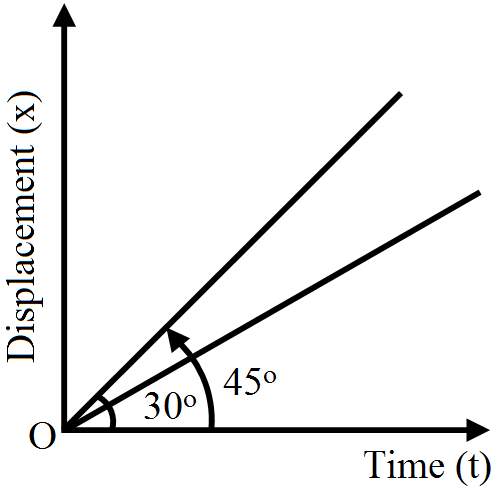
- ✓
$1:\sqrt{3}$
- B
$1:2$
- C
$1:1$
- D
$\sqrt{3}:2$
AnswerCorrect option: A. $1:\sqrt{3}$
In case $x-t$ graph the graphs are a straight line, slope of the straight line gives velocity of the particle.
Slope $=\tan \theta,$
where $\theta$ is the angle which the tangent to the curve makes with the horizontal in anti$-$clockwise direction.
$\text{v}_\text{A}=\tan30^\circ=\frac{1}{\sqrt{3}},$
$\text{v}_\text{B}=\tan45^\circ=1$
$\Rightarrow\text{v}_\text{A}:\text{v}_\text{B}=\frac{1}{\sqrt{3}}:1$
$=1:\sqrt{3}$
View full question & answer→MCQ 2011 Mark
The kinematic equations of rectilinear motion for constant acceleration for a general situation, where the position coordinate at $t = 0$ is non$-$zero, say $x_0$ is:
- A
$\text{v}=\text{v}_0+\text{at}$
- B
$\text{x}=\text{x}_0+\text{v}_0\text{t}+\frac{1}{2}\text{at}^2$
- C
$\text{v}^2=\text{v}^2_0+2\text{a}(\text{x}-\text{x}_0)$
- ✓
View full question & answer→MCQ 2021 Mark
A person is standing at $-2$ location on the number line. He runs to and fro from $-2$ to $+5$ location $5$ times. How much distance has he covered if he comes back to $-2$ location at the end?
- ✓
$35$ units
- B
$7$ units
- C
$30$ units
- D
$15$ units
AnswerCorrect option: A. $35$ units
In one turn the person covers $5 – (-2)$ units of distance, i.e. $7.$
Therefore in $5$ turns, he will cover $5 \times 7 = 35$ units of distance.
View full question & answer→MCQ 2031 Mark
Path length does not depend on $...........$
AnswerThe path length depends on the final and initial point. It also depends on the path taken. But it does not depend on the coordinate system. The coordinate system merely defines thee path and does not affect its total length.
View full question & answer→MCQ 2041 Mark
Distance does not depend on $.............$
AnswerThe distance depends on the final and initial points as these points define the path.
Distance also depends on the path chosen, the distance between same initial and final point with different paths can be different.
It does not depend on speed as whatever the speed may be, if the initial and final points and path remains same, the distance remains same.
View full question & answer→MCQ 2051 Mark
If the velocity varies parabolically, how does the acceleration vary?
AnswerVelocity varies parabolically implies that velocity is of the form $at + bt^2$.
On differentiating the velocity, we get the equation for acceleration.
Therefore, $\text{a}=\frac{\text{dv}}{\text{dt}}=\text{a}+2\text{bt},$ which is a linear equation.
Hence the acceleration varies linearly.
View full question & answer→MCQ 2061 Mark
A balloon is rising with a constant acceleration of $2\ m/ s^2.$ At a certain instant when the balloon was moving with a velocity of $4\ m/ s,$ a stone was dropped from it in a region where $g = 10\ m/ s^2.$ The velocity and acceleration of stone as it comes out from the balloon are respectively $($in $m/ s$ and $m/ s^2)$
AnswerCorrect option: A. $4, 10$
When the stone was in the balloon, the stone had the same velocity as that of balloon.
So when the stone came out of the balloon, the velocity of stone was $4m/ s$ upwards.
After coming out of the balloon, the stone was in free fall motion,
so the stone experienced an acceleration due to gravity equal to $g = 10\ m/ s^2$ in downward direction.
View full question & answer→MCQ 2071 Mark
A body travels $200\ cm$ in the first two seconds and $220\ cm$ in the next $4$ seconds with same acceleration. The velocity of the body at the end of the $7^{th}$ second is:
- ✓
$10\ cm/ s$
- B
$5\ cm/ s$
- C
$12\ cm/ s$
- D
$2\ cm/ s$
AnswerCorrect option: A. $10\ cm/ s$
View full question & answer→MCQ 2081 Mark
From the top of a tower, two stones whose masses are in the ratio $1 : 2$ are thrown, one straight up with an initial speed $u$ and the second straight down with same speed $u.$ neglecting air resistance,
- A
The heavier stone hits the ground with a higher speed.
- B
The lighter stone hits the ground with a higher speed.
- ✓
Both the stones will have same speed when they hit the ground.
- D
The speed cannot be determined with the given data.
AnswerCorrect option: C. Both the stones will have same speed when they hit the ground.
For motion under gravity, speed is independent of masses The net vertical displacement for both stone are same.
Also they are launched with same initial speed $u,$
therefore both the stone will have same speed when they hit the ground.
View full question & answer→MCQ 2091 Mark
Which force can possibly act on a body moving in a straight line?
AnswerIn the physical world, no surface is frictionless. Hence whenever a body moves, the force of friction acts on it. Rest all forces act on the body only when it moves along a curve and not along a straight line.
View full question & answer→MCQ 2101 Mark
A book lying on a table is an example of:
- ✓
- B
- C
A body neither at rest nor motion
- D
AnswerA book lying on a table is an example of a body at rest.
View full question & answer→MCQ 2111 Mark
Area under a speed $-$ time graph gives:
- A
The time taken by a moving object.
- ✓
The distance travelled by a moving object.
- C
The acceleration of a moving object.
- D
The retardation of a moving object.
AnswerCorrect option: B. The distance travelled by a moving object.
The area under the velocity $-$ time graph gives the distance traveled by a moving object during that time interval.
While the area under the velocity$-$time graph gives displacement of the particle.
View full question & answer→MCQ 2121 Mark
A $50.0\ kg$ boy is sitting on an amusement park ride where he accelerates straight upward from rest to a speed of $30.0\ m/ s$ in $3.0s$
What is his mass as he accelerates upward?
- A
$990.0\ kg$
- B
$100.0\ kg$
- ✓
$50.0\ kg$
- D
$5.00\ kg$
AnswerCorrect option: C. $50.0\ kg$
The mass of a body is a universal constant which does not change with acceleration. It is a property of the object itself.
Hence the mass remains the same and equal to $50.0\ kg.$
View full question & answer→