Question
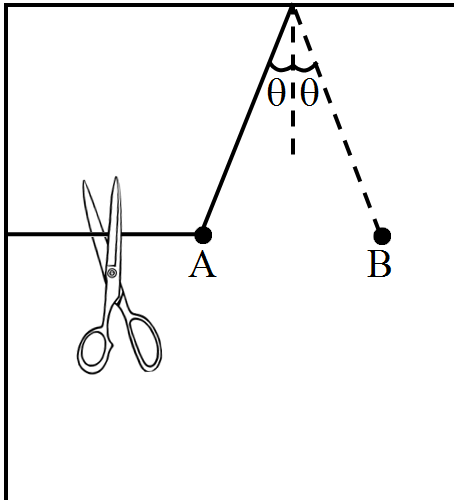
A ball is held at rest at position A in Fig., by two light strings. The horizontal string is cut and the ball starts swinging as a pendulum. Point B is the farthest to the right where the ball goes as it swings back and forth. What is the ratio of the tension in the supporting string in position B to its value at A before the horizontal string was cut?A ball is held at rest at position A in Fig., by two light strings. The horizontal string is cut and the ball starts swinging as a pendulum. Point B is the farthest to the right where the ball goes as it swings back and forth. What is the ratio of the tension in the supporting string in position B to its value at A before the horizontal string was cut?
Answer

In the first case, ball is in equilibrium. So, the net force on the body in any direction should be zero. $\therefore \sum \ \vec{\text{F}}$ in the vertical direction = 0 $\therefore \text{T}_{1} \cos \theta = \text{mg}\Rightarrow \text{T}_{1} = \frac{\text{mg}}{\cos \theta}$

Need a full question paper?

Generate a complete, print-ready paper with questions like this in minutes — across 16+ boards, with answer keys.

Start Generating Free

Similar questions

A square plate of mass 120g and edge 5.0cm rotates about one of the edges. If it has a uniform angular acceleration of $0.2rad/s^2$, what torque acts on the plate?
For a particle in S.H.M., the displacement x of the particle as a function of time t is given as $\text{x = A}\sin(2\pi\text{t}).$ Here x is in cm and t is in seconds.
Let the time taken by the particle to travel from x = 0 to $\text{x}=\frac{\text{A}}{2}$ be $T_1$ and the time taken to travel from $\text{x}=\frac{\text{A}}{2}$ to x = A be $T_2$​​​​​​​. Find $\frac{\text{T}_1}{\text{T}_2}.$
Two soap bubbles have radii 2 cm and 3 cm respectively. What would be the radius of curvature of the surface formed at the contact surface when the two bubbles are brought near each other?
The maximum speed and acceleration of a particle executing simple harmonic motion are $10cm/s$ and $50cm/s^2$. Find the position(s) of the particle when the speed is 8cm/s.
A structural steel rod has a radius of $10 mm$ and a length of $1.0 m$. A $100 kN$ force stretches it along its length. Calculate (a) stress, (b) elongation, and (c) strain on the rod. Young's modulus, of structural steel is $2.0 \times 10^{11} N m ^{-2}$.
A monochromatic light source of intensity $6mW$ emits $8 \times 10^{16}$ photons per second. This light ejects photoelectrons from a metal surface. The stopping potential for this setup is $2.0V$. Calculate the work function of the metal.
A cricket bowler releases the ball in two different ways.
  1. Giving it only horizontal velocity, and
  2. Giving it horizontal velocity and a small downward velocity. The speed $v_s$ at the time of release is the same. Both are released at a height H from the ground. Which one will have greater speed when the ball hits the ground? Neglect air resistance.
The half-life of a radioisotope is 10h. Find the total number of disintegrations in the tenth hour measured from a time when the activity was 1Ci.
A thin prism of crown glass $(\mu_\text{r}=1.515,\mu_\text{v}=1.525)$ and a thin prism of flint glass $(\mu_\text{r}=1.612,\mu_\text{v}=1.632)$ are placed in contact with each other. Their refracting angles are 5.0° each and are similarly directed. Calculate the angular dispersion produced by the combination.
To maintain a rotor at a uniform angular speed of $200rad s^{-1}$, an engine needs to transmit a torque of $180Nm$. What is the power required by the engine? (Note: uniform angular velocity in the absence of friction implies zero torque. In practice, applied torque is needed to counter frictional torque). Assume that the engine is 100% efficient.