Question
To maintain a rotor at a uniform angular speed of $200rad s^{-1}$, an engine needs to transmit a torque of $180Nm$. What is the power required by the engine? (Note: uniform angular velocity in the absence of friction implies zero torque. In practice, applied torque is needed to counter frictional torque). Assume that the engine is 100% efficient.
Answer

Angular speed of the rotor, $\omega=200\text{rad/s}$ Torque required, $\tau=180\text{Nm}$ The power of the rotor (P) is related to torque and angular speed by the relation, $\text{P}=\tau\omega$ = 180 × 200 = 36 × 103 = 36kW Hence, the power required by the engine is 36kW.

Need a full question paper?

Generate a complete, print-ready paper with questions like this in minutes — across 16+ boards, with answer keys.

Start Generating Free

Similar questions

What is meant by monochromatic emittance, emissive power, emissivity and monochromatic absorbtance.
The coefficient of apparent expansion of a liquid when determined using two different vessels A and B are $\gamma_1$ and $\gamma_2$ respectively. If the coefficient of linear expansion of vessel A is α, find the coefficient of linear expansion of vessel B.
A block of metal of mass 50 g when placed over an inclined plane at an angle of $15^{\circ}$ slides down without acceleration. If the inclination is increased by $15^{\circ}$, what would be the acceleration of the block?
A wheel of moment of inertia $0.10kg-m^2$ is rotating about a shaft at an angular speed of 160rev/ minute. A second wheel is set into rotation at 300rev/ minute and is coupled to the same shaft so that both the wheels finally rotate with a common angular speed of 200rev/ minute. Find the moment of inertia of the second wheel.
A fat man is used to consuming about 3000k/ cal worth of food everyday. His food contains 50g of butter plus a plate of sweets everyday. besides items which provide him with other nutrients (proteins, vitamins, minerals, etc.) in addition to fats and carbohydrates. The calorific value of 10g of butter is 60k/ cal and that of a plate of sweets is of average 700k/ cal. What dietary strategy should he adopt to cut down his calories to about 2100k/ cal per day? Assume the man cannot resist eating the full plate of sweets once it is offered to him.
A football is kicked into the air vertically upwards. What is its
  1. acceleration, and
  2. velocity at the highest point?
Plot the corresponding reference circle for each of the following simple harmonic motions. Indicate the initial (t = 0) position of the particle, the radius of the circle, and the angular speed of the rotating particle. For simplicity, the sense of rotation may be fixed to be anticlockwise in every case: (x is in cm and t is in s).
$\text{x}=2\cos\pi\text{t}$
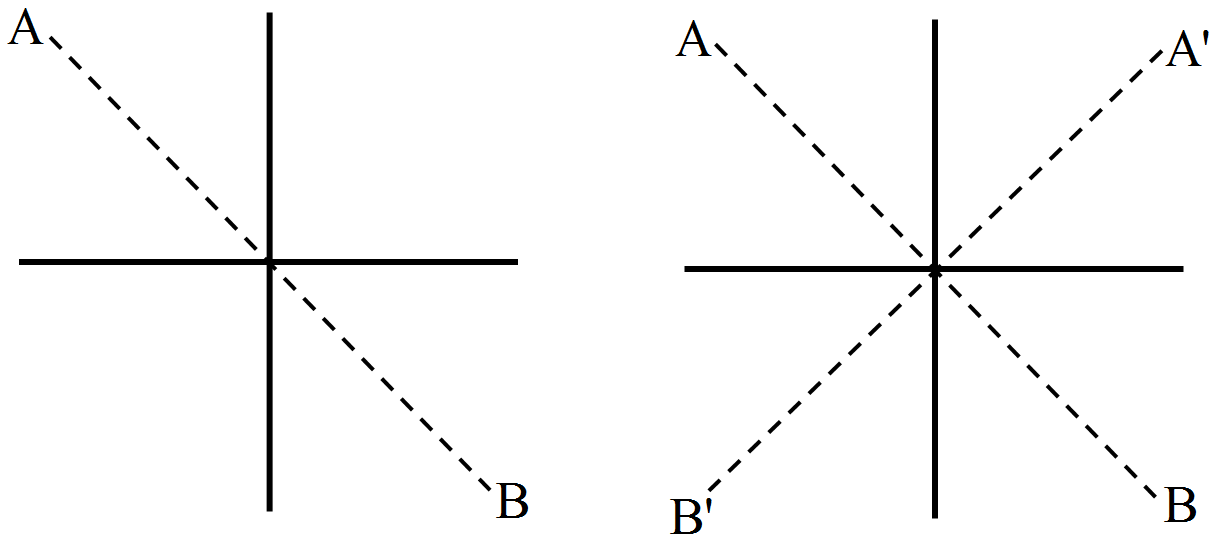
Two uniform thin identical rods, each of mass M and length L, are joined so as to form a cross as shown in Fig. What is the moment of inertia of the system about the bisector line AB?
What is the height at which the value of g is the same as at a depth of $\frac{\text{R}}{2}?$
The stopping potential in a photoelectric experiment is linearly related to the inverse of the wavelength $\Big(\frac{1}{\lambda}\Big)$ of the light falling on the cathode. The potential difference applied across an X-ray tube is linearly related to the inverse of the cutoff wavelength$\Big(\frac{1}{\lambda}\Big)$ of the X-ray emitted. Show that the slopes of the lines in the two cases are equal and find its value.