Question
A ball is thrown at an angle $\theta$ with the horizontal. Its horizontal range is equal to its maximum height. This is possible only when the value of $\tan \theta$ is ..........

Answer

(a)

$\frac{H}{R}=\frac{1}{4} \tan \theta$

$\Rightarrow H=R$, given,

$\tan \theta=4$

$\Rightarrow \theta=\tan ^{-1}(4)$

Need a full question paper?

Generate a complete, print-ready paper with questions like this in minutes — across 16+ boards, with answer keys.

Start Generating Free

Similar questions

If the maximum value of accelerating potential provided by a ratio frequency oscillator is $12\, {kV}$. The number of revolution made by a proton in a cyclotron to achieve one sixth of the speed of light is ....... .

$\left[{m}_{{p}}=1.67 \times 10^{-27} {kg}, {e}=1.6 \times 10^{-19} {C},\right.$ Speed of light $\left.=3 \times 10^{8} {m} / {s}\right]$

Samples of two radioactive nuclides, $X$ and $Y$, each have equal activity $A_0$ at time $t = 0$ . $X$ has a half life of $24$ years and $Y$ a half life of $16$ years. The samples  are mixed together.What will be the total activity of the mixture at $t = 48$ years ?
What will be the formula of mass of the earth in terms of $g, R$ and $G$ ?
Two cars are moving in the same direction with the same speed $30 \,km/hr$. They are separated by a distance of $5\, km$, the speed of a car moving in the opposite direction if it meets these two cars at an interval of $4$ minutes, will be.......$km/hr$
Match List $- I$ with List $- II:$

  List$-1$ (Electromagnetic waves)   List$-2$ (Wavelength)
$(a)$ $AM$ radio waves $(i)$ $10^{-10}\,m$
$(b)$ Microwaves $(ii)$ $10^{2}\,m$
$(c)$ Infrared radiations $(iii)$ $10^{-2}\,m$
$(d)$ $X-$rays $(iv)$ $10^{-4}\,m$

Choose the correct answer from the options given below:
$8$ mercury drops coalesce to form one mercury drop, the energy changes by a factor of
$A$ concave mirror is used to form image of the Sun on a white screen. If the lower half of the mirror were covered with an opaque card, the effect on the image on the screen would be
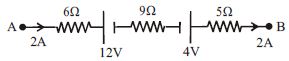
The potential difference between $A$ and $B$ in the Figure is .............. $V$
Young's modulus depends upon
A damped harmonic oscillator has a frequency of $5$ oscillations per second. The amplitude drops to half its value for every $10$ oscillations. The time it will take to drop to $\frac{1}{1000}$ of the original amplitude is close to .... $s$