A damped harmonic oscillator has a frequency of $5$ oscillations per second. The amplitude drops to half its value for every $10$ oscillations. The time it will take to drop to $\frac{1}{1000}$ of the original amplitude is close to .... $s$
JEE MAIN 2019, Diffcult
Download our app for free and get started
$A=A_{0} e^{-\gamma t}$
$A=\frac{A_{0}}{2}$ after $10$ oscillations
$\because$ After 2 seconds
$\frac{A_{0}}{2}=A_{0} e^{-\gamma(2)} \quad ; \quad 2=e^{2 \gamma}$
$ \ell n 2=2 \gamma \quad ; \quad \gamma=\frac{\ell n 2}{2}$
$\because A=A_{0} e^{-\gamma t}$
$\ell n \frac{\mathrm{A}_{0}}{\mathrm{A}}=\gamma \mathrm{t} ; \quad \ell \mathrm{n} 1000 \frac{\ell n 2}{2} \mathrm{t}$
$2\left(\frac{3 \ell n 10}{\ell n 2}\right)=t ; \quad \frac{6 \ell n 10}{\ell n 2}=t$
$t=19.931 \mathrm{sec}$
$t \approx 20 \mathrm{sec}$
$A=\frac{A_{0}}{2}$ after $10$ oscillations
$\because$ After 2 seconds
$\frac{A_{0}}{2}=A_{0} e^{-\gamma(2)} \quad ; \quad 2=e^{2 \gamma}$
$ \ell n 2=2 \gamma \quad ; \quad \gamma=\frac{\ell n 2}{2}$
$\because A=A_{0} e^{-\gamma t}$
$\ell n \frac{\mathrm{A}_{0}}{\mathrm{A}}=\gamma \mathrm{t} ; \quad \ell \mathrm{n} 1000 \frac{\ell n 2}{2} \mathrm{t}$
$2\left(\frac{3 \ell n 10}{\ell n 2}\right)=t ; \quad \frac{6 \ell n 10}{\ell n 2}=t$
$t=19.931 \mathrm{sec}$
$t \approx 20 \mathrm{sec}$

Download our appand get started for free
Experience the future of education. Simply download our apps or reach out to us for more information. Let's shape the future of learning together!No signup needed.*
Similar Questions
- 1The amplitude of a particle executing $SHM$ is $3\,cm$. The displacement at which its kinetic energy will be $25 \%$ more than the potential energy is: $.............cm$.View Solution
- 2The amplitude and the time period in a $S.H.M.$ is $0.5 \,cm$ and $0.4 \,sec$ respectively. If the initial phase is $\pi /2$ radian, then the equation of $S.H.M.$ will beView Solution
- 3A mass $0.9\,kg$, attached to a horizontal spring, executes $SHM$ with an amplitude $A _{1}$. When this mass passes through its mean position, then a smaller mass of $124\,g$ is placed over it and both masses move together with amplitude $A _{2}$. If the ratio $\frac{ A _{1}}{ A _{2}}$ is $\frac{\alpha}{\alpha-1}$, then the value of $\alpha$ will be$......$View Solution
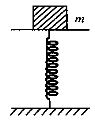
- 4A mass of $2.0\, kg$ is put on a flat pan attached to a vertical spring fixed on the ground as shown in the figure. The mass of the spring and the pan is negligible. When pressed slightly and released the mass executes a simple harmonic motion. The spring constant is $200\, N/m.$ What should be the minimum amplitude of the motion so that the mass gets detached from the pan (take $g = 10 m/s^2$).View Solution
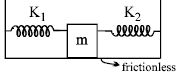
- 5Two springs with negligible masses and force constant of $K_1 = 200\, Nm^{-1}$ and $K_2 = 160\, Nm^{-1}$ are attached to the block of mass $m = 10\, kg$ as shown in the figure. Initially the block is at rest, at the equilibrium position in which both springs are neither stretched nor compressed. At time $t = 0,$ a sharp impulse of $50\, Ns$ is given to the block with a hammer.View Solution
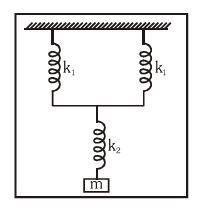
- 6View SolutionThe total spring constant of the system as shown in the figure will be
- 7A simple pendulum with length $L$ and mass $m$ of the bob is vibrating with an amplitude $A$. The maximum tension in the string isView Solution
- 8The mass of a particle is $1\,\,kg$ and it is moving along $x-$ axis. The period of its small oscillation is $\frac {\pi }{2}$ . Its potential energy may beView Solution
- 9A simple harmonic oscillator has an amplitude a and time period $T$. The time required by it to travel from $x = a$ to $x = \frac{a }{2}$ isView Solution
- 10A particle executes $SHM.$ Its velocities are $v_1$and $v_2$ at displacement $x_1$ and $x_2$ from mean position respectively. The frequency of oscillation will beView Solution