Question
A ball is thrown from ground at an angle $\theta$ with horizontal and with an initial speed $u_0$. For the resulting projectile motion, the magnitude of average velocity of the ball up to the point when it hits the ground for the first time is $V _1$. After hitting the ground, ball rebounds at the same angle $\theta$ but with a reduced speed of $u_0 / \alpha$. Its motion continues for a long time as shown in figure. If the magnitude of average velocity of the ball for entire duration of motion is $0.8 V _1$, the value of $\alpha$ is. . . . . .

Answer

 Average velocity $=\frac{\text { Total displacement }}{\text { Total time }}$

$\text { Total time taken }=t_1+t_2+t_3+\ldots . . . . . . . .$

$=t_1+\frac{t_1}{\alpha}+\frac{t_1}{\alpha^2}+\ldots \ldots . .$

$\text { Total time }=\frac{t_1}{1-\frac{1}{\alpha}}$

$\text { Total displacement }=v_1 t_1+v_2 t_2+\ldots \ldots . . .$

$=v_1 t_1+\frac{v_1}{\alpha} \cdot \frac{t_1}{\alpha}+\ldots \ldots . .$

$=\frac{v_1 t_1}{1-\frac{1}{\alpha^2}}$

On solving

$< v \rangle=\frac{ v _1 \alpha}{\alpha+1}=0.8 v _1$

$\alpha=4.00$

Need a full question paper?

Generate a complete, print-ready paper with questions like this in minutes — across 16+ boards, with answer keys.

Start Generating Free

Similar questions

The planes of two rigid discs are perpendicular to each other. They are rotating about their axes. If their angular velocities are $3 \,rad/sec$ and $4\, rad/sec$ respectively, then the resultant angular velocity of the system would be ........ $rad/sec$
The drift velocity does not depend upon
Two identical dipoles each of magnetic moment $1.0\, A-m^2$ are placed at a separation of $2\,m$ with their axes perpendicular to each other. What is the magnetic field at a point midway between the dipoles ?
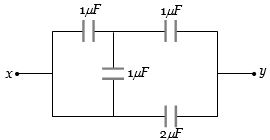
Four capacitors are connected as shown in the figure. Their capacities are indicated in the figure. The effective capacitance between points $x$ and $y$ is (in $\mu F$)
If current in an electric bulb changes by $1\%$, then the power will change by ............ $\%$
A magnetic needle is placed on a cork floating in a still lake in the northern hemisphere. Does the needle together with the cork move towards the north of the lake
A particle having a mass of $10^{- 2} \,kg$ carries a charge of $5 \times 10^{-8}\, C.$ The particle is given an initial horizontal velocity of $10^5\, m/s $ in the presence of electric field $E$ and magnetic field  $B.$ To keep the particle moving in a horizontal direction, it is necessary that
$(1)$ $\vec B$ should be perpendicular to the direction of velocity and $\vec E$ should be along the direction of velocity
$(2)$  Both $\vec B$ and $\vec E$ should be along the direction of velocity
$(3)$ Both $\vec B$ and $\vec E$ are mutually perpendicular and perpendicular to the direction of velocity.
$(4)$ $\vec B$ should be along the direction of velocity and $\vec E$ should be perpendicular to the direction of velocity
Which one of the following pairs of statements is possible?
The average translational kinetic energy of ${N}_{2}$ gas molecules at $\ldots \ldots \ldots . .{ }^{\circ} {C}$ becomes equal to the ${K} . {E}$. of an electron accelerated from rest through a potential difference of $0.1$ $volt.$

$\left(\right.$ Given $\left.{k}_{{B}}=1.38 \times 10^{-23} \, {J} / {K}\right)$

(Fill the nearest integer).

A gas is collected over the water at $25°C.$ The total pressure of moist gas was $735 \,mm$ of mercury. If the aqueous vapour pressure at $25°C$ is $23.8\, mm.$ Then the pressure of dry gas is..... $mm$
The area of the parallelogram having diagonals ${3\hat i}\,\, + \,\,\hat j\,\, - \,\,2\hat k$ and $\hat i\,\, - \,\,3\hat j\,\, + \;\,4\hat k$ is