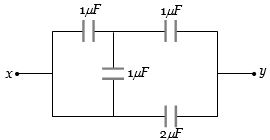
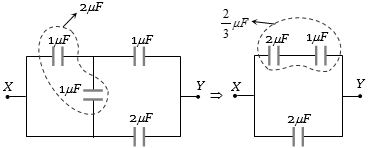
Four capacitors are connected as shown in the figure. Their capacities are indicated in the figure. The effective capacitance between points $x$ and $y$ is (in $\mu F$)
Easy


Download our appand get started for free
Experience the future of education. Simply download our apps or reach out to us for more information. Let's shape the future of learning together!No signup needed.*
Similar Questions
- 1A parallel plate capacitor of capacitance $C$ is connected to a battery and is charged to a potential difference $V$. Another capacitor of capacitance $2C$ is connected to another battery and is charged to potential difference $2V$. The charging batteries are now disconnected and the capacitors are connected in parallel to each other in such a way that the positive terminal of one is connected to the negative terminal of the other. The final energy of the configuration isView Solution
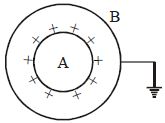
- 2$A$ and $B$ are two concentric spheres. If $A$ is given a charge $Q$ while $B$ is earthed as shownView Solution
- 3Assertion $(A):$ A spherical equipotential surface is not possible for a point charge.View Solution
Reason $(R):$ A spherical equipotential surface is possible inside a spherical capacitor.
- 4View SolutionAfter charging a capacitor the battery is removed. Now by placing a dielectric slab between the plates :-
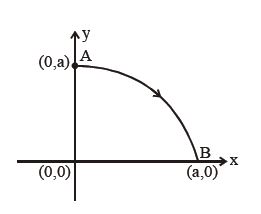
- 5Electric field at a place is $\overrightarrow {E\,} = {E_0}\hat i\,V/m$ . A particle of charge $+q_0$ moves from point $A$ to $B$ along a circular path find work done in this motion by electric fieldView Solution
- 6A parallel plate capacitor has plates of area $A$ separated by distance $d$ between them. It is filled with a dielectric which has a dielectric constant that varies as $\mathrm{k}(\mathrm{x})=\mathrm{K}(1+\alpha \mathrm{x})$ where $\mathrm{x}$ is the distance measured from one of the plates. If $(\alpha \text {d)}<<1,$ the total capacitance of the system is best given by the expressionView Solution
- 7The parallel combination of two air filled parallel plate capacitors of capacitance $C$ and $nC$ is connected to a battery of voltage, $V$. When the capacitor are fully charged, the battery is removed and after that a dielectric material of dielectric constant $K$ is placed between the two plates of the first capacitor. The new potential difference of the combined system isView Solution
- 8Two charged spherical conductors of radius $R_{1}$ and $\mathrm{R}_{2}$ are connected by a wire. Then the ratio of surface charge densities of the spheres $\left(\sigma_{1} / \sigma_{2}\right)$ is :View Solution
- 9When two identical capacitors are in series have $3\,\mu F$ capacitance and when parallel $12\,\mu F$. What is the capacitance of each.......$\mu \,F$View Solution
- 10Two capacitors of capacitance $2C$ and $C$ are joined in parallel and charged to potential $V$. The battery is now removed and the capacitor $C$ is filled with a medium of dielectric constant $K$. The potential difference across each capacitor will beView Solution