Question
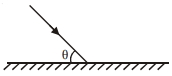
A ball of mass $m$ moving with speed $u$ collides with a smooth horizontal surface at angle $\theta$ with it as shown in figure. The magnitude of impulse imparted to surface by ball is [Coefficient of restitution of collision is $e$]
Answer

(d)

$u_y=-u \sin \theta \hat{j}$

$\vec{v}_y=+e u \sin \theta \hat{j}$

$\vec{I}=m\left(\vec{v}_y-\vec{u}_y\right)$

$=m u(e+1) \sin \theta$

Need a full question paper?

Generate a complete, print-ready paper with questions like this in minutes — across 16+ boards, with answer keys.
Start Generating Free

Similar questions

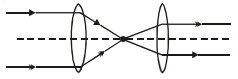
Ray diagram for two lenses kept at some distance given in the diagram, which of the following option is correct $\left(f_1, f_2=\right.$ focal length, $d=$ distance between lenses $)$
A dipole with an electric moment $\vec{p}$ is located at a distance $r$ from a long thread charged uniformly with a linear charge density $\lambda$. Find the force $F$ acting on the dipole if the vector $\vec{p}$ is oriented along the thread
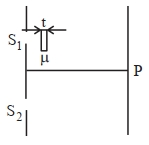
As shown in the figure, in Young's double slit experiment, a thin plate of thickness $t =10\,\mu m$ and refractive index $\mu _{1}=1.2$ is inserted infront of slit $S _1$. The experiment is conducted in air $(\mu=1)$ and uses a monochromatic light of wavelength $\lambda=500\,nm$. Due to the insertion of the plate, central maxima is shifted by a distance of $x \beta_0 . \beta_0$ is the fringe-width before the insertion of the plate.The value of the $x$ is $.............$
A particle of mass $1 kg$ is subjected to a force which depends on the position as $\vec{F}=-k(x \hat{i}+y \hat{j}) kgms ^{-2}$ with $k=1 kgs ^{-2}$. At time $t=0$, the particle's position $\vec{r}=\left(\frac{1}{\sqrt{2}} \hat{i}+\sqrt{2} \hat{j}\right) m$ and its velocity $\vec{v}=\left(-\sqrt{2} \hat{i}+\sqrt{2} \hat{j}+\frac{2}{\pi} \hat{k}\right) m s^{-1}$. Let $v_x$ and $v_y$ denote the $x$ and the $y$ components of the particle's velocity, respectively. Ignore gravity. When $z=0.5 m$, the value of $\left(x v_y-y v_x\right)$ is. . . . . $m^2 s^{-1}$
A Carnot engine with sink's temperature at $17\,^oC$ has $50\%$ efficiency. By how much should its source temperature be changed to increases its efficiency to $60\%$ ?...... $K$
A photon is emitted in transition from $n =4$ to $n =1$ level in hydrogen atom. The corresponding wavelength for this transition is $.........\,nm$ $\text { (given, } h =4 \times 10^{-15} eVs \text { ) : }$
The mass defect in a particular reaction is $0.4 \mathrm{~g}$.

The amount of energy liberated is $\mathrm{n} \times 10^7 \mathrm{kWh}$, where$\mathrm{n}=$________.(speed of light $=3 \times 10^8 \mathrm{~m} / \mathrm{s}$ )

$A$ ladder of length $L$ is slipping with its ends against a vertical wall and a horizontal floor. At a certain moment, the speed of the end in contact with the horizontal floor is $v$ and the ladder makes an angle $\alpha = 30^o$ with the horizontal. Then the speed of the ladder’s center must be
A square loop of area $25\,cm ^2$ has a resistance of $10\,\Omega$. The loop is placed in uniform magnetic field of magnitude $40.0 T$. The plane of loop is perpendicular to the magnetic field. The work done in pulling the loop out of the magnetic field slowly and uniformly in $1.0 sec$, will be $..........\times 10^{-3}$
The distance $x$ covered by a particle in one dimensional motion varies with time $t$ as $\mathrm{x}^{2}=\mathrm{at}^{2}+2 \mathrm{bt}+\mathrm{c.}$ If the acceleration of the particle depends on $\mathrm{x}$ as $\mathrm{x}^{-\mathrm{n}},$ where $\mathrm{n}$ is an integer, the value of $\mathrm{n}$ is