A square loop of area $25\,cm ^2$ has a resistance of $10\,\Omega$. The loop is placed in uniform magnetic field of magnitude $40.0 T$. The plane of loop is perpendicular to the magnetic field. The work done in pulling the loop out of the magnetic field slowly and uniformly in $1.0 sec$, will be $..........\times 10^{-3}$
JEE MAIN 2023, Diffcult


Download our appand get started for free
Experience the future of education. Simply download our apps or reach out to us for more information. Let's shape the future of learning together!No signup needed.*
Similar Questions
- 1A square frame of side I carries a current $i$. The magnetic field at its centre is $B$. The same current is passed through a circular coil having the same perimeter as the square. The field at the centre of the circular coil is $B^{\prime}$. The ratio of $\frac{B}{B^{\prime}}$ isView Solution
- 2A moving coil galvanometer has a coil with $175\, turns$ and area $1\, cm^2$ It uses a torsion band of torsion constant $10^{-6}\, N\, -m/rad$. The coil is placed in a magnetic field $B$ parallel to its plane. The coil deflects by $10$ for a current of $1\, mA$. The value of $B$ (in Tesla) is approximatelyView Solution
- 3A milli voltmeter of $25\,millivolt$ range is to be converted in to an ammeter of $25\,A$ range. The value (in $ohm$) of necessary shunt will beView Solution
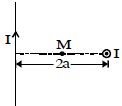
- 4Two infinite length wires are placed according to figure. Magnitude of magnetic field at point $M$ which is mid point of line joining the two wireView Solution
- 5A square loop of area $25\,cm ^2$ has a resistance of $10\,\Omega$. The loop is placed in uniform magnetic field of magnitude $40.0 T$. The plane of loop is perpendicular to the magnetic field. The work done in pulling the loop out of the magnetic field slowly and uniformly in $1.0 sec$, will be $..........\times 10^{-3}$View Solution
- 6At a specific instant emission of radioactive compound is deflected in a magnetic field. The compound can emitView Solution
$(i)$ Electrons $(ii)$ Protons $(iii)$ $H{e^{2 + }}$ $(iv)$ Neutrons
The emission at the instant can be
- 7View SolutionIn a cyclotron experiment, if we assume that maximum radius attained by any charged particle is equal to radius of dees, then minimum kinetic energy gained by the particles will be for
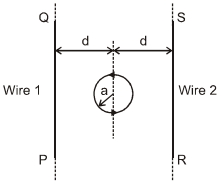
- 8The figure shows a circular loop of radius a with two long parallel wires (numbered $1$ and $2$) all in the plane of the paper. The distance of each wire from the centre of the loop is $d$. The loop and the wires are carrying the same current $I$. The current in the loop is in the counterclockwise direction if seen from above.$Image$View Solution
$1.$ When $d \approx$ a but wires are not touching the loop, it is found that the net magnetic filed on the axis of the loop is zero at a height $h$ above the loop. In that case
$(A)$ current in wire $1$ and wire $2$ is the direction $P Q$ and $R S$, respectively and $h \approx a$
$(B)$ current in wire $1$ and wire $2$ is the direction $PQ$ and $SR$, respectively and $h \approx a$
$(C)$ current in wire $1$ and wire $2$ is the direction $PQ$ and $SR$, respectively and $h \approx 1.2 a$
$(D)$ current in wire $1$ and wire $2$ is the direction $PQ$ and $RS$, resepectively and $h \approx 1.2 a$
$2.$ Consider $d \gg a$, and the loop is rotated about its diameter parallel to the wires by $30^{\circ}$ from the position shown in the figure. If the currents in the wires are in the opposite directions, the torque on the loop at its new position will be (assume that the net field due to the wires is constant over the loop)
$(A)$ $\frac{\mu_0 I^2 a^2}{d}$ $(B)$ $\frac{\mu_0 I^2 a^2}{2 d}$ $(C)$ $\frac{\sqrt{3} \mu_0 I^2 a^2}{d}$ $(D)$ $\frac{\sqrt{3} \mu_0 I^2 a^2}{2 d}$
Give the answer question $1$ and $2.$
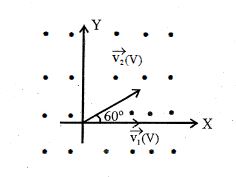
- 9Two charged particles of mass $m$ and charge $q$ each are projected from origin simultaneously with same speed $V$ in transverse magnetic field. If ${\vec r_1}$ and ${\vec r_2}$ are the position vectors of particles (with respect to origin) at $t = \frac{{\pi m}}{{qB}}$ then the value of ${\vec r_1}.{\vec r_2}$ at that time isView Solution
- 10The ($\tau -\theta$) graph for a coil isView Solution