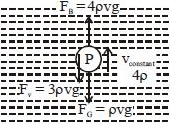
A ball rises to surface at a constant velocity in a liquid whose density is $4$ times greater than that of the material of the ball. The ratio of the force of friction acting on the rising ball and its weight is
A$3 : 1$
B$4 : 1$
C$1 : 3$
D$1 : 4$
Medium
Download our app for free and get started
A$3 : 1$
a $\mathrm{F}_{\mathrm{B}}=\mathrm{F}_{\mathrm{v}}+\mathrm{F}_{\mathrm{G}}$
Experience the future of education. Simply download our apps or reach out to us for more information. Let's shape the future of learning together!No signup needed.*
Consider a cylindrical tank of radius $1 m$ is filled with water. The top surface of water is at $15\,m$ from the bottom of the cylinder. There is a hole on the wall of cylinder at a height of $5\,m$ from the bottom. A force of $5 \times 10^{5} N$ is applied an the top surface of water using a piston. The speed of efflux from the hole will be.
(given atmospheric pressure $P_{A}=1.01 \times 10^{5}\,Pa$, density of water $\rho_{ w }=1000\,kg / m ^{3}$ and gravitational acceleration $g=10\,m / s ^{2}$ )
A cylindrical block of area of cross-section $A$ and of material of density $\rho$ is placed in a liquid of density one-third of density of block. The block compresses a spring and compression in the spring is one-third of the length of the block. If acceleration due to gravity is $g$, the spring constant of the spring is:
A closed vessel have a small hole in one face of vessel near the bottom as shown. The velocity of water coming out from the given hole at given instant is ....... $m/s$
A hollow cone floats with its axis vertical upto one-third of its height in a liquid of relative density $0.8$ and with its vertex submerged. When another liquid of relative density $\rho$ is filled in it upto one-third of its height, the cone floats upto half its vertical height. The height of the cone is $0.10$ $m$ and the radius of the circular base is $0.05$ $m$. The specific gravity $\rho$ is given by
A plane is in level flight at constant speed and each of its two wings has an area of $25 \;m ^{2}$ If the speed of the air is $180 \;km / h$ over the lower wing and $234\; km / h$ over the upper wing surface, determine the plane's mass in $kg$. (Take air density to be $1\; kg m ^{-3}$ ).
Water from a pipe is coming at a rate of $100\, litres$ per minute. If the radius of the pipe is $5\, cm$, the Reynolds number for the flow is of the order of : (density of water $= 1000\, kg/m^3$, coefficient of viscosity of water $= 1\, mPa\, s$)
The velocity of water in a river is $18\, km/h$ near the surface. If the river is $5\, m$ deep, find the shearing stress between the horizontal layers of water. The co-efficient of viscosity of water $= 10^{-2}\,,poise$