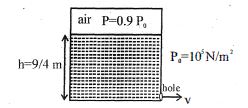
A closed vessel have a small hole in one face of vessel near the bottom as shown. The velocity of water coming out from the given hole at given instant is ....... $m/s$
Medium
Download our app for free and get started
$9 \mathrm{P}_{0}+\rho \mathrm{gh}=\mathrm{P}_{0}+\frac{1}{2} \rho \mathrm{V}^{2}$
$\Rightarrow \mathrm{v}=5 \mathrm{m} / \mathrm{s}$

Download our appand get started for free
Experience the future of education. Simply download our apps or reach out to us for more information. Let's shape the future of learning together!No signup needed.*
Similar Questions
- 1In Millikan's oil drop experiment, what is viscous force acting on an uncharged drop of radius $2.0 \times 10^{-5}\, {m}$ and density $1.2 \times 10^{3} \,{kgm}^{-3}$ ? Take viscosity of liquid $=1.8 \times 10^{-5}\, {Nsm}^{-2} .$ (Neglect buoyancy due to air).View Solution
- 2A cylindrical tank has a hole of $1 cm^2$ in its bottom. If the water is allowed to flow into the tank from a tube above it at the rate of $70 cm^3/sec$. then the maximum height up to which water can rise in the tank is .......... $cm$View Solution
- 3The vertical limbs of a $U$ shaped tube are filled with a liquid of density $\rho$ upto a height $h$ on each side. The horizontal portion of the $U$ tube having length $2h$ contains a liquid of density $2\rho$ . The $U$ tube is moved horizontally with an accelerator $g/2$ parallel to the horizontal arm. The difference in heights in liquid levels in the two vertical limbs, at steady state will beView Solution
- 4A $0.5\ kg$ mass of lead is submerged in a container filled to the brim with water and a block of wood floats on top. The lead mass is slowly lifted from the container by a thin wire and as it emerges into air the level of the water in the container drops a bit. The lead mass is now placed on the block of wood. As the lead is placed on the wood.View Solution
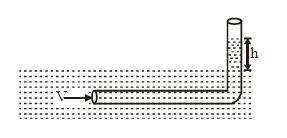
- 5An $L-$ shaped glass tube is just immersed in flowing water towards tube as shown. If speed of water current is $V,$ then the height $h$ upto which water rises will beView Solution
- 6Water from a tap emerges vertically downwards with an initial speed of $1.0\,ms^{-1}.$ The cross-sectional area of the tap is $10^{-4}\,m^2.$ Assume that the pressure is constant throughout the stream of water and that flow is streamlined. The cross-sectional area of the stream, $0.15\,m$ below the tap would be: (take $g = 10\,ms^{-2}$ )View Solution
- 7In making an alloy, a substance of specific gravity ${s_1}$ and mass ${m_1}$ is mixed with another substance of specific gravity ${s_2}$ and mass ${m_2}$; then the specific gravity of the alloy isView Solution
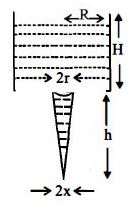
- 8Consider a water jar of radius $R$ that has water filled up to height $H$ and is kept on a stand of height $h$ (see figure) . Through a hole of radius $r$ $(r << R)$ at its bottom, the water leaks out and the stream of water coming down towards the ground has a shape like a funnel as shown in the figure. If the radius of the cross-section of water stream when it hits the ground is $x.$ ThenView Solution
- 9View SolutionA wooden piece floats half submerged in a tub of water. If the system is transferred to a lift ascending with acceleration the wooden piece will
- 10Two identical cylindrical vessels with their bases at same level, each contains a liquid of density $d$ . The height of the liquid in one vessel is $ h_1$ and that in the other vessel is $h_2$ . The area of either base is $A$ . The work done by gravity in equalizing the levels when the two vessels are connected isView Solution