A ball whose density is $0.4 × 10^3 kg/m^3$ falls into water from a height of $9 cm$ . To what depth does the ball sink........ $cm$
Diffcult


Download our appand get started for free
Experience the future of education. Simply download our apps or reach out to us for more information. Let's shape the future of learning together!No signup needed.*
Similar Questions
- 1There is a $1$ $mm $ thick layer of glycerine between a flat plate of area $100$ $cm^2$ $\&$ a big fixed plate. If the coefficient of viscosity of glycerine is $1.0$ $kg/m^{-s}$ then ....... $N$ force is required to move the plate with a velocity of $7$ $cm/s$ ?View Solution
- 2$Assertion :$ The buoyant force on a submerged rigid object can be considered to be acting at the centre of mass of the object.View Solution
$Reason :$ For a rigid body a force field distributed uniformly through its volume can be considered to be acting at the centre of mass of the body. - 3A barometer kept in an elevator reads $76 \,cm$ when it is at rest. If the elevator goes up with some acceleration, the reading will be .......... $cm$View Solution
- 4View SolutionAn empty glass jar is submerged in tank of water with open mouth of the jar downwards, so that air inside the jar is trapped and cannot get out. As the jar is pushed down slowly, the magnitude of net buoyant force on the system of volume of gas trapped in the jar and the jar
- 5The pressure acting on a submarine is $3 \times 10^{5}\;Pa$ at a certain depth. If the depth is doubled, the percentage increase in the pressure acting on the submarine would be: (Assume that atmospheric pressure is $1 \times 10^{5} \;Pa$ density of water is $10^{3}\, kg \,m ^{-3}, g =10 \,ms ^{-2}$ )View Solution
- 6The Bhagirathi and the Alaknanda merge at Deoprayag to form the Ganga with their speeds in the ratio $1: 1: 5$. The cross-sectional areas of the Bhagirathi, the Alaknanda and the Ganga are in the ratio $1: 2: 3$. Assuming streamline flow, the ratio of the speed of Ganga to that of the Alaknanda isView Solution
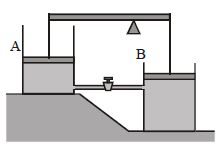
- 7In the arrangement shown both the vessels $A$ and $B$ are identical but amount of water in $B$ is double of that in $A$. The vessels are closed by identical leak proof pistons at the same height. The pistons are connected to the ends of lever arm. There is no friction between the pistons and the container walls. The system is in equilibrium in the situation shown. Now the valve in the horizontal tube connecting both the vessels is opened. In which direction will the water flow through the tube ?View Solution
- 8View SolutionIn old age arteries carrying blood in the human body become narrow resulting in an increase in the blood pressure. This follows from
- 9View SolutionThe pressure at the bottom of a tank containing a liquid does not depend on
- 10View SolutionThe venturi-meter works on :