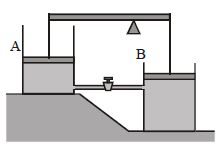
In the arrangement shown both the vessels $A$ and $B$ are identical but amount of water in $B$ is double of that in $A$. The vessels are closed by identical leak proof pistons at the same height. The pistons are connected to the ends of lever arm. There is no friction between the pistons and the container walls. The system is in equilibrium in the situation shown. Now the valve in the horizontal tube connecting both the vessels is opened. In which direction will the water flow through the tube ?
Medium
Download our app for free and get started

Download our appand get started for free
Experience the future of education. Simply download our apps or reach out to us for more information. Let's shape the future of learning together!No signup needed.*
Similar Questions
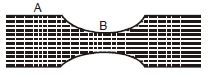
- 1Water flows in a horizontal tube as shown in figure. The pressure of water changes by $600\, N/ m^2$ between $A$ and $B$ where the area of crosssection are $30\, cm^2$ and $15\, cm^2$ respectively. Find the rate of flow of water through the tube.View Solution
- 2A flat plate of area $10\,cm^2$ is separated from a large plate by a layer of glycerine $1\, mm$ thick. If the coefficient of viscosity of glycerine is $20$ poise, the force required to keep the plate moving with a velocity of $1\,cm/sec$ is .......... $dyne$View Solution
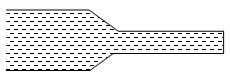
- 3Water flows through a frictionless duct with a cross-section varying as shown in fig. Pressure $p$ at points along the axis is represented byView Solution
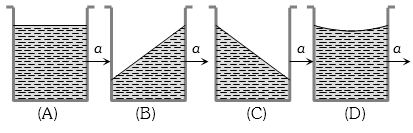
- 4View SolutionA vessel containing water is given a constant acceleration a towards the right, along a straight horizontal path. Which of the following diagram represents the surface of the liquid
- 5View SolutionSelect the correct statement regarding stream line flow
- 6A beaker containing a liquid of density $\rho $ moves up with an acceleration $a$ ; the pressure due to the liquid at a depth $h$ below the free surface of the liquid isView Solution
- 7A light cylindrical vessel is kept on a horizontal surface. Area of base is A. A hole of crosssectional area $'a'$ is made just at its bottom side. The minimum coefficient of friction necessary to prevent sliding the vessel due to the impact force of the emerging liquid is $(a\,<\,<\,A)$View Solution
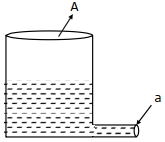
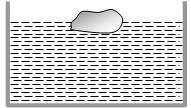
- 8View SolutionA body floats in a liquid contained in a beaker. The whole system as shown falls freely under gravity. The upthrust on the body due to the liquid is
- 9View SolutionA small steel ball is dropped into a long cylinder containing glycerine. Which one of the following is the correct representation of the velocity time graph for the transit of the ball?
- 10A small ball of mass $M$ and density $\rho$ is dropped in a viscous liquid of density $\rho_0$. After some time, the ball falls with a constant velocity. What is the viscous force on the ball ?View Solution