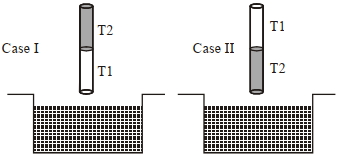
A cylindrical capillary tube of $0.2 mm$ radius is made by joining two capillaries $T 1$ and $T 2$ of different materials having water contact angles of $0^{\circ}$ and $60^{\circ}$, respectively. The capillary tube is dipped vertically in water in two different configurations, case I and II as shown in figure. Which of the following option($s$) is(are) correct?
(Surface tension of water $=0.075 N / m$, density of water $=1000 kg / m ^3$, take $g =10 m / s ^2$ )
$(1)$ The correction in the height of water column raised in the tube, due to weight of water contained in the meniscus, will be different for both cases.
$(2)$ For case I, if the capillary joint is $5 cm$ above the water surface, the height of water column raised in the tube will be more than $8.75 cm$. (Neglect the weight of the water in the meniscus)
$(3)$ For case $I$, if the joint is kept at $8 cm$ above the water surface, the height of water column in the tube will be $7.5 cm$. (Neglect the weight of the water in the meniscus)
$(4)$ For case II, if the capillary joint is $5 cm$ above the water surface, the height of water column raised in the tube will be $3.75 cm$. (Neglect the weight of the water in the meniscus)