Question
A baloon filled with helium rises against gravity increasing its potential energy. The speed of the baloon also increases as it rises. How do you reconcile this with the law of conservation of mechanical energy? You can neglect viscous drag of air and assume that density of air is constant.
Answer

As the dragging viscous force of air on balloon is neglected so there is Net Buoyant Force = Vpg = Volume of air displaced × net density upward × g$=\text{V}(\text{p}_{\text{air}}-\text{p}_\text{He})\text{g}(\text{upward})$
Let a be the upward acceleration on balloon then,$\text{ma}=\text{V}(\text{p}_{\text{air}}-\text{p}_\text{He})\text{g}\ ...(\text{i})$
V = Volume of air displacement by balloon = Volume of balloon $p_{air}$ = density of air $p_{He}$ = density of helium$\text{m}\frac{\text{dv}}{\text{dt}}=\text{V}(\text{p}_{\text{air}}-\text{p}_\text{He})\text{g}$
$\text{m dv}=\text{V}(\text{p}_{\text{air}}-\text{p}_\text{He})\text{g}\cdot\text{dt}$
Integrating both sides $\text{mv}=\text{V}(\text{p}_{\text{air}}-\text{p}_\text{He})\text{gt}$$\text{v}=\frac{\text{V}}{\text{m}}(\text{p}_{\text{air}}-\text{p}_\text{He})\text{gt}$
KE of balloon $=\frac{1}{2}\text{mv}^2$$\frac{1}{2}\text{mv}^2=\frac{1}{2}\text{m}\frac{\text{v}^2}{\text{m}^2}(\text{p}_{\text{air}}-\text{p}_\text{He})^2\text{g}^2\text{t}^2$
$=\frac{\text{V}^2}{2\text{m}}(\text{p}_{\text{air}}-\text{p}_\text{He})^2\text{g}^2\text{t}^2\ ....(\text{ii})$
If the balloon rises to a height h, from (i)$\text{a}=\frac{\text{V}}{\text{m}}(\text{p}_{\text{air}}-\text{p}_\text{He})\text{g}$
$\text{h}=\text{ut}+\frac{1}{2}\text{at}^2=0\cdot\text{t}+\frac{1}{2}\Big[\frac{\text{V}}{\text{m}}(\text{p}_\text{air}-\text{p}_\text{He})\Big]\text{t}^2$
$\therefore\ \text{h}=\frac{\text{V}}{2\text{m}}(\text{p}_\text{air}-\text{p}_\text{he})\text{gt}^2\ ...(\text{iii})$
From (ii) and (iii) rearranging the terms of (ii) according to h in (iii)$\frac{1}{2}\text{mv}^2=\Big\{\frac{\text{V}}{2\text{m}}(\text{p}_\text{air}-\text{p}_\text{He})\text{gt}^2\Big\}\cdot\text{V}(\text{p}_\text{air}-\text{p}_{\text{He}})\text{g}$
$\frac{1}{2}\text{mv}^2=\{\text{h\}}\cdot\text{V}(\text{p}_\text{air}-\text{p}_{\text{He}})\text{g}$
$\frac{1}{2}\text{mv}^2=\text{V}\cdot(\text{p}_\text{air}-\text{p}_{\text{He}})\text{gh}$
$\frac{1}{2}\text{mv}^2=\text{V}\text{p}_\text{air}\text{gh}-\text{V}\text{p}_{\text{He}}\text{gh}$
$\frac{1}{2}\text{mv}^2+\text{p}_{\text{He}}\text{Vgh}=\text{p}_\text{air}\text{Vgh}$
$\text{KE}_{\text{ballon}}+\text{PE}_{\text{ballon}}=\text{Changein PE of air}$
So, as the balloon goes up, an equal volume of air comes down, increases in PE and KE of the balloon is at cost of PE of air (which comes down).

Need a full question paper?

Generate a complete, print-ready paper with questions like this in minutes — across 16+ boards, with answer keys.

Start Generating Free

Similar questions

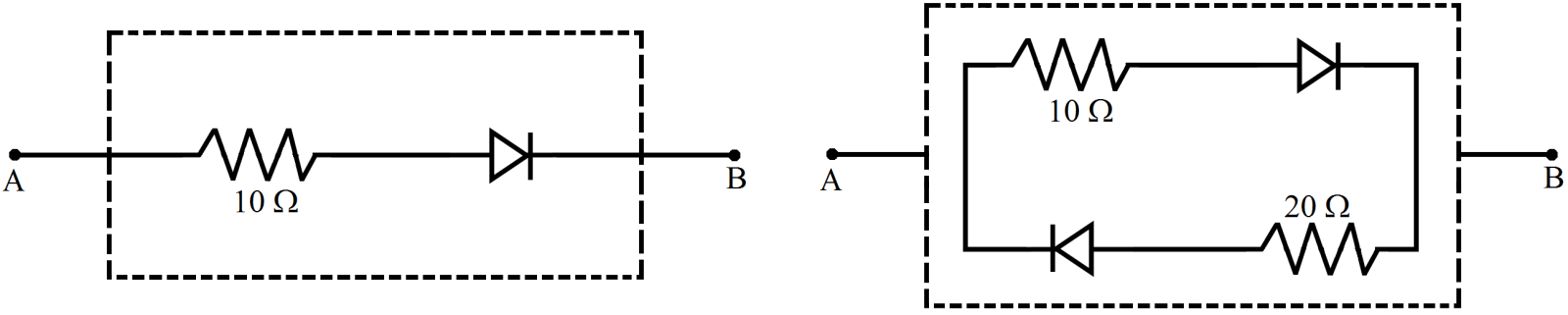
Draw the current-voltage characteristics for the device shown in figure. between the terminals A and B.
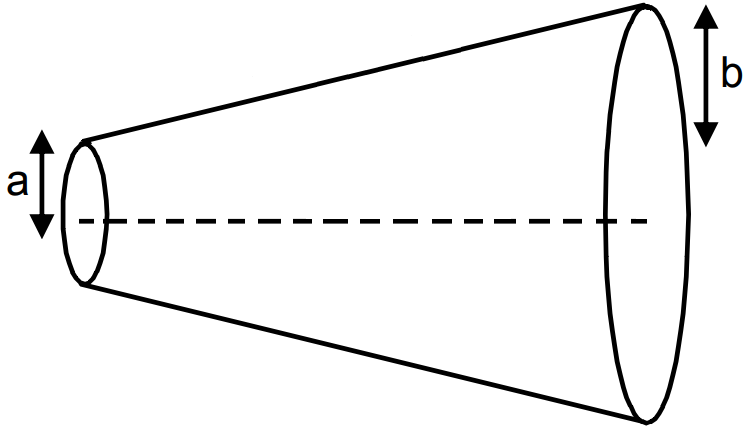
Figure. shows a conductor of length l with a circular cross-section. The radius of the cross-section varies linearly from a to b. The resistivity of the material is ρ. Assuming that b - a << l, find the resistance of the conductor.
Separation of Motion of a system of particles into motion of the centre of mass and motion about the centre of mass: Show $\text{K}=\text{K}'+\frac{1}{2}\text{M}\text{V}^2$ where K' is the total kinetic energy of the system of particles, K′ is the total kinetic energy of the system when the particle velocities are taken with respect to the centre of mass and $\frac{\text{MV}^2}{2}$ is the kinetic energy of the translation of the system as a whole (i.e. of the centre of mass motion of the system). The result has been used in $\sec7.14$
Describe surface tension on the basis of molecular forces.
  1. Prove the theorem of perpendicular axes.
(Hint: Square of the distance of a point (x, y) in the x - y plane from an axis through the origin and perpendicular to the plane is $x^2+ y^2$).
  1. Prove the theorem of parallel axes.
(Hint: If the centre of mass of a system of n particles is chosen to be the origin $\sum\text{m}_{\text{i}}\text{r}_\text{i}=0)$
Find the amount of the fluid flowing through the tube per second through venturi flow meter.
A wire stretched between two rigid supports vibrates in its fundamental mode with a frequency of $45Hz$. The mass of the wire is $3.5 \times 10^{–2}kg$ and its linear mass density is $4.0 \times 10^{–2}kg m^{–1}$. What is
  1. The speed of a transverse wave on the string,
  2. The tension in the string?
Derive expression for velocity of a car on a banked circular road having coefficient of frictions. Hence write the expression for optimum velocity.
The radii of curvature of a lens are +20cm and +30cm. The material of the lens has a refracting index 1.6. Find the focal length of the lens.
  1. If it is placed in air.
  2. If it is placed in water $(\mu=1.33).$
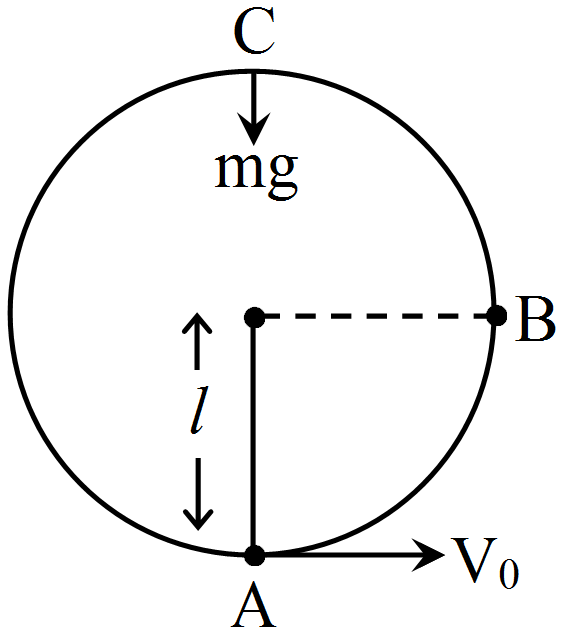
A bob of mass $m$ is suspended by a light string of length $l.$ It is imparted a horizontal velocity $v_o$ at the lowest point $A$ so that it completes a semi$-$circular trajectory in the vertical plane with the string becoming slack only on reaching the topmost point $C.$ This is shown in the figure. Obtain an expression for:
  1. Horizontal velocity $v.$
  2. The speed at point $B$ and $C.$
  3. The ratio of the kinetic energies$\bigg(\frac{\text{K}_\text{B}}{\text{K}_\text{C}}\bigg)$ at $B$ and $C.$
  4. Comment on the nature of the trajectory of the bob after it reaches the point $C.$