Separation of Motion of a system of particles into motion of the centre of mass and motion about the centre of mass: Show $\text{K}=\text{K}'+\frac{1}{2}\text{M}\text{V}^2$ where K' is the total kinetic energy of the system of particles, K′ is the total kinetic energy of the system when the particle velocities are taken with respect to the centre of mass and $\frac{\text{MV}^2}{2}$ is the kinetic energy of the translation of the system as a whole (i.e. of the centre of mass motion of the system). The result has been used in $\sec7.14$
Exercise
Download our app for free and get started
We have the relation for velocity of the $I^{th}$ particle as, $\text{v}_\text{i}=\text{v}'_\text{i}+\text{V}$
$\sum\limits_\text{i}\text{m}_\text{i}\text{v}_\text{i}=\sum\limits_\text{i}\text{m}_\text{i}\text{v}_\text{i}'+\sum\limits_\text{i}\text{m}_\text{i}\text{V}\ ...(\text{ii})$ Taking the dot product of equation (ii) with itself, we get $\sum\limits_\text{i}\text{m}_\text{i}\text{v}_\text{i}\cdot\sum_\limits\text{i}\text{m}_\text{i}\text{v}_\text{i}=\sum\limits_\text{i}\text{m}_\text{i}\big(\text{v}'_\text{i}+\text{V}\big)\cdot\sum\limits_\text{i}\text{m}_\text{i}\big(\text{v}'_\text{i}+\text{V}\big)$
$\text{M}^2\sum\limits_\text{i}\text{v}_\text{i}^2=\text{M}^2\sum\limits_\text{i}\text{v}'{_\text{i}^2}+\text{M}^2\sum\limits_\text{i}\text{v}_\text{i}\cdot\text{v}_\text{i}'+\text{M}^2\sum\limits_\text{i} \text{v}'_\text{i}\cdot\text{v}_\text{i}+\text{M}^2\text{V}^2$ Here, for the centre of mass of the system of particles, $\sum\limits_\text{i}\text{v}_\text{i}\cdot\text{v}'_\text{i}=-\sum\limits_\text{i}\text{v}'_\text{i}\cdot\text{v}_\text{i}$
$\text{M}^2\sum\limits_\text{i}\text{v}_\text{i}^2=\text{M}^2\sum\limits_\text{i}\text{v}'{_\text{i}^2}+\text{M}^2\text{V}^2$
$\text{M}^2\sum\limits_\text{i}\text{v}_\text{i}^2=\text{M}^2\sum\limits_\text{i}\text{v}'{_\text{i}^2}+\text{M}^2\text{V}^2$
$\frac{1}{2}\text{M}\sum\limits_\text{i}\text{v}^2_\text{i}=\frac{1}{2}\text{M}\sum\limits_\text{i}\text{v}'^2_\text{i}+\frac{1}{2}\text{MV}^2$
$\text{K}=\text{K}'+\frac{1}{2}\text{MV}^2$ Where, $\text{K}=\frac{1}{2}\text{M}\sum\limits_\text{i}\text{v}^2_\text{i}$ = Total kinetic energy of the system of particles $\text{K}'=\frac{1}{2}\text{M}\sum\limits_\text{i}\text{v}'^2_\text{i}$ = Total kinetic energy of the system of particles with respect to the centre of mass $\frac{1}{2}\text{MV}^2$ = Kinetic energy of the translation of the system as a whole.
$\sum\limits_\text{i}\text{m}_\text{i}\text{v}_\text{i}=\sum\limits_\text{i}\text{m}_\text{i}\text{v}_\text{i}'+\sum\limits_\text{i}\text{m}_\text{i}\text{V}\ ...(\text{ii})$ Taking the dot product of equation (ii) with itself, we get $\sum\limits_\text{i}\text{m}_\text{i}\text{v}_\text{i}\cdot\sum_\limits\text{i}\text{m}_\text{i}\text{v}_\text{i}=\sum\limits_\text{i}\text{m}_\text{i}\big(\text{v}'_\text{i}+\text{V}\big)\cdot\sum\limits_\text{i}\text{m}_\text{i}\big(\text{v}'_\text{i}+\text{V}\big)$
$\text{M}^2\sum\limits_\text{i}\text{v}_\text{i}^2=\text{M}^2\sum\limits_\text{i}\text{v}'{_\text{i}^2}+\text{M}^2\sum\limits_\text{i}\text{v}_\text{i}\cdot\text{v}_\text{i}'+\text{M}^2\sum\limits_\text{i} \text{v}'_\text{i}\cdot\text{v}_\text{i}+\text{M}^2\text{V}^2$ Here, for the centre of mass of the system of particles, $\sum\limits_\text{i}\text{v}_\text{i}\cdot\text{v}'_\text{i}=-\sum\limits_\text{i}\text{v}'_\text{i}\cdot\text{v}_\text{i}$
$\text{M}^2\sum\limits_\text{i}\text{v}_\text{i}^2=\text{M}^2\sum\limits_\text{i}\text{v}'{_\text{i}^2}+\text{M}^2\text{V}^2$
$\text{M}^2\sum\limits_\text{i}\text{v}_\text{i}^2=\text{M}^2\sum\limits_\text{i}\text{v}'{_\text{i}^2}+\text{M}^2\text{V}^2$
$\frac{1}{2}\text{M}\sum\limits_\text{i}\text{v}^2_\text{i}=\frac{1}{2}\text{M}\sum\limits_\text{i}\text{v}'^2_\text{i}+\frac{1}{2}\text{MV}^2$
$\text{K}=\text{K}'+\frac{1}{2}\text{MV}^2$ Where, $\text{K}=\frac{1}{2}\text{M}\sum\limits_\text{i}\text{v}^2_\text{i}$ = Total kinetic energy of the system of particles $\text{K}'=\frac{1}{2}\text{M}\sum\limits_\text{i}\text{v}'^2_\text{i}$ = Total kinetic energy of the system of particles with respect to the centre of mass $\frac{1}{2}\text{MV}^2$ = Kinetic energy of the translation of the system as a whole.

Download our appand get started for free
Experience the future of education. Simply download our apps or reach out to us for more information. Let's shape the future of learning together!No signup needed.*
Similar Questions
- 1View SolutionA disc of radius R is cut out from a larger disc of radius 2R in such a way that the edge of the hole touches the edge of the disc. Locate the centre of mass of the residual disc.
- 2View SolutionA ball is whirled in a circle by attaching it to a fixed point with a string. Is there an angular rotation of the ball about its centre? If yes, is this angular velocity equal to the angular velocity of the ball about the fixed point?
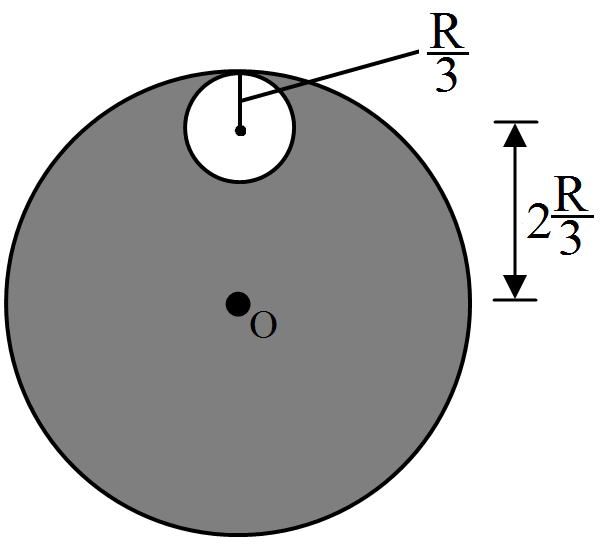
- 3From a circular disc of radius R and mass 9M, a small disc of radius $\frac{\text{R}}{3}$ is removed as shown in Fig. Find the moment of inertia of the remaining disc about an axis perpendicular to the plane of the disc and passing through the point O.View Solution
- 4View SolutionA particle of mass m is projected from origin O with speed u at an angle with positive x-axis. Find the angular momentum of particle at any time t about O before the particle strikes the ground again.
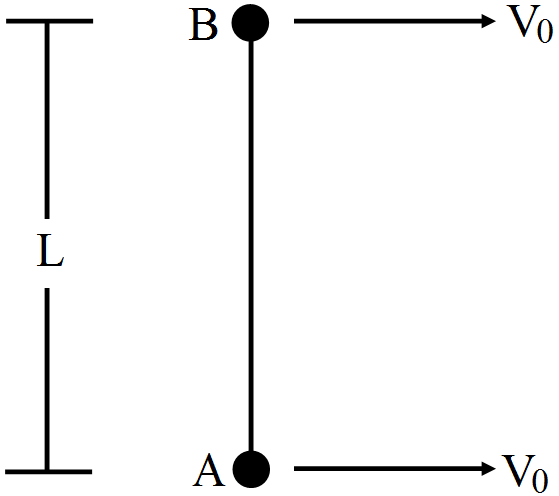
- 5View SolutionTwo small balls A and B, each of mass m, are joined rigidly to the ends of a light rod of lengh L (figure). The system translates on a frictionless horizontal surface with a velocity vo in a direction perpendicular to the rod. A particle P of mass m kept at rest on the surface sticks to the ball A as the ball collides with it. Find:
- The linear speeds of the balls A and B after the collision.
- The velocity of the centre of mass C of the system A + B + P.
- The angular speed of the system about C after the collision.
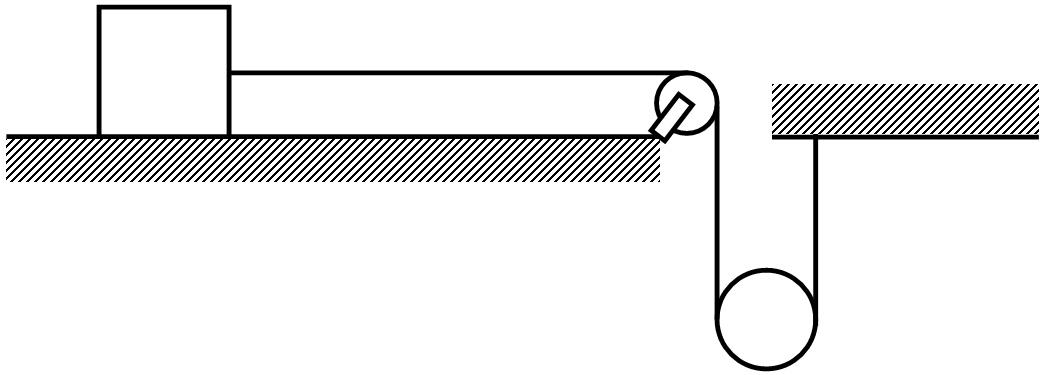
- 6The descending pulley shown in figure has a radius $20cm$ and moment of inertia $0.20kg-m^2$. The fixed pulley is light and the horizontal plane frictionless. Find the acceleration of the block if its mass is $1.0kg$.View Solution
- 7Prove that the velocity v of translation of a rolling body (like a ring, disc, cylinder or sphere) at the bottom of an inclined plane of height h is given by:$\text{v}^2=\frac{2\text{gh}}{\big(1+\frac{\text{K}^2}{\text{R}^2}\big)}$View Solution
Note K is the radius of gyration of the body about its symmetry axis, and R is the radius of the body. The body starts from rest at the top of the plane. - 8Separation of Motion of a system of particles into motion of the centre of mass and motion about the centre of mass: Show $\text{K}=\text{K}'+\frac{1}{2}\text{M}\text{V}^2$ where K' is the total kinetic energy of the system of particles, K′ is the total kinetic energy of the system when the particle velocities are taken with respect to the centre of mass and $\frac{\text{MV}^2}{2}$ is the kinetic energy of the translation of the system as a whole (i.e. of the centre of mass motion of the system). The result has been used in $\sec7.14$View Solution
- 9A uniform rod pivoted at its upper end hangs vertically. It is displaced through an angle of $60°$ and then released. Find the magnitude of the force acting on a particle of mass dm at the tip of the rod when the rod makes an angle of $37°$ with the vertical.View Solution
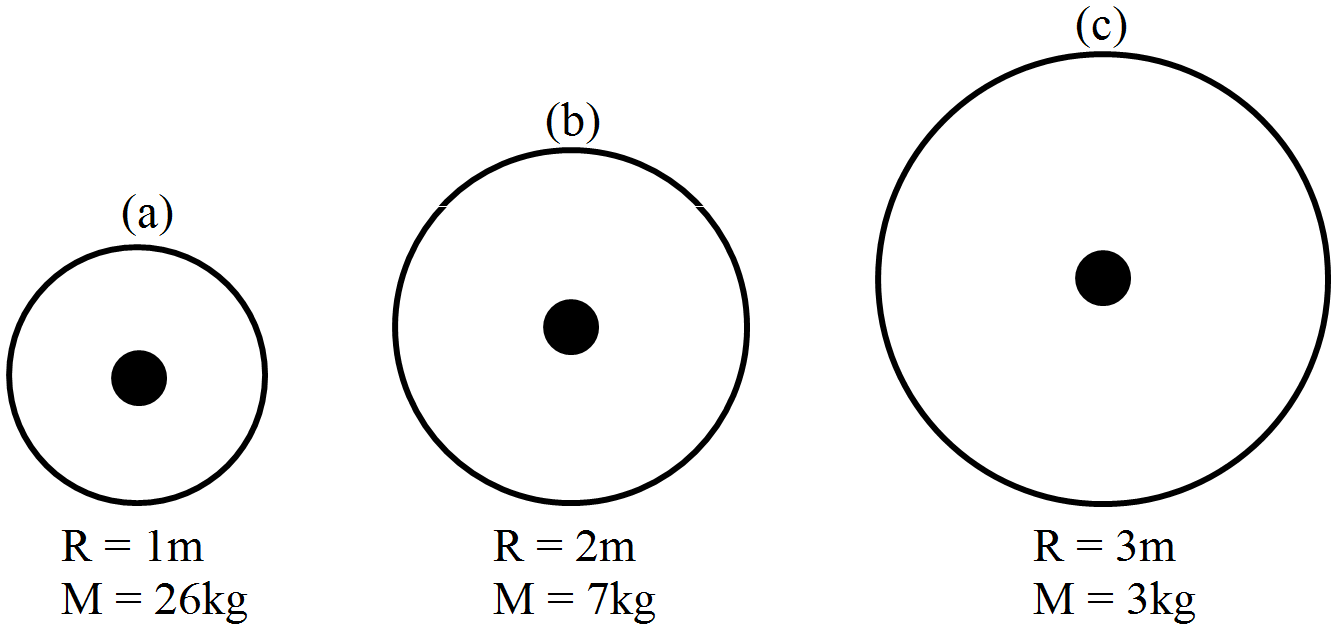
- 10View SolutionFigure shows three uniform discs, along with their radii R and masses M. Rank the discs according to their rotational inertia about their central axes, greatest first.