Question
A bar magnet takes $\frac{\pi}{10}$ second to complete one oscillation in an oscillation magnetometer. The moment of inertia of the magnet about the axis of rotation is $1.2 \times 10^{-4} \mathrm{~kg}-\mathrm{m}^2$ and the earth's horizontal magnetic field is $30\mu \text{T}.$ Find the magnetic moment of the magnet.
Answer

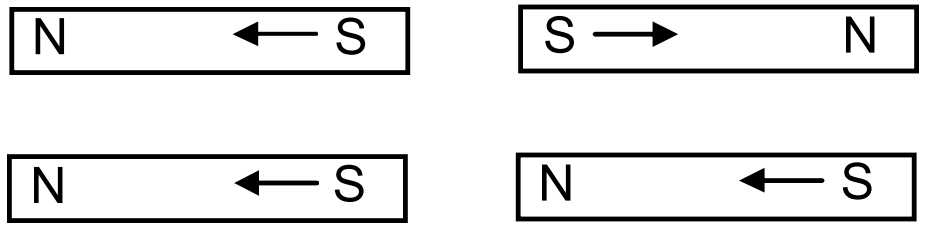
We know: $\text{v}=\frac{1}{2\pi}\sqrt{\frac}{\text{mB}_\text{H}}{\text{I}}$For like poles tied together
$M=M_1-M_2$
For unlike poles $\mathrm{M}^{\prime}=\mathrm{M}_1+\mathrm{M}_2$
$\frac{\text{v}_1}{\text{v}_2}=\sqrt{\frac{\text{M}_1-\text{M}_2}{\text{M} _1-\text{M}_2}}\Rightarrow\Big(\frac{10}{2}\Big)^2$
$=\frac{\text{M}_1-\text{M}_2}{\text{M}_1+\text{M}_2}\Rightarrow25=\frac{\text{M}_1-\text{M}_2}{\text{M}_1+\text{M}_2}$
$\Rightarrow\frac{26}{24}=\frac{2\text{M}_1}{2\text{M}_2}\Rightarrow\frac{\text{M}_1}{\text{M}_2}=\frac{13}{12}$

Need a full question paper?

Generate a complete, print-ready paper with questions like this in minutes — across 16+ boards, with answer keys.

Start Generating Free

Similar questions

An ideal gas is pumped into a rigid container having diathermic walls so that the temperature remains constant. In a certain time interval, the pressure in the container is doubled. Is the internal energy of the contents of the container also doubled in the interval?
If the earth's magnetic field has a magnitude $3.4 \times 10^{-5} T$ at the magnetic equator of the earth what would be its value at the earth's geomagnetic poles?
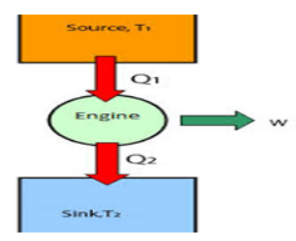
Read the passage given below and answer the following questions from (i) to (v). Heat engine is a device by which a system is made to undergo a cyclic process that results in conversion of heat to work. It consists of a working substance-the system. For example, mixture of fuel vapors and air in a gasoline or diesel engine or steam in a steam engine are the working Substances. The working substance goes through a cycle consisting of several processes. In some of these processes, it absorbs a total amount of heat Q1 from an external reservoir at some high temperature T1. In some other processes of the cycle, the working substance releases a total amount of heat $Q_2$ to an external reservoir at some lower temperature T2. The work done (W) by the system in a cycle is transferred to the environment via some arrangement (e.g. the working substance may be in a cylinder with a moving piston that transfers mechanical energy to the wheels of a vehicle via a shaft). The basic features of a heat engine are schematically represented in Fig.

The cycle is repeated again and again to get useful work for some purpose. The discipline of Thermodynamics has its roots in the study of heat engines. A basic question relates to the efficiency of a heat engine. The efficiency ( h ) of a heat engine is defined by $n =\frac{ W }{ Q _1}$ Where Q 1 is the heat input i.e., the heat absorbed by the system in one complete cycle and $W$ is the work done on the environment in a cycle. In a cycle, a certain amount of heat $\left(Q_2\right)$ may also be rejected to the environment. Then according to the First Law of Thermodynamics, over one complete cycle. $W = Q _1-$ $Q_2 n =1-\frac{Q_2}{Q_1}$ For $Q_2=0, n=1$, i.e., the engine will have $100 \%$ efficiency in converting heat into work. Note that the First Law of Thermodynamics i.e., the energy conservation law does not rule out such an engine. But experience shows that such an ideal engine with $\eta=1$ is never possible. A refrigerator is the reverse of a heat engine. Here the working substance extracts heat $Q _2$ from the cold reservoir at temperature $T 2$, some external work $W$ is done on it and heat Q1 is released to the hot reservoir at temperature T1. The efficiency of refrigerator is expressed in terms of coefficient of performance $(\alpha)$ of a refrigerator is given by $\alpha=\frac{ Q _2}{W}$ where $Q _2$ is the heat extracted from the cold reservoir and $W$ is the work done on the system
  1. In a heat engine the process need not be cyclic. True or False?
  1. True
  2. False
  1. Efficiency of heat engine N = 100% is it practically possible?
  1. Yes
  2. No
  1. Define efficiency of heat engine.
  2. Define coefficient of performance.
  3. Write a note on heat engine.
An amount $n$ (in moles) of a monatomic gas at an initial temperature $T_0$ is enclosed in a cylindrical vessel fitted with a light piston. The surrounding air has a temperature $T_5\left(>T_0\right)$ and the atmospheric pressure is $\mathrm{P}_{\mathrm{a}} \cdot$ Heat may be conducted between the surrounding and the gas through the bottom of the cylinder. The bottom has a surface area A, thickness $x$ and thermal conductivity K. Assuming all changes to be slow, find the distance moved by the piston in time t.
Read the passage given below and answer the following questions from $(i)$ to $(v)$. All engineering phenomena deal with definite and measured quantities and so depend on the making of the measurement. We must be
clear and precise in making these measurements. To make a measurement, magnitude of the physical quantity (unknown) is compared.
The record of a measurement consists of three parts, i.e. the dimension of the quantity, the unit which represents a standard quantity and a number which is the ratio of the measured quantity to the standard quantity.
  1. A device which is used for measurement of length to an accuracy of about $10^{-5}m$, is:
  1. Screw gauge
  2. Spherometer
  3. Vernier callipers
  4. Either $(a)$ or $(b)$
  1. Which of the technique is not used for measuring time intervals?
  1. Electrical oscillator
  2. Atomic clock
  3. Spring oscillator
  4. Decay of elementary particles
  1. The mean length of an object is 5cm. Which of the following measurements is most accurate?
  1. $4.9\ cm$
  2. $4.805\ cm$
  3. $5.25\ cm$
  4. $5.4\ cm$
  1. If the length of rectangle $l = 10.5\ cm,$ breadth $b = 2.1\ cm$ and minimum possible measurement by scale$ = 0.1\ cm,$ then the area is:
  1. $22.0\ cm^2$
  2. $21.0\ cm^2$
  3. $22.5\ cm^2$
  4. $21.5\ cm^2$
  1. Age of the universe is about $10^{10}$ yr, whereas the mankind has existed for $10^6$ yr. For how many seconds would the man have existed, if age of universe were $1$ day?
  1. $9.2\ s$
  2. $10.2\ s$
  3. $8.6\ s$
  4. $10.5\ s$
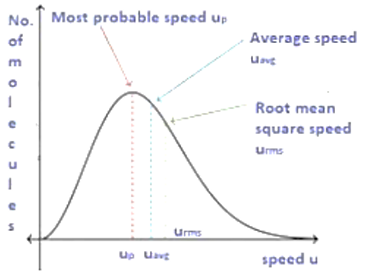
Root mean square velocity (RMS value)is the square root of the mean of squares of the velocity of individual gas molecules and the Average velocity is the arithmetic mean of the velocities of different molecules of a gas at a given temperature.
Image
1. Moon has no atmosphere because:
(a) the escape velocity of the moon’s surface is more than the r.m.s velocity of all molecules
(b) it is far away from the surface of the earth
(c) the r.m.s. velocity of all the gas molecules is more than the escape velocity of the moon’s surface
(d) its surface temperature is $10^{\circ} C$
2. For an ideal gas, $\frac{C_P}{C_V}$ is
(a) $\leq 1$    (b) none of these    (c) $>1$    (d) $<1$
3. The root means square velocity of hydrogen is $\sqrt{5}$ times that of nitrogen. If $T$ is the temperature of the gas then:
(a) $T\left(H_2\right)=T\left(N_2\right)$    (b) $T \left( H _2\right)< T \left( N _2\right)$
(c) $T \left( H _2\right) \neq T \left( N _2\right)$    (d) $T \left( H _2\right)> T \left( N _2\right)$
4. Suppose the temperature of the gas is tripled and $N _2$ molecules dissociate into an atom. Then what will be the rms speed of atom:
(a) $v_0 \sqrt{2}$    (b) $v_0 \sqrt{6}$    (c) $v_0 \sqrt{3}$    (d) $v_0$
OR
The velocities of the molecules are $v , 2 v , 3 v , 4 v \& 5 v$. The RMS speed will be:
(a) 11 v    (b) $v (12)^{11}$   (c) v    (d) $v (11)^{12}$
Read the passage given below and answer the following questions from 1 to 5. If A is vector given by $A = Ax\ i + Ay\j$ where The quantities $A_x$ and $A_y$ are called x, and y- components of the vector A. Note that Ax is itself not a vector, but $A_x$ i is a vector, and so is $A_y\ j$. Using simple trigonometry, we can express $A_x$ and $A_y$ in terms of the magnitude of A and the angle \theta it makes with the x-axis. $\text{Ax} = \text{A} \cos(\theta)$
$\text{Ay} = \text{A} \text{ \sin}(\theta)$ If A and $\theta$ are given, Ax and Ay can be obtained using If Ax and Ay are given, A and $\theta$ can be obtained as follows – $\text{A}^2_\text{x}+\text{A}^2_\text{y}=(\text{A}\cos\theta)^2+(\text{A}\sin\theta)^2$ $\text{A}^2_\text{x}+\text{A}^2_\text{y}=\text{A}^2\cos^2\theta+\text{A}^2\sin^2\theta$ $\Rightarrow\text{A}^2_\text{x}+\text{A}^2_\text{y}=\text{A}^2(\cos^2\theta+\sin^2\theta)$ ${A}^2_\text{x}+\text{A}^2_\text{y}=\text{A}^2(\because\sin^2\theta+\cos^2\theta=1)$ $\text{A}^2=\text{A}^2_\text{y}+\text{A}^2_\text{y}$ $\Rightarrow\text{A}=\sqrt{\text{A}^2_\text{x}+\text{A}^2_\text{y }}...$ $\text{Dividing}\text{ A}_\text{y}\text{ by} \text{ A}_\text{y},\text{we get}$ $\frac{\text{A}_\text{y}}{\text{A}_\text{x}}=\frac{\text{A}\sin\theta}{\text{A}\cos\theta}$ $\Rightarrow\frac{\text{A}_\text{y}}{\text{A}_\text{x}}=\tan\theta$ $\tan\theta=\frac{\text{A}_\text{y}}{\text{A}_\text{x}}$ $\theta=\tan^{-1}\Big[\frac{\text{A}_\text{y}}{\text{A}_\text{x}}\Big]$
Position vector-The position vector r of a particle P located in a plane with reference to the origin of an x-y reference frame is given by $r = x i + y j$ where x and y are components of r along x-, and y- axes or simply they are the coordinates of the object. Suppose a particle moves along the Then, the displacement is: $\triangle r = r_2-r_1.$ We can write this in a component form: $\triangle r = (x’ i + y’ j) – ( x i + y j) = i\triangle x – j\triangle y$ Where $\triangle x = x’ – x, \triangle y = y – y.$
The average velocity (v) of an object is the ratio of the displacement and the corresponding time Interval. $\text{V}=\frac{\triangle\text{r}}{\triangle\text{t}}$
$=\frac{\text{i}\triangle\text{x}-\text{j}\triangle\text{y}}{\triangle\text{t}}$
$=\text{i}\times\frac{\triangle\text{x}}{\triangle\text{t}}+\text{j}\times\frac{\triangle\text{y}}{\triangle\text{t}}$
$=\text{V}_\text{x}\text{i}+\text{V}_\text{y}\text{j}$ So, if the expressions for the coordinates x and y are known as functions of time, we can use these equations to find vx and vy. The magnitude of v is then $V = ( v_x^2+ v_y^2)$ and the direction of v is given by the angle q and given by $\tan(\theta)=\frac{\text{vx}}{\text{vy}}$
  1. If A is vector given by A = Ax i + Ay j .if the magnitude of vector is A and the angle $\theta$ it makes with the x-axis Ax can be given by:
  1. Ax = A cos(q)
  2. Ax = A sin(q)
  3. Ax = A tan(q)
  4. None of the above
  1. If A is vector given by A = Ax i + Ay j .if the magnitude of vector is A and the angle $\theta$ it makes with the x-axis Ay can be given by:
  1. Ax = A cos(q)
  2. Ax = A sin(q)
  3. Ax = A tan(q)
  4. None of the above
  1. Write a note on position vector and displacement of object:
  1. Write a note on average velocity:
  1. If A is vector given by A = Ax i + Ay j where obtain expression for resultant amplitude of vector and its angle with x axis:
A steel blade placed gently on the surface of water floats on it. If the same blade is kept well inside the water, it sinks. Explain.
Read the passage given below and answer the following questions from 1 to 5. Beat The phenomenon of regular variation in intensity of sound with time at a particular position due to superposition of two sound waves of slightly different frequencies is called beats. For waves
$\therefore\text{y}=2\text{a}\cos\pi(\text{v}_1-\text{v}_2)\text{t}.\sin\pi(\text{v}_1-\text{v}_2)\text{t}$ is the required equation of beats. Beat frequency is given by $\text{v}_{\text{beat}}=\text{v}_1-\text{v}_2$ Beat period is given by
$\text{T}=\frac{1}{\text{Beat frequency}}=\frac{1}{\text{v}_1-\text{v}_2}$
  1. Which of the following phenomenon is used by the musicians to tune their musical instruments?
  1. Interference
  2. Diffraction
  3. Beats
  4. Polarisation
  1. The phenomenon of beats can take place
  1. For longitudinal waves only
  2. For transverse wave only
  3. For sound waves only
  4. For both longitudinal and transverse waves
  1. When two waves of almost equal frequencies $v_1$ and $v_2$ reach at a point simultaneously, the time interval between successive maxima is:
  1. $\text{v}_1+\text{v}_2$
  2. $\text{v}_1-\text{v}_2$
  3. $\frac{1}{\text{v}_1+\text{v}_2}$
  4. $\frac{1}{\text{v}_1-\text{v}_2}$
  1. Two turning forks of frequencies $n_1$ and $n_2$ produces n beats per second. If $n_2$ and n are known, $n_1$ may be given by:
  1. $\frac{\text{n}_2}{\text{n}}+\text{n}_2$
  2. $\text{n}_2\text{n}$
  3. $\text{n}_2\pm\text{n}$
  4. $\frac{\text{n}_2}{\text{n}}-\text{n}_2$
  1. P and Q are two wires whose fundamental frequencies are 256 Hz and 382 Hz respectively. How many beats in two seconds will be heard by the third harmonic of A and second harmonic of B?
  1. 4
  2. 8
  3. 16
  4. zero