Question
Read the passage given below and answer the following questions from (i) to (v). Heat engine is a device by which a system is made to undergo a cyclic process that results in conversion of heat to work. It consists of a working substance-the system. For example, mixture of fuel vapors and air in a gasoline or diesel engine or steam in a steam engine are the working Substances. The working substance goes through a cycle consisting of several processes. In some of these processes, it absorbs a total amount of heat Q1 from an external reservoir at some high temperature T1. In some other processes of the cycle, the working substance releases a total amount of heat $Q_2$ to an external reservoir at some lower temperature T2. The work done (W) by the system in a cycle is transferred to the environment via some arrangement (e.g. the working substance may be in a cylinder with a moving piston that transfers mechanical energy to the wheels of a vehicle via a shaft). The basic features of a heat engine are schematically represented in Fig.
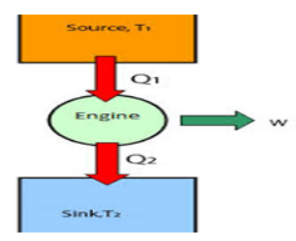
The cycle is repeated again and again to get useful work for some purpose. The discipline of Thermodynamics has its roots in the study of heat engines. A basic question relates to the efficiency of a heat engine. The efficiency ( h ) of a heat engine is defined by $n =\frac{ W }{ Q _1}$ Where Q 1 is the heat input i.e., the heat absorbed by the system in one complete cycle and $W$ is the work done on the environment in a cycle. In a cycle, a certain amount of heat $\left(Q_2\right)$ may also be rejected to the environment. Then according to the First Law of Thermodynamics, over one complete cycle. $W = Q _1-$ $Q_2 n =1-\frac{Q_2}{Q_1}$ For $Q_2=0, n=1$, i.e., the engine will have $100 \%$ efficiency in converting heat into work. Note that the First Law of Thermodynamics i.e., the energy conservation law does not rule out such an engine. But experience shows that such an ideal engine with $\eta=1$ is never possible. A refrigerator is the reverse of a heat engine. Here the working substance extracts heat $Q _2$ from the cold reservoir at temperature $T 2$, some external work $W$ is done on it and heat Q1 is released to the hot reservoir at temperature T1. The efficiency of refrigerator is expressed in terms of coefficient of performance $(\alpha)$ of a refrigerator is given by $\alpha=\frac{ Q _2}{W}$ where $Q _2$ is the heat extracted from the cold reservoir and $W$ is the work done on the system
The cycle is repeated again and again to get useful work for some purpose. The discipline of Thermodynamics has its roots in the study of heat engines. A basic question relates to the efficiency of a heat engine. The efficiency ( h ) of a heat engine is defined by $n =\frac{ W }{ Q _1}$ Where Q 1 is the heat input i.e., the heat absorbed by the system in one complete cycle and $W$ is the work done on the environment in a cycle. In a cycle, a certain amount of heat $\left(Q_2\right)$ may also be rejected to the environment. Then according to the First Law of Thermodynamics, over one complete cycle. $W = Q _1-$ $Q_2 n =1-\frac{Q_2}{Q_1}$ For $Q_2=0, n=1$, i.e., the engine will have $100 \%$ efficiency in converting heat into work. Note that the First Law of Thermodynamics i.e., the energy conservation law does not rule out such an engine. But experience shows that such an ideal engine with $\eta=1$ is never possible. A refrigerator is the reverse of a heat engine. Here the working substance extracts heat $Q _2$ from the cold reservoir at temperature $T 2$, some external work $W$ is done on it and heat Q1 is released to the hot reservoir at temperature T1. The efficiency of refrigerator is expressed in terms of coefficient of performance $(\alpha)$ of a refrigerator is given by $\alpha=\frac{ Q _2}{W}$ where $Q _2$ is the heat extracted from the cold reservoir and $W$ is the work done on the system
- In a heat engine the process need not be cyclic. True or False?
- True
- False
- Efficiency of heat engine N = 100% is it practically possible?
- Yes
- No
- Define efficiency of heat engine.
- Define coefficient of performance.
- Write a note on heat engine.