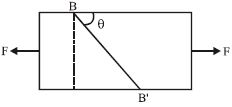
A bar of cross-sectional area $A$ is subjected two equal and opposite tensile forces at its ends as shown in figure. Consider a plane $BB'$ making an angle $\theta $ with the length The ratio of tensile stress to the shearing stress on the plane $BB'$ is
Diffcult
Download our app for free and get started
Consider the equilibrium of the plane $\mathrm{BB'}$
A force $F$ must be acting on this plane making an angle $\left(90^{\circ}-\theta\right)$ with the normal $ON.$ Resolving $F$ into two compoents, along the plane and normal to the plane.
Component of force $\mathrm{F}$ along the plane.
$\therefore \quad \mathrm{F}_{\mathrm{P}}=\mathrm{F} \cos \theta$
component of force $\mathrm{F}$ normal to the plane.
$\mathrm{F}_{\mathrm{N}}=\mathrm{F} \cos \left(90^{\circ}-\theta\right)=\mathrm{F} \sin \theta$
Let the area of the face $\mathrm{BB}^{\prime}$ be $\mathrm{A}^{\prime}$. Then
$\frac{\mathrm{A}}{\mathrm{A}^{\prime}}=\sin \theta \quad \therefore \quad \mathrm{A}^{\prime}=\frac{\mathrm{A}}{\sin \theta}$
Tensile stress $=\frac{\mathrm{F} \sin \theta}{\mathrm{A}^{\prime}}=\frac{\mathrm{F}}{\mathrm{A}} \sin ^{2} \theta$
Shearing stress $=\frac{\mathrm{F} \cos \theta}{\mathrm{A}^{\prime}}$
$=\frac{\mathrm{F}}{\mathrm{A}} \cos \theta \sin \theta$
Their corresponding ratio is
$\frac{\text { Tensilestress }}{\text { Shearing stress }}=\frac{F}{A} \sin ^{2} \theta \times \frac{A}{F \sin \theta \cos \theta}=\tan \theta$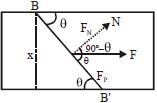

Download our appand get started for free
Experience the future of education. Simply download our apps or reach out to us for more information. Let's shape the future of learning together!No signup needed.*
Similar Questions
- 1The lower surface of a cube is fixed. On its upper surface, force is applied at an angle of $30°$ from its surface. The change will be of the typeView Solution
- 2If a load of $9$ $kg$ is suspended on a wire, the increase in length is $4.5\, mm$. The force constant of the wire isView Solution
- 3Consider a thin square plate floating on a viscous liquid in a large tank. The height $h$ of the liquid in the tank is much less than the width of the tank. The floating plate is pulled horizontally with a constant velocity $u_0$. Which of the following statements is (are) true?View Solution
$(A)$ The resistive force of liquid on the plate is inversely proportional to $h$
$(B)$ The resistive force of liquid on the plate is independent of the area of the plate
$(C)$ The tangential (shear) stress on the floor of the tank increases with $u _0$
$(D)$ The tangential (shear) stress on the plate varies linearly with the viscosity $\eta$ of the liquid
- 4View SolutionCorrect pair is ..........
- 5The work done in increasing the length of a $1$ $metre$ long wire of cross-section area $1\, mm^2$ through $1\, mm$ will be ....... $J$ $(Y = 2\times10^{11}\, Nm^{-2})$View Solution
- 6The mass and length of a wire are $M$ and $L$ respectively. The density of the material of the wire is $d$. On applying the force $F$ on the wire, the increase in length is $l$, then the Young's modulus of the material of the wire will beView Solution
- 7A wire is loaded by $6\, kg$ at its one end, the increase in length is $12\, mm.$ If the radius of the wire is doubled and all other magnitudes are unchanged, then increase in length will be ......... $mm$View Solution
- 8If Young's modulus of iron is $2 \times {10^{11}}\,N/{m^2}$ and the interatomic spacing between two molecules is $3 \times {10^{ - 10}}$metre, the interatomic force constant is ......... $N/m$View Solution
- 9The bulk modulus of rubber is $9.1 \times 10^8\,N/m^2$. To what depth a rubber ball be taken in a lake so that its volume is decreased by $0.1\%$ ? ....... $m$View Solution
- 10The ratio of diameters of two wires of same material is $n : 1$. The length of wires are $4\, m$ each. On applying the same load, the increase in length of thin wire will beView Solution