The mass and length of a wire are $M$ and $L$ respectively. The density of the material of the wire is $d$. On applying the force $F$ on the wire, the increase in length is $l$, then the Young's modulus of the material of the wire will be
Easy
Download our app for free and get started
(d) $Y = \frac{F}{A}\frac{L}{l}$ $ = \frac{{Fd{L^2}}}{{Ml}}$
As $M =$ volume $\times$ density $ = A \times L \times d$ $\therefore$ $A = \frac{M}{{Ld}}$

Download our appand get started for free
Experience the future of education. Simply download our apps or reach out to us for more information. Let's shape the future of learning together!No signup needed.*
Similar Questions
- 1A wire is stretched by $0.01$ $m$ by a certain force $F.$ Another wire of same material whose diameter and length are double to the original wire is stretched by the same force. Then its elongation will beView Solution
- 2If a load of $9$ $kg$ is suspended on a wire, the increase in length is $4.5\, mm$. The force constant of the wire isView Solution
- 3A sample of a liquid has an initial volume of $1.5\,L$ . The volume is reduced by $0.2\,mL$ , when the pressure increases by $140\,kP$ . What is the bulk modulus of the liquidView Solution
- 4A steel rod of length $\ell$, cross sectional area $A$, young's modulus of elasticity $Y$, and thermal coefficient of linear expansion $'a'$ is heated so that its temperature increases by $t\,^oC$. Work that can be done by rod on heating will beView Solution
- 5The Young's modulus of a wire of length $L$ and radius $r$ is $Y$ $N/m^2$. If the length and radius are reduced to $L/2$ and $r/2,$ then its Young's modulus will beView Solution
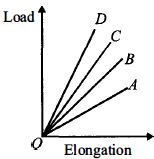
- 6View SolutionThe load versus elongation graphs for four wires of same length and made of the same material are shown in the figure. The thinnest wire is represented by the line
- 7For silver, Young's modulus is $7.25 \times {10^{10}}\,N/{m^2}$ and Bulk modulus is $11 \times {10^{10}}\,N/{m^2}$. Its Poisson's ratio will beView Solution
- 8View SolutionWhy the spring is made up of steel in comparison of copper
- 9A force of $200\, N$ is applied at one end of a wire of length $2\, m$ and having area of cross-section ${10^{ - 2}}\,c{m^2}$. The other end of the wire is rigidly fixed. If coefficient of linear expansion of the wire $\alpha = 8 \times 10{^{-6}}°C^{-1}$ and Young's modulus $Y = 2.2 \times {10^{11}}\,N/{m^2}$ and its temperature is increased by $5°C$, then the increase in the tension of the wire will be ........ $N$View Solution
- 10A structural steel rod has a radius of $10\,mm$ and length of $1.0\,m.$ A $100\,kN$ force stretches it along its length . Young's modulus of structural steel is $2 \times 10^{11}\,Nm^{-2}.$ The percentage strain is about ....... $\%$View Solution