The bulk modulus of rubber is $9.1 \times 10^8\,N/m^2$. To what depth a rubber ball be taken in a lake so that its volume is decreased by $0.1\%$ ? ....... $m$
Medium


Download our appand get started for free
Experience the future of education. Simply download our apps or reach out to us for more information. Let's shape the future of learning together!No signup needed.*
Similar Questions
- 1A string of area of cross-section $4\,mm ^{2}$ and length $0.5$ is connected with a rigid body of mass $2\,kg$. The body is rotated in a vertical circular path of radius $0.5\,m$. The body acquires a speed of $5\,m / s$ at the bottom of the circular path. Strain produced in the string when the body is at the bottom of the circle is $\ldots . . \times 10^{-5}$. (Use Young's modulus $10^{11}\,N / m ^{2}$ and $g =10\,m / s ^{2}$ )View Solution
- 2The length of wire becomes $l_1$ and $l_2$ when $100\,N$ and $120\,N$ tensions are applied respectively. If $10l_2=11l_1$, the natural length of wire will be $\frac{1}{x} l_1$. Here the value of $x$ is ........View Solution
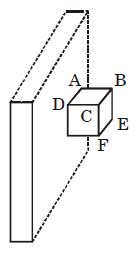
- 3A steel rod is projecting out of rigid wall. The shearing strength of steel is $345 \,\,MN/m^2.$ The dimensions $AB = 5\,\, cm,\,BC = BE = 2\,\, cm.$ The maximum load that can be put on the face $ABCD$ is .......... $kg$ (neglect bending of the rod) $(g = 10\,\, m/s^2)$View Solution
- 4A cubical solid aluminium (bulk modulus $=-V \frac{ dP }{ dV }=70 GPa$ ) block has an edge length of $1 m$ on the surface of the earth. It is kept on the floor of a $5 km$ deep ocean. Taking the average density of water and the acceleration due to gravity to be $10^3 kg m ^{-3}$ and $10 ms ^{-2}$, respectively, the change in the edge length of the block in $mm$ is . . . . .View Solution
- 5View SolutionThe bulk modulus of an ideal gas at constant temperature
- 6A force is applied to a steel wire ' $A$ ', rigidly clamped at one end. As a result elongation in the wire is $0.2\,mm$. If same force is applied to another steel wire ' $B$ ' of double the length and a diameter $2.4$ times that of the wire ' $A$ ', the elongation in the wire ' $B$ ' will be $............\times 10^{-2}\,mm$ (wires having uniform circular cross sections)View Solution
- 7One end of a uniform wire of length $L$ and of weight $W$ is attached rigidly to a point in the roof and a weight ${W_1}$ is suspended from its lower end. If $S$ is the area of cross-section of the wire, the stress in the wire at a height $3L/4$ from its lower end isView Solution
- 8View SolutionYoung's modulus depends upon
- 9Young's modulus of rubber is ${10^4}\,N/{m^2}$ and area of cross-section is $2\,c{m^2}$. If force of $2 \times {10^5}$ dynes is applied along its length, then its initial length $l$ becomesView Solution
- 10A wire is loaded by $6\, kg$ at its one end, the increase in length is $12\, mm.$ If the radius of the wire is doubled and all other magnitudes are unchanged, then increase in length will be ......... $mm$View Solution