Out of the following functions representing motion of a particle which represents $SHM$
$(A)\;y= sin\omega t-cos\omega t$
$(B)\;y=sin^3\omega t$
$(C)\;y=5cos\left( {\frac{{3\pi }}{4} - 3\omega t} \right)$
$(D)\;y=1+\omega t+{\omega ^2}{t^2}$
AIPMT 2011, Medium
Download our app for free and get started
$y=\sin \omega t-\cos \omega t$
$=\sqrt{2}\left[\frac{1}{\sqrt{2}} \sin \omega t-\frac{1}{\sqrt{2}} \cos \omega t\right]=\sqrt{2} \sin \left(\omega t-\frac{\pi}{4}\right)$
It represents a $SHM$ with time period, $T=\frac{2 \pi}{\omega}$
$y=\sin ^{3} \omega t=\frac{1}{4}[3 \sin \omega t-\sin 3 \omega t]$
It represents a periodic motion with time period
$T=\frac{2 \pi}{\omega}$ but not $SHM$
$y =5 \cos \left(\frac{3 \pi}{4}-3 \omega t\right) $
$=5 \cos \left(3 \omega t-\frac{3 \pi}{4}\right) \quad[\because \quad \cos (-\theta)=\cos \theta]$
It represents a $SHM$ with time period, $T=\frac{2 \pi}{3 \omega}$
$y=1+\omega t+\omega^{2} t^{2}$
It represents a non-periodic motion. Also it is not physically acceptable as $y \rightarrow \infty$ as $t \rightarrow \infty$

Download our appand get started for free
Experience the future of education. Simply download our apps or reach out to us for more information. Let's shape the future of learning together!No signup needed.*
Similar Questions
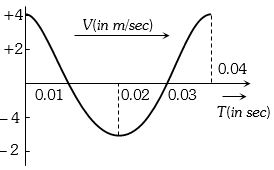
- 1The velocity-time diagram of a harmonic oscillator is shown in the adjoining figure. The frequency of oscillation is ..... $Hz$View Solution
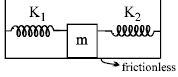
- 2Two springs with negligible masses and force constant of $K_1 = 200\, Nm^{-1}$ and $K_2 = 160\, Nm^{-1}$ are attached to the block of mass $m = 10\, kg$ as shown in the figure. Initially the block is at rest, at the equilibrium position in which both springs are neither stretched nor compressed. At time $t = 0,$ a sharp impulse of $50\, Ns$ is given to the block with a hammer.View Solution
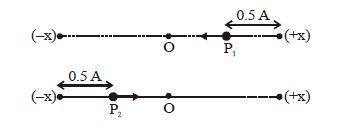
- 3Two bodies performing $S.H.M.$ have same amplitude and frequency. Their phases at a certain instant are as shown in the figure. The phase difference between them isView Solution
- 4If a body of mass $0.98\, kg$ is made to oscillate on a spring of force constant $4.84\, N/m$, the angular frequency of the body is ..... $ rad/s$View Solution
- 5A $1 \,kg$ block attached to a spring vibrates with a frequency of $1\, Hz$ on a frictionless horizontal table. Two springs identical to the original spring are attached in parallel to an $8\, kg$ block placed on the same table. So, the frequency of vibration of the $8\, kg$ block is ..... $Hz$View Solution
- 6Two particles executing $S.H.M.$ of same frequency, meet at $x=+A / 2$, while moving in opposite directions. Phase difference between the particles is .........View Solution
- 7The period of oscillation of a mass $M$ suspended from a spring of negligible mass is $T$. If along with it another mass $M$ is also suspended, the period of oscillation will now beView Solution
- 8In $SHM,$ acceleration versus displacement (from mean position) graph :View Solution
- 9${T}_{0}$ is the time period of a simple pendulum at a place. If the length of the pendulum is reduced to $\frac{1}{16}$ times of its initial value, the modified timeView Solution
- 10When a mass $m$ is attached to a spring, it normally extends by $0.2\, m$. The mass $m$ is given a slight addition extension and released, then its time period will beView Solution