Question
A barge is pulled into harbour by two tug boats as shown in the figure.
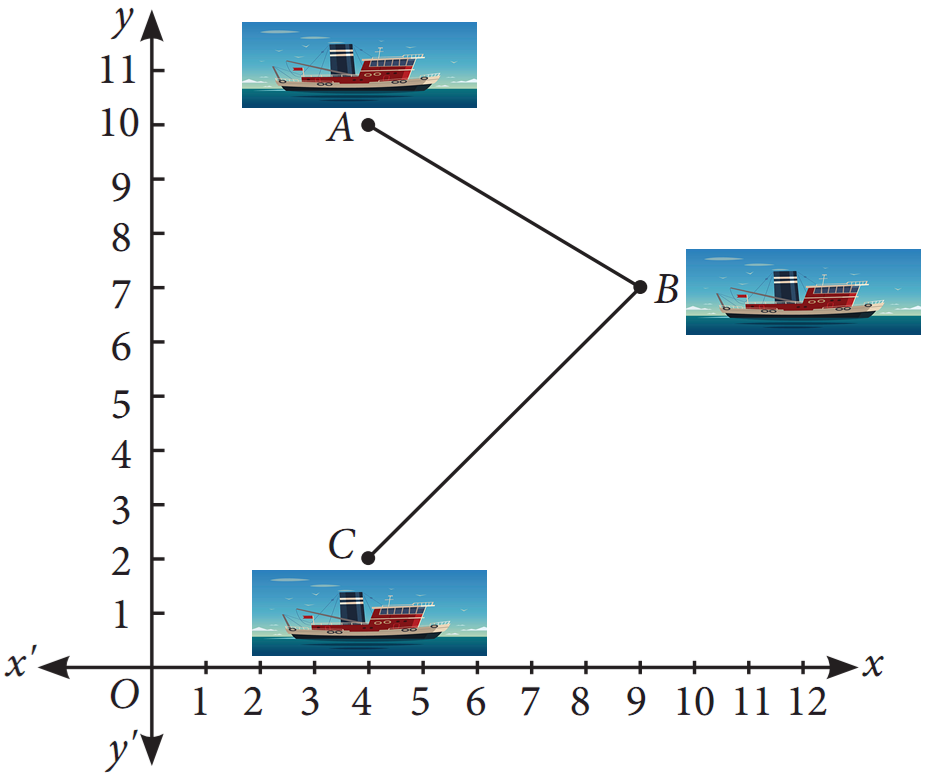
Based on the above information, answer the following questions.
  1. Position vector of A is:
  1. $4\hat{\text{i}}+2\hat{\text{j}}$
  2. $4\hat{\text{i}}+10\hat{\text{j}}$
  3. $4\hat{\text{i}}-10\hat{\text{j}}$
  4. $4\hat{\text{i}}-2\hat{\text{j}}$
  1. Position vector of B is:
  1. $4\hat{\text{i}}+4\hat{\text{j}}$
  2. $6\hat{\text{i}}+6\hat{\text{j}}$
  3. $9\hat{\text{i}}+7\hat{\text{j}}$
  4. $3\hat{\text{i}}+3\hat{\text{j}}$
  1. Find the vector $\overline{\text{AC}}$ in terms of $\hat{\text{i}},\hat{\text{j}}.$
  1. $8\hat{\text{j}}$
  2. $-8\hat{\text{j}}$
  3. $8\hat{\text{i}}$
  4. None of these
  1. If $\vec{\text{A}}=\hat{\text{i}}+2\hat{\text{j}}+3\hat{\text{k}},$ then its unit vector is:
  1. $\frac{\hat{\text{i}}}{\sqrt{14}}+\frac{2\hat{\text{j}}}{\sqrt{14}}+\frac{3\hat{\text{k}}}{\sqrt{14}}$
  2. $\frac{3\hat{\text{i}}}{\sqrt{14}}+\frac{2\hat{\text{j}}}{\sqrt{14}}+\frac{\hat{\text{k}}}{\sqrt{14}}$
  3. $\frac{2\hat{\text{i}}}{\sqrt{14}}+\frac{3\hat{\text{j}}}{\sqrt{14}}+\frac{\hat{\text{k}}}{\sqrt{14}}$
  4. None of these
  1. If $\vec{\text{A}}=4\hat{\text{i}}+3\hat{\text{j}}$ and $\vec{\text{B}}=3\hat{\text{i}}+4\hat{\text{j}},$ then $|\vec{\text{A}}|+|\vec{\text{B}}|=$
  1. 12
  2. 13
  3. 14
  4. 10

Answer

  1. (b) $4\hat{\text{i}}+10\hat{\text{j}}$
Solution:

Here, (4, 10) are the coordinates of A.

$\therefore\text{P.V of }\text{A}=4\hat{\text{i}}+10\hat{\text{j}}$
  1. (c) $9\hat{\text{i}}+7\hat{\text{j}}$
Solution:

Here, (9, 7) are the coordinates of B.

$\therefore\text{P.V of }\text{B}=9\hat{\text{i}}+7\hat{\text{j}}$
  1. (b) $-8\hat{\text{j}}$
Solution:

Here, P.V. of $\text{A}=4\hat{\text{i}}+10\hat{\text{j}}$ and P.V. of

$\text{C}=4\hat{\text{i}}+2\hat{\text{j}}$

$\therefore\overline{\text{AC}}=(4-4)\hat{\text{i}}+(2-10)\hat{\text{j}}=-8\hat{\text{j}}$
  1. (a) $\frac{\hat{\text{i}}}{\sqrt{14}}+\frac{2\hat{\text{j}}}{\sqrt{14}}+\frac{3\hat{\text{k}}}{\sqrt{14}}$
Solution:

Here, $\vec{\text{A}}=\hat{\text{i}}+2\hat{\text{j}}+3\hat{\text{k}}$

$\therefore|\vec{\text{A}}|=\sqrt{1^2+2^2+3^2}=\sqrt{1+4+9}=\sqrt{14}$

$\therefore\vec{\text{A}}=\frac{\vec{\text{A}}}{|\vec{\text{A}}|}=\frac{\hat{\text{i}}+2\hat{\text{j}}+3\hat{\text{k}}}{\sqrt{14}}$

$=\frac{1}{\sqrt{14}}\hat{\text{i}}+\frac{2}{\sqrt{14}}\hat{\text{j}}+\frac{3}{\sqrt{14}}\hat{\text{k}}$
  1. (d) 10
Solution:

We have, $\vec{\text{A}}=4\hat{\text{i}}+3\hat{\text{j}}$ and $\vec{\text{B}}=3\hat{\text{i}}+4\hat{\text{j}}$

$\therefore|\vec{\text{A}}|=\sqrt{4^2+3^2}=\sqrt{16+9}=\sqrt{25}=5$

And $|\vec{\text{B}}|=\sqrt{3^2+4^2}=\sqrt{9+16}=\sqrt{25}=5$

Thus, $|\vec{\text{A}}|+|\vec{\text{B}}|=5+5=10.$

Need a full question paper?

Generate a complete, print-ready paper with questions like this in minutes — across 16+ boards, with answer keys.

Start Generating Free

Similar questions

An owner of an electric bike rental company have determined that if they charge customers $₹\ x$ per day to rent a bike, where $50 < x < 200,$ then number of bikes (n), they rent per day can be shown by linear function $n(x) = 2000 - 10x.$ If they charge $₹\ 50$ per day or less, they will rent all their bikes. If they charge $₹\ 200$ or more per day, they will not rent any bike.

Based on the above information, answer the following questions.
  1. Total revenue $R$ as a function of $x$ can be represented as.
  1. $2000x - 10x^2$
  2. $2000x + 10x^2$
  3. $2000 - 10x$
  4. $2000 - 5x^2$
  1. If $R(x)$ denote the revenue, then maximum value of $R(x)$ occur when $x$ equals.
  1. $10$
  2. $100$
  3. $1000$
  4. $50$
  1. At $x = 260$, the revenue collected by the company is.
  1. $₹\ 10$
  2. $₹\ 500$
  3. $₹\ 0$
  4. $₹\ 1000$
  1. The number of bikes rented per day, if $x = 105$ is.
  1. $850$
  2. $900$
  3. $950$
  4. $1000$
  1. Maximum revenue collected by company is.
  1. $₹\ 40,000$
  2. $₹\ 50,000$
  3. $₹\ 75,000$
  4. $₹\ 1,00,000$
A company produces three products every day. Their production on certain day is $45$ tons. It is found that the production of third product exceeds the production of first product by $8$ tons while the total production of first and third product is twice the production of second product.

Using the concepts of matrices and determinants, answer the following questions.
  1. If $x, y$ and $z$ respectively denotes the quantity (in tons) of first, second and third product produced, then which of the following is true?
  1. $x + y + z = 45$
  2. $x + 8 = z$
  3. $x - 2y + z = 0$
  4. All of these.
  1. If $\begin{pmatrix}1&1&1\\1&0&-2\\1&-1&1\end{pmatrix}^{-1}=\frac{1}{6}\begin{pmatrix}2&2&2\\3&0&-3\\1&-2&1\end{pmatrix}$ then the inverse of $\begin{pmatrix}1&1&1\\1&0&-1\\1&-2&1\end{pmatrix}$ is:
  1. $\begin{pmatrix}\frac{1}{3}&\frac{1}{3}&\frac{1}{3}\\\frac{1}{2}&0&\frac{-1}{2}\\\frac{1}{6}&\frac{-1}{3}&\frac{1}{6}\end{pmatrix}$
  2. $\begin{pmatrix}\frac{1}{2}&0&-\frac{1}{2}\\\frac{1}{3}&\frac{1}{3}&\frac{1}{3}\\\frac{1}{6}&\frac{-1}{3}&\frac{1}{6}\end{pmatrix}$
  3. $\begin{pmatrix}\frac{1}{3}&\frac{1}{2}&\frac{1}{6}\\\frac{1}{3}&0&\frac{-1}{3}\\\frac{1}{3}&\frac{-1}{2}&\frac{1}{6}\end{pmatrix}$
  4. None of these.
  1. $x : y : z$ is equal to:
  1. $12 : 13 : 20$
  2. $11 : 15 : 19$
  3. $15 : 19 : 11$
  4. $13 : 12 : 20$
  1. Which of the following is not true?
  1. $|A| = |A'|$
  2. $(A')^{-1} = (A^{-1})'$
  3. $A$ is skew synunetric matrix of odd order, then $|A| = 0$
  4. $|AB| = |A| + |B|$
  1. Which of the following is not true in the given determinant of $A,$ where A $=[\text{a}_\text{ij}]_{3\times3}?$
  1. Order of minor is less than order of the det $(A).$
  2. Minor of an element can never be equal to cofactor of the same element.
  3. Value of a determinant is obtained by multiplying elements of a row or column by corresponding cofactors.
  4. Order of minors and cofactors of same elements of $A$ is same.
Read the following text carefully and answer the questions that follow:
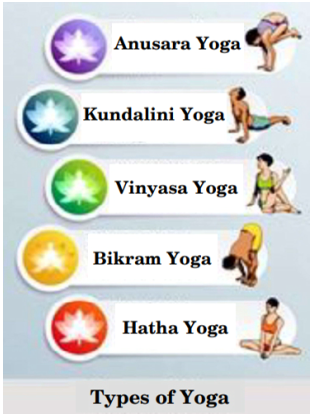
There are different types of Yoga which involve the usage of different poses of Yoga Asanas, Meditation and Pranayam as shown in the figure below:
Image
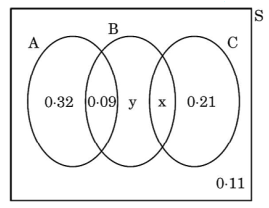
The Venn diagram below represents the probabilities of three different types of Yoga,$ A, B$ and $C$ performed by the people of a society. Further, it is given that probability of a member performing type $C$ Yoga is$ 0.44.$
Image
$i$. Find the value of $x. (1)$
$ii$. Find the value of $y. (1)$
$iii$. Find $P \left(\frac{ C }{ B }\right)$.
OR
Find the probability that a randomly selected person of the society does Yoga of type $A$ or $B$ but not $C.\  (2)$
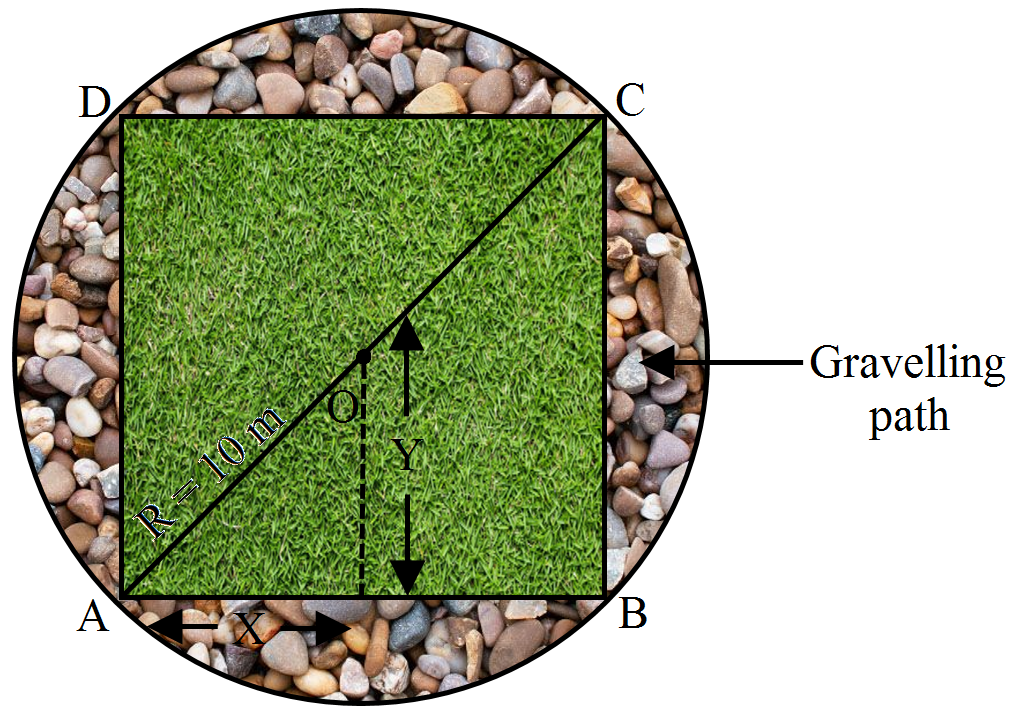
In a society there is a garden in the shape of rectangle inscribed in a circle of radius 10m as shown in given figure.

Based on the above information, answer the following questions.
  1. If 2x and 2y denotes the length and breadth in metres, of the rectangular part, then the relation between the variables is.
  1. $x^2 - y^2 = 10$
  2. $x^2 + y^2 = 10$
  3. $x^2 + y^2 = 100$
  4. $x^2 - y^2 = 100$
  1. The area (A) of green grass, in terms of x, is given by.
  1. $2\text{x}\sqrt{100-\text{x}^2}$
  2. $4\text{x}\sqrt{100-\text{x}^2}$
  3. $2\text{x}\sqrt{100+\text{x}^2}$
  4. $4\text{x}\sqrt{100+\text{x}^2}$
  1. The maximum value of A is.
  1. $100\text{m}^2$
  2. $200\text{m}^2$
  3. $400\text{m}^2$
  4. $1600\text{m}^2$
  1. The value of length of rectangle, when A is maximum, is.
  1. $10\sqrt{2}\text{m}$
  2. $20\sqrt{2}\text{m}$
  3. $20\text{m}$
  4. $5\sqrt{2}\text{m}$
  1. The area of gravelling path is.
  1. $100(\pi+2)\text{m}^2$
  2. $100(\pi-2)\text{m}^2$
  3. $200(\pi+2)\text{m}^2$
  4. $200(\pi-2)\text{m}^2$
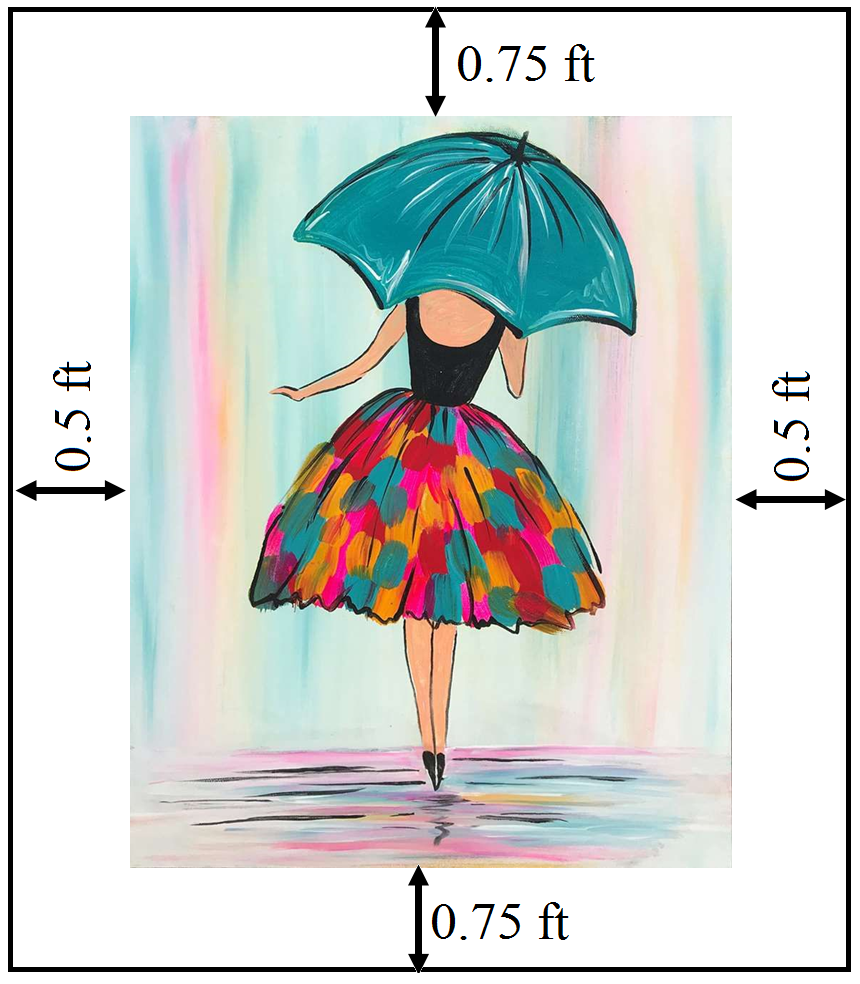
Kyra has a rectangular painting canvas having a total area of $24\ ft^2$ which includes a border of $0.5$ ft. on the left right and a border of $0.75$ ft. on the bottom, top inside it.

Based on the above information, answer the following questions.
  1. If Kyra wants to paint in the maximum area, then she needs to maximize.
  1. Area of outer rectangle.
  2. Area of inner rectangle.
  3. Area of top border.
  4. None of these.
  1. If x is the length of the outer rectangle, then area of inner rectangle in terms of x is.
  1. $(\text{x}+3)\Big(\frac{24}{\text{x}}-2\Big)$
  2. $(\text{x}-1)\Big(\frac{24}{\text{x}}+1.5\Big)$
  3. $(\text{x}-1)\Big(\frac{24}{\text{x}}-1.5\Big)$
  4. $(\text{x}-1)\Big(\frac{24}{\text{x}}\Big)$
  1. Find the range of x.
  1. $(1, \infty)$
  2. $(1, 16)$
  3. $(-\infty, 16)$
  4. $(-1, 16)$
  1. If area of inner rectangle is maximum, then x is equal to.
  1. 2 ft.
  2. 3 ft.
  3. 4 ft.
  4. 5 ft.
  1. If area of inner rectangle is maximum, then length and breadth of this rectangle are respectively.
  1. 3 ft, 4.5 ft.
  2. 4.5 ft, 5 ft.
  3. 1 ft, 2 ft.
  4. 2 ft, 4 ft.
If a real valued function $f(x)$ is finitely derivable at any point of its domain, it is necessarily continuous at that point. But its converse need not be true.
For example, every polynomial, constant function are both continuous as well as differentiable and inverse trigonometric functions are continuous and differentiable in its domains etc.
Based on the above information, answer the following questions.
  1. If $\text{f}(\text{x})=\begin{cases}\text{x},\text{for x}\leq0\\0,\text{for x}>0\end{cases},$ then at $x = 0$
  1. $f(x)$ is differentiable and continuous.
  2. $f(x)$ is neither continuous nor differentiable.
  3. $f(x)$ is continuous but not differentiable.
  4. None of these.
  1. If $\text{f}(\text{x})=|\text{x}-1|,\text{x }\in\text{ R},$ then at $x = 1$
  1. $f(x)$ is not continuous.
  2. $f(x)$ is continuous but not differentiable.
  3. $f(x)$ is continuous and differentiable.
  4. None of these.
  1. $f(x) = x^3$ is:
  1. Continuous but not differentiable at $x = 3$
  2. Continuous but not differentiable at $x = 3$
  3. Neither continuous nor differentiable at $x = 3$
  4. None of these.
  1. If $\text{f}(\text{x})=[\sin\text{x}],$ then which of the following is true$?$
  1. $f(x)$ is continuous and differentiable at $x = 0.$
  2. $f(x)$ is discontinuous at $x = 0.$
  3. $f(x)$ is continuous at $x = 0$ but not differentiable.
  4. $f(x)$ is differentiable but not continuous at $\text{x}=\frac{\pi}{2}.$
  1. If $\text{f}(\text{x})=\sin^{-1}\text{x},-1\leq\text{x}\leq1,$ then:
  1. $f(x)$ is both continuous and differentiable.
  2. $f(x)$ is neither continuous nor differentiable.
  3. $f(x)$ is continuous but not differentiable.
  4. None of these.
Akash and Prakash appeared for first round of an interview for two vacancies. The probability of Nisha's selection is $\frac{1}{3}$ and that of Ayushi's selection is $\frac{1}{2}$.

Image

(i) Find the probability that both of them are selected.

(ii) The probability that none of them is selected.

Three car dealers, say A, Band C, deals in three types of cars, namely Hatchback cars, Sedan cars, SUV cars. The sales figure of 2019 and 2020 showed that dealer A sold 120 Hatchback, 50 Sedan, 10 SUV cars in 2019 and 300 Hatchback, 150 Sedan, 20 SUV cars in 2020; dealer B sold 100 Hatchback, 30 Sedan, 5 SUV cars in 2019 and 200 Hatchback, 50 Sedan, 6 SUV cars in 2020; dealer C sold 90 Hatchback, 40 Sedan, 2 SUV cars in 2019 and 100 Hatchback, 60 Sedan, 5 SUV cars in 2020.

Based on the above information, answer the following questions.
  1. The matrix summarizing sales data of 2019 is:
  1. $\begin{matrix}&\text{Hatchback}&\text{Sedan}&\text{SUV}\end{matrix}\\\begin{matrix}\text{A}\\\text{B}\\\text{C}\end{matrix}\begin{bmatrix}\ \ \ \ \ \ 300\ \ \ &\ \ 150&\ \ \ \ \ 20\\\ \ \ 200&\ \ 50&\ \ \ \ \ 6\\\ \ \ 100&\ \ 30&\ \ \ \ \ 5\end{bmatrix}$
  2. $\begin{matrix}&\text{Hatchback}&\text{Sedan}&\text{SUV}\end{matrix}\\\begin{matrix}\text{A}\\\text{B}\\\text{C}\end{matrix}\begin{bmatrix}\ \ \ \ \ \ 120\ \ \ &\ \ 100&\ \ \ \ \ 20\\\ \ \ 100&\ \ 30&\ \ \ \ \ 5\\\ \ \ 90&\ \ 40&\ \ \ \ \ 2\end{bmatrix}$
  3. $\begin{matrix}&\text{Hatchback}&\text{Sedan}&\text{SUV}\end{matrix}\\\begin{matrix}\text{A}\\\text{B}\\\text{C}\end{matrix}\begin{bmatrix}\ \ \ \ \ \ 100\ \ \ &\ \ 30&\ \ \ \ \ 5\\\ \ \ 120&\ \ 50&\ \ \ \ \ 10\\\ \ \ 90&\ \ 40&\ \ \ \ \ 2\end{bmatrix}$
  4. $\begin{matrix}&\text{Hatchback}&\text{Sedan}&\text{SUV}\end{matrix}\\\begin{matrix}\text{A}\\\text{B}\\\text{C}\end{matrix}\begin{bmatrix}\ \ \ \ \ \ 200\ \ \ &\ \ 50&\ \ \ \ \ 6\\\ \ \ 100&\ \ 30&\ \ \ \ \ 5\\\ \ \ 300&\ \ 150&\ \ \ \ \ 20\end{bmatrix}$
  1. The matrix summarizing sales data of 2020 is:
  1. $\begin{matrix}&\text{Hatchback}&\text{Sedan}&\text{SUV}\end{matrix}\\\begin{matrix}\text{A}\\\text{B}\\\text{C}\end{matrix}\begin{bmatrix}\ \ \ \ \ \ 300\ \ \ &\ \ 150&\ \ \ \ \ 20\\\ \ \ 200&\ \ 50&\ \ \ \ \ 6\\\ \ \ 100&\ \ 60&\ \ \ \ \ 5\end{bmatrix}$
  2. $\begin{matrix}&\text{Hatchback}&\text{Sedan}&\text{SUV}\end{matrix}\\\begin{matrix}\text{A}\\\text{B}\\\text{C}\end{matrix}\begin{bmatrix}\ \ \ \ \ \ 120\ \ \ &\ \ 50&\ \ \ \ \ 10\\\ \ \ 100&\ \ 60&\ \ \ \ \ 5\\\ \ \ 90&\ \ 40&\ \ \ \ \ 2\end{bmatrix}$
  3. $\begin{matrix}&\text{Hatchback}&\text{Sedan}&\text{SUV}\end{matrix}\\\begin{matrix}\text{A}\\\text{B}\\\text{C}\end{matrix}\begin{bmatrix}\ \ \ \ \ \ 100\ \ \ &\ \ 60&\ \ \ \ \ 5\\\ \ \ 120&\ \ 50&\ \ \ \ \ 10\\\ \ \ 90&\ \ 40&\ \ \ \ \ 2\end{bmatrix}$
  4. $\begin{matrix}&\text{Hatchback}&\text{Sedan}&\text{SUV}\end{matrix}\\\begin{matrix}\text{A}\\\text{B}\\\text{C}\end{matrix}\begin{bmatrix}\ \ \ \ \ \ 200\ \ \ &\ \ 50&\ \ \ \ \ 6\\\ \ \ 100&\ \ 60&\ \ \ \ \ 5\\\ \ \ 300&\ \ 150&\ \ \ \ \ 20\end{bmatrix}$
  1. The cost incurred by the organisation on village Z is:
  1. $\begin{matrix}&\text{Hatchback}&\text{Sedan}&\text{SUV}\end{matrix}\\\begin{matrix}\text{A}\\\text{B}\\\text{C}\end{matrix}\begin{bmatrix}\ \ \ \ \ \ 190\ \ \ &\ \ 100&\ \ \ \ \ 7\\\ \ \ 300&\ \ 80&\ \ \ \ \ 11\\\ \ \ 420&\ \ 200&\ \ \ \ \ 30\end{bmatrix}$
  2. $\begin{matrix}&\text{Hatchback}&\text{Sedan}&\text{SUV}\end{matrix}\\\begin{matrix}\text{A}\\\text{B}\\\text{C}\end{matrix}\begin{bmatrix}\ \ \ \ \ \ 300\ \ \ &\ \ 80&\ \ \ \ \ 11\\\ \ \ 190&\ \ 100&\ \ \ \ \ 7\\\ \ \ 420&\ \ 200&\ \ \ \ \ 30\end{bmatrix}$
  3. $\begin{matrix}&\text{Hatchback}&\text{Sedan}&\text{SUV}\end{matrix}\\\begin{matrix}\text{A}\\\text{B}\\\text{C}\end{matrix}\begin{bmatrix}\ \ \ \ \ \ 420\ \ \ &\ \ 200&\ \ \ \ \ 30\\\ \ \ 300&\ \ 80&\ \ \ \ \ 11\\\ \ \ 190&\ \ 100&\ \ \ \ \ 7\end{bmatrix}$
  4. None of these
  1. The increase in sales from 2019 to 2020 is given by the matrix.
  1. $\begin{matrix}&\text{Hatchback}&\text{Sedan}&\text{SUV}\end{matrix}\\\begin{matrix}\text{A}\\\text{B}\\\text{C}\end{matrix}\begin{bmatrix}\ \ \ \ \ \ 180\ \ \ &\ \ 100&\ \ \ \ \ 10\\\ \ \ 10&\ \ 20&\ \ \ \ \ 1\\\ \ \ 100&\ \ 20&\ \ \ \ \ 3\end{bmatrix}$
  2. $\begin{matrix}&\text{Hatchback}&\text{Sedan}&\text{SUV}\end{matrix}\\\begin{matrix}\text{A}\\\text{B}\\\text{C}\end{matrix}\begin{bmatrix}\ \ \ \ \ \ 10\ \ \ &\ \ 20&\ \ \ \ \ 3\\\ \ \ 100&\ \ 20&\ \ \ \ \ 1\\\ \ \ 180&\ \ 100&\ \ \ \ \ 10\end{bmatrix}$
  3. $\begin{matrix}&\text{Hatchback}&\text{Sedan}&\text{SUV}\end{matrix}\\\begin{matrix}\text{A}\\\text{B}\\\text{C}\end{matrix}\begin{bmatrix}\ \ \ \ \ \ 180\ \ \ &\ \ 100&\ \ \ \ \ 10\\\ \ \ 100&\ \ 20&\ \ \ \ \ 1\\\ \ \ 10&\ \ 20&\ \ \ \ \ 3\end{bmatrix}$
  4. $\begin{matrix}&\text{Hatchback}&\text{Sedan}&\text{SUV}\end{matrix}\\\begin{matrix}\text{A}\\\text{B}\\\text{C}\end{matrix}\begin{bmatrix}\ \ \ \ \ \ 100\ \ \ &\ \ 20&\ \ \ \ \ 3\\\ \ \ 180&\ \ 100&\ \ \ \ \ 10\\\ \ \ 10&\ \ 20&\ \ \ \ \ 3\end{bmatrix}$
  1. If each dealer receive profit of ₹ 50000 on sale of a Hatchback. ₹ 100000 on sale of a Sedan and ₹ 200000 on sale of a SUV, then amount of profit received in the year 2020 by each dealer is given by the matrix.
  1. $\begin{matrix}\text{A}\\\text{B}\\\text{C}\end{matrix}\begin{bmatrix}30000000\\15000000\\12000000\end{bmatrix}$
  2. $\begin{matrix}\text{A}\\\text{B}\\\text{C}\end{matrix}\begin{bmatrix}12000000\\16200000\\34000000\end{bmatrix}$
  3. $\begin{matrix}\text{A}\\\text{B}\\\text{C}\end{matrix}\begin{bmatrix}34000000\\16200000\\12000000\end{bmatrix}$
  4. $\begin{matrix}\text{A}\\\text{B}\\\text{C}\end{matrix}\begin{bmatrix}15000000\\30000000\\12000000\end{bmatrix}$
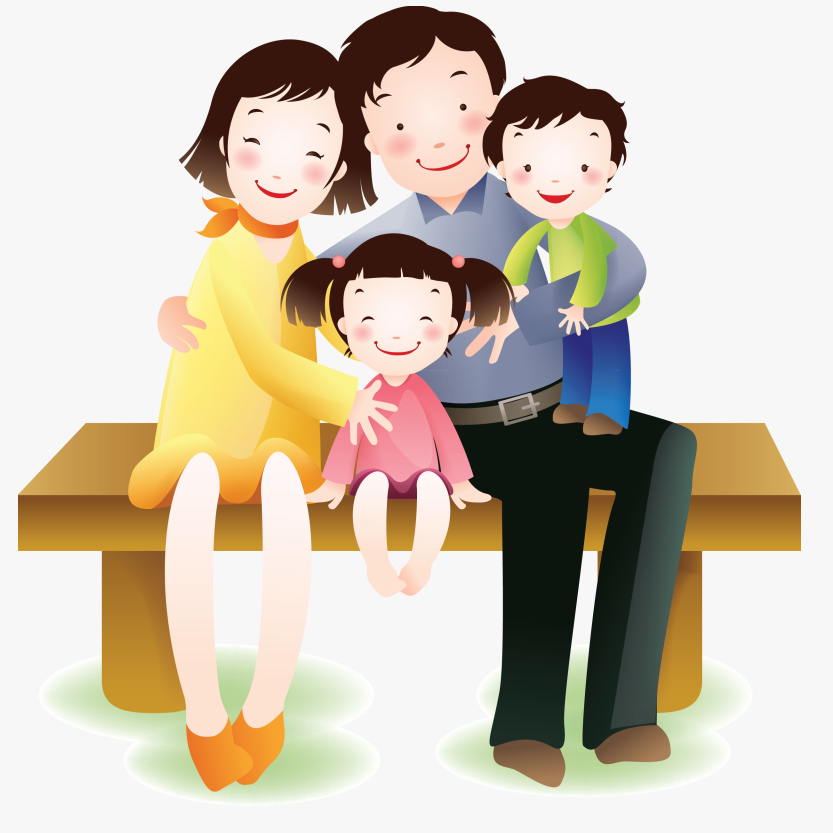
In a wedding ceremony, consists of father, mother, daughter and son line up at random for a family photograph, as shown in figure.
Based on the above information, answer the following questions.
  1. Find the probability that daughter is at one end, given that father and mother are in the middle.
  1. $1$
  2. $\frac{1}{2}$
  3. $\frac{1}{3}$
  4. $\frac{2}{3}$
  1. Find the probability that mother is at right end, given that son and daughter are together.
  1. $\frac{1}{2}$
  2. $\frac{1}{3}$
  3. $\frac{1}{4}$
  4. $0$
  1. Find the probability that father and mother are in the middle, given that son is at right end.
  1. $\frac{1}{4}$
  2. $\frac{1}{2}$
  3. $\frac{1}{3}$
  4. $\frac{2}{3}$
  1. Find the probability that father and son are standing together, given that mother and daughter are standing together.
  1. $0$
  2. $1$
  3. $\frac{1}{2}$
  4. $\frac{2}{3}$
  1. Find the probability that father and mother are on either of the ends, given that son is at second position from the right end.
  1. $\frac{1}{3}$
  2. $\frac{2}{3}$
  3. $\frac{1}{4}$
  4. $\frac{2}{5}$
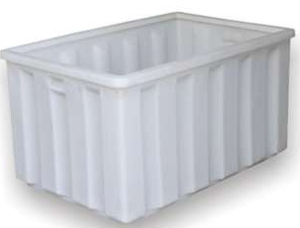
Ankit wants to construct a rectangular tank for his house that can hold $80 \mathrm{ft}^3$ of water. He wants to construct on one corner of terrace so that sufficient space is left after construction of tank. For that he has to keep width of tank constant $5 \mathrm{ft}$, but the length and heights are variables. The top of the tank is open. Building the tank cost ₹20 per sq. foot for the base and ₹10 per sq. foot for the side.

Image

(i) Express cost of tank as a function of height(h).

(ii) Verify by second derivative test that cost is minimum at critical point.

(iii) Find the value of $\mathrm{h}$ at which $\mathrm{c}(\mathrm{h})$ is minimum.

OR

Find the minimum cost of tank?