Question
Kyra has a rectangular painting canvas having a total area of $24\ ft^2$ which includes a border of $0.5$ ft. on the left right and a border of $0.75$ ft. on the bottom, top inside it.
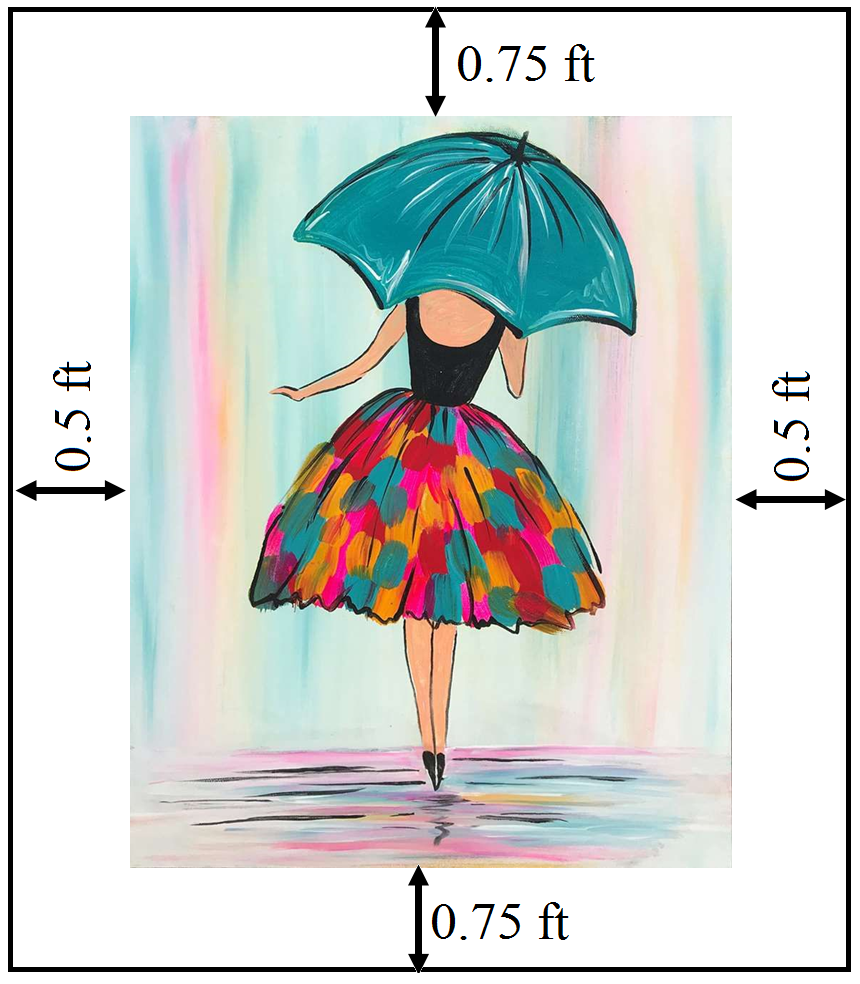
Based on the above information, answer the following questions.
  1. If Kyra wants to paint in the maximum area, then she needs to maximize.
  1. Area of outer rectangle.
  2. Area of inner rectangle.
  3. Area of top border.
  4. None of these.
  1. If x is the length of the outer rectangle, then area of inner rectangle in terms of x is.
  1. $(\text{x}+3)\Big(\frac{24}{\text{x}}-2\Big)$
  2. $(\text{x}-1)\Big(\frac{24}{\text{x}}+1.5\Big)$
  3. $(\text{x}-1)\Big(\frac{24}{\text{x}}-1.5\Big)$
  4. $(\text{x}-1)\Big(\frac{24}{\text{x}}\Big)$
  1. Find the range of x.
  1. $(1, \infty)$
  2. $(1, 16)$
  3. $(-\infty, 16)$
  4. $(-1, 16)$
  1. If area of inner rectangle is maximum, then x is equal to.
  1. 2 ft.
  2. 3 ft.
  3. 4 ft.
  4. 5 ft.
  1. If area of inner rectangle is maximum, then length and breadth of this rectangle are respectively.
  1. 3 ft, 4.5 ft.
  2. 4.5 ft, 5 ft.
  3. 1 ft, 2 ft.
  4. 2 ft, 4 ft.

Answer

  1. (b) Area of inner rectangle
Solution:
In order to paint in the maximum area, Kyra needs to maximize the area of inner rectangle.
  1. (c) $(\text{x}-1)\Big(\frac{24}{\text{x}}-1.5\Big)$
Solution:
Let x be the length and y be the breadth of outer rectangle.
$\therefore$ Length of inner rectangle = $x - 1$
and breadth of inner rectangle = y - 1.5
$\therefore$ A(x) = (x - 1)(y - 1.5) [$\therefore$ xy = 24 (given)
$=\big(\text{x}-1\big)\bigg(\frac{24}{\text{x}}-1.5\bigg)$
  1. (b) $(1, 16)$
Solution:
Dimensions of rectangle (outer/inner) should be positive.
$\therefore\text{x}-1>0\text{ and }\frac{24}{\text{x}}-1.5>0$
$\therefore\text{x}>1\text{ and }{\text{x}}<16$
$\therefore$ Range of x is (1, 16)
  1. (c) 4 ft
Solution:
We have $\text{A}'\text{(x)}=(\text{x}-1)\bigg(\frac{24}{\text{x}}-1.5\bigg)$
$\Rightarrow\text{A}'(\text{x)}=(\text{x}-1)\Big(\frac{-24}{\text{x}^2}\Big)+\bigg(\frac{24}{\text{x}}-1.5\bigg)$
$=\frac{24}{\text{x}^2}-1.5\ \text{and}\ \text{A}''(\text{x})=\frac{-48}{\text{x}^3}$
For A(x) to be maximum or minimum, A'(x) = 0
$\Rightarrow-1.5+\frac{24}{\text{x}^2}=0$
$\Rightarrow\text{x}^2=16$
$\Rightarrow\text{x}=\pm4$
$\therefore\text{x}=4$ [Since, length can't be negative]
Also, $\text{A}''(4)=\frac{-48}{4^3}<0$
Thus, at x = 4, area is maximum.
  1. (a) 3 ft, 4.5 ft.
Solution:
If area of inner rectangle is maximum, then Length of inner rectangle = x - 1 = 4 - 1 = 3 ft.
And breadth of inner rectangle $=\text{y}-1.5=\frac{24}{\text{x}}-1.5$
$=\frac{24}{4}-1.5=6-1.5=4.5\ \text{ft}$

Need a full question paper?

Generate a complete, print-ready paper with questions like this in minutes — across 16+ boards, with answer keys.

Start Generating Free

Similar questions

A real estate company is going to build a new residential complex. The land they have purchased can hold at most $4500$ apartments. Also, if they make x apartments, then the monthly maintenance cost for the whole complex would be as follows: Fixed cost $= ₹\ 50,00,000$. Variable cost $= (160x - 0.04x^2)$

Based on the above information, answer the following questions.
  1. The maintenance cost as a function of x will be.
  1. $160x - 0.04x^2$
  2. $5000000$
  3. $5000000 + 160x - 0.04x^2$
  4. None of these
  1. If $C(x)$ denote the maintenance cost function, then maximum value of $C(x)$ occur at $x =$
  1. $0$
  2. $2000$
  3. $4500$
  4. $5000$
  1. The maximum value of $C(x)$ would be.
  1. $₹\ 5225000$
  2. $₹\ 5160000$
  3. $₹\ 5000000$
  4. $₹\ 4000000$
  1. The number of apartments, that the complex should have in order to minimize the maintenance cost, is.
  1. $4500$
  2. $5000$
  3. $1750$
  4. $3500$
  1. If the minimum maintenance cost is attain, then the maintenance cost for each apartment would be.
  1. $₹\ 1091.11$
  2. $₹\ 1200$
  3. $₹\ 1000$
  4. $₹\ 2000$
The function f(x) will be discontinuous at x = a if f(x) has
  • Discontinuity of first kind : $\lim\limits_{\text{h}\rightarrow0}\text{f}(\text{a}-\text{h})$ and $\lim\limits_{\text{h}\rightarrow0}\text{f}(\text{a}+\text{h})$ both exist but are not equal. If is also known as irremovable discontinuity.
  • Discontinuity of second kind : If none of the limits $\lim\limits_{\text{h}\rightarrow0}\text{f}(\text{a}-\text{h})$ and $\lim\limits_{\text{h}\rightarrow0}\text{f}(\text{a}+\text{h})$ exist.
  • Removable discontinuity : $\lim\limits_{\text{h}\rightarrow0}\text{f}(\text{a}-\text{h})$ and $\lim\limits_{\text{h}\rightarrow0}\text{f}(\text{a}+\text{h})$ both exist and equal but not equal to f(a).
Based on the above information, answer the following questions.
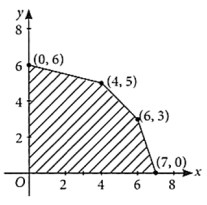
  1. If $\text{f}(\text{x})=\begin{cases}\frac{\text{x}^2-9}{\text{x}-3},&\text{for x}\neq3\\4,&\text{for x}=3\end{cases},$ then at x = 3
  1. f has removable discontinuity.
  2. f is continuous.
  3. f has irremovable discontinuity.
  4. None of these.
  1. Let $\text{f}(\text{x})=\begin{cases}\text{x}+2,&\text{if x}\leq4\\\text{x}+4,&\text{if x}\geq4\end{cases}$ then at x = 4
  1. f is continuous.
  2. f has removable discontinuit.
  3. f has irremovable discontinuit.
  4. None of thesee.
  1. Consider the function f(x) defined as $\text{f}(\text{x})=\begin{cases}\frac{\text{x}^2-4}{\text{x}-2},&\text{for x}\neq2\\5,&\text{for x}=2\end{cases},$ then at x = 2
  1. f has removable discontinuity.
  2. f has irremovable discontinuity.
  3. f is continuous.
  4. f is continuous if f(2) = 3
  1. If $\text{f}(\text{x})=\begin{cases}\frac{\text{x}-|\text{x}|}{\text{x}},&\text{x}\neq0\\2,&\text{x}=0\end{cases},$ then at x = 0
  1. f is continuous.
  2. f has removable discontinuity.
  3. f has irremovable discontinuity.
  4. None of these.
  1. If $\text{f}(\text{x})=\begin{cases}\frac{\text{e}^\text{x}-1}{\log(1+2\text{x})},&\text{if x}\neq0\\7,&\text{if x}=0\end{cases},$ then at x = 0
  1. fis continuous if f(0) = 2
  2. f is continuous
  3. f has irremovable discontinuity.
  4. f has removable discontinuity.
A rumour on whatsapp spreads in a population of 5000 people at a rate proportional to the product of the number of people who have heard it and the number of people who have not. Also, it is given that 100 people initiate the rumour and a total of 500 people know the rumour after 2 days.

Based on the above information, answer the following questions.
  1. If y(t) denote the number of people who know the rumour at an instant t, then maximum value of y(t) is:
  1. 500
  2. 100
  3. 5000
  4. None of these
  1. $\frac{\text{dn}}{\text{dt}}$ is proportional to:
  1. (y - 5000)
  2. y(y - 500)
  3. y(500 - y)
  4. y(5000 - y)
  1. The value of y(0) is:
  1. 100
  2. 500
  3. 600
  4. 200
  1. The value of y(2) is:
  1. 100
  2. 500
  3. 600
  4. 200
  1. The value of y at any time t is given by:
  1. $\text{y}=\frac{5000}{_\text{e}-5000\text{kt}_{+1}}$
  2. $\text{y}=\frac{5000}{_\text{1+e}-5000\text{kt}}$
  3. $\text{y}=\frac{5000}{_\text{49e}-5000\text{kt}_{+1}}$
  4. $\text{y}=\frac{5000}{_\text{49}{(_\text{1+e}}-5000\text{kt})}$
In a family there are four children. All of them have to work in their family business to earn their livelihood at the age of 18. Based on the above information, answer the following questions.
  1. Probability that all children are girls, if it is given that elder child is a boy, is:
  1. $\frac{3}{8}$
  2. $\frac{1}{8}$
  3. $\frac{5}{8}$
  4. None of these.
  1. Probability that all children are boys, if two elder children are boys, is:
  1. $\frac{1}{4}$
  2. $\frac{3}{4}$
  3. $\frac{1}{2}$
  4. None of these.
  1. Find the probability that two middle children are boys, if it is given that eldest child is a girl.
  1. $0$
  2. $\frac{3}{4}$
  3. $\frac{1}{4}$
  4. None of these.
  1. Find the probability that all children are boys, if it is given that at most one of the children is a girl.
  1. $0$
  2. $\frac{1}{5}$
  3. $\frac{2}{5}$
  4. $\frac{4}{5}$
  1. Find the probability that all children are boys, if it is given that at least three of the children are boys.
  1. $\frac{1}{5}$
  2. $\frac{2}{5}$
  3. $\frac{3}{5}$
  4. $\frac{4}{5}$
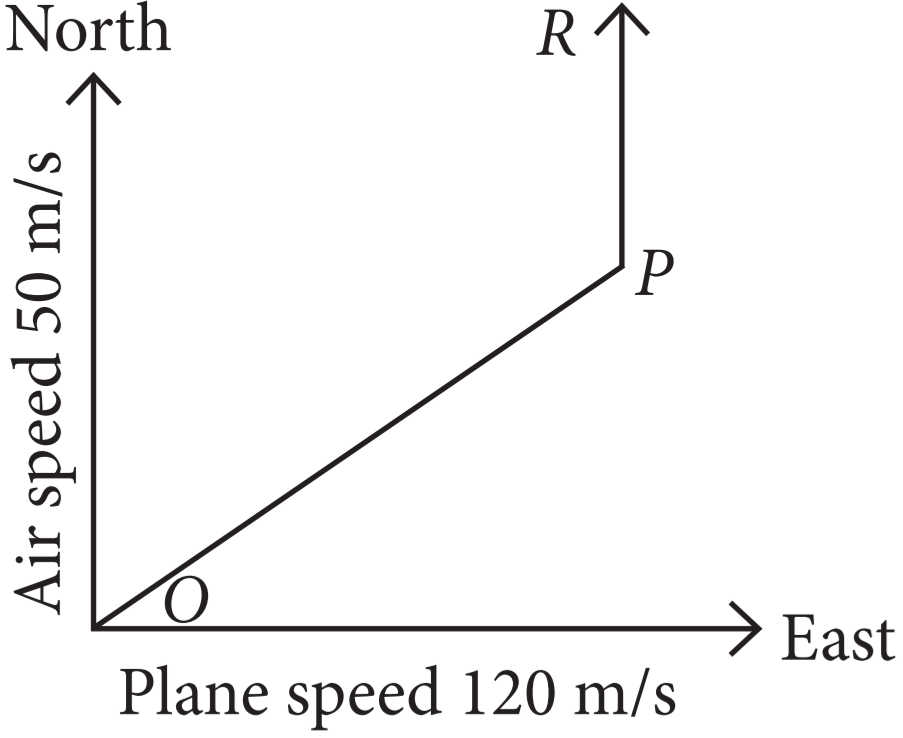
A plane started from airport situated at O with a velocity of 120m/s towards east. Air is blowing at a velocity of 50m/ s towards the north as shown in the figure.
The plane travelled 1hr in OP direction with the resultant velocity. From P to R the plane travelled 1hr keeping velocity of 120m/s and finally landed at R.

Based on the above information, answer the following questions.
  1. What is the resultant velocity from O to P?
  1. 100m/ s
  2. 130m/ s
  3. 126m/ s
  4. 180m/ s
  1. What is the direction of travel of plane from O to P with East?
  1. $\tan^{-1}\Big(\frac{5}{12}\Big)$
  2. $\tan^{-1}\Big(\frac{12}{3}\Big)$
  3. 50
  4. 80
  1. What is the displacement from O to P?
  1. 600km
  2. 468km
  3. 532km
  4. 500km
  1. What is the resultant velocity from P to R?
  1. 120m/ s
  2. 70m/ s
  3. 170m/ s
  4. 200m/ s
  1. What is the displacement from P to R?
  1. 450km
  2. 532km
  3. 610km
  4. 612km
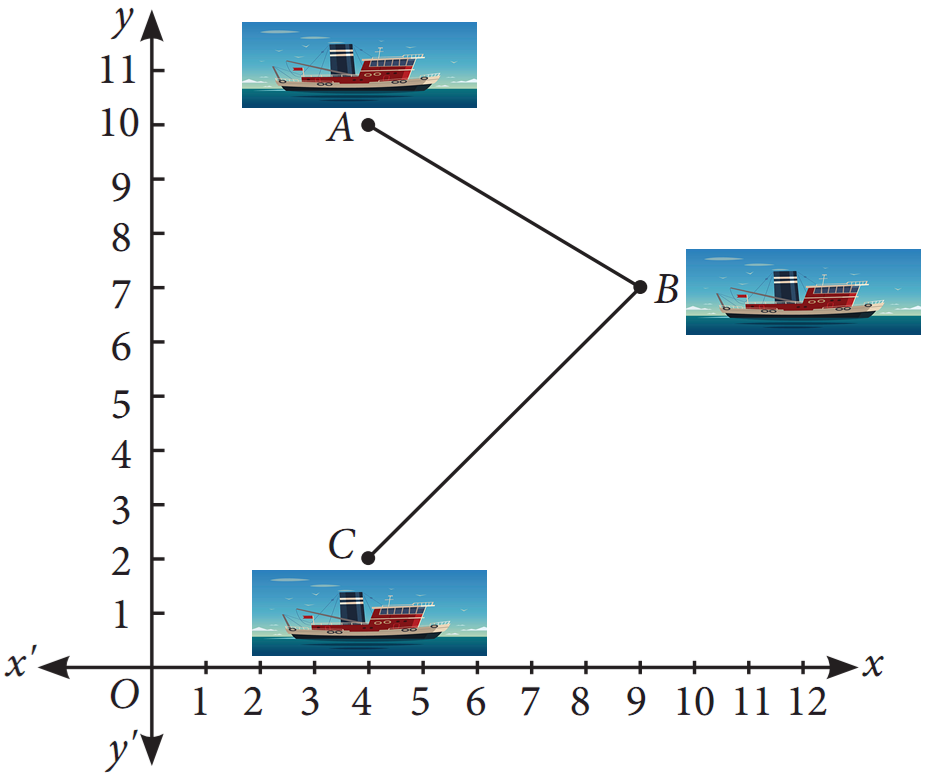
A barge is pulled into harbour by two tug boats as shown in the figure.
Based on the above information, answer the following questions.
  1. Position vector of A is:
  1. $4\hat{\text{i}}+2\hat{\text{j}}$
  2. $4\hat{\text{i}}+10\hat{\text{j}}$
  3. $4\hat{\text{i}}-10\hat{\text{j}}$
  4. $4\hat{\text{i}}-2\hat{\text{j}}$
  1. Position vector of B is:
  1. $4\hat{\text{i}}+4\hat{\text{j}}$
  2. $6\hat{\text{i}}+6\hat{\text{j}}$
  3. $9\hat{\text{i}}+7\hat{\text{j}}$
  4. $3\hat{\text{i}}+3\hat{\text{j}}$
  1. Find the vector $\overline{\text{AC}}$ in terms of $\hat{\text{i}},\hat{\text{j}}.$
  1. $8\hat{\text{j}}$
  2. $-8\hat{\text{j}}$
  3. $8\hat{\text{i}}$
  4. None of these
  1. If $\vec{\text{A}}=\hat{\text{i}}+2\hat{\text{j}}+3\hat{\text{k}},$ then its unit vector is:
  1. $\frac{\hat{\text{i}}}{\sqrt{14}}+\frac{2\hat{\text{j}}}{\sqrt{14}}+\frac{3\hat{\text{k}}}{\sqrt{14}}$
  2. $\frac{3\hat{\text{i}}}{\sqrt{14}}+\frac{2\hat{\text{j}}}{\sqrt{14}}+\frac{\hat{\text{k}}}{\sqrt{14}}$
  3. $\frac{2\hat{\text{i}}}{\sqrt{14}}+\frac{3\hat{\text{j}}}{\sqrt{14}}+\frac{\hat{\text{k}}}{\sqrt{14}}$
  4. None of these
  1. If $\vec{\text{A}}=4\hat{\text{i}}+3\hat{\text{j}}$ and $\vec{\text{B}}=3\hat{\text{i}}+4\hat{\text{j}},$ then $|\vec{\text{A}}|+|\vec{\text{B}}|=$
  1. 12
  2. 13
  3. 14
  4. 10
Logarithmic differentiation is a powerful technique to differentiate functions of the form $\text{f}(\text{x})=[\text{u}(\text{x})]^{\text{v}(\text{x})},$ where both u(x) and v(x) are differentiable functions and f and u need to be positive functions. Let function $\text{y}=\text{f}(\text{x})=(\text{u}(\text{x}))^{\text{v}(\text{x})},$ then $\text{y}'=\text{y}\Big[\frac{\text{v}(\text{x})}{\text{u}(\text{x})}\text{u}'(\text{x})+\text{v}'(\text{x})\cdot\log[\text{u}(\text{x})]\Big]$ On the basis of above information, answer the following questions.
  1. Differentiate $x^x$ w.r.t. $x.$
  1. $\text{x}^\text{x}(1+\log\text{x})$
  2. $\text{x}^\text{x}(1-\log\text{x})$
  3. $-\text{x}^\text{x}(1+\log\text{x})$
  4. $\text{x}^\text{x}\log\text{x}$
  1. Differentiate $x^x + a^x+ x^a + a^a$ w.r.t. $x.$
  1. $(1+\log\text{x})+(\text{a}^\text{x}\log\text{a}+\text{ax}^{\text{a}-1})$
  2. $\text{x}^\text{x}(1+\log\text{x})+\log\text{a}+\text{ax}^{\text{a}-1}$
  3. $\text{x}^\text{x}(1+\log\text{x})+\text{x}^\text{a}\log\text{x}+\text{ax}^{\text{a}-1}$
  4. $\text{x}^\text{x}(1+\log\text{x})+\text{a}^\text{x}\log\text{a}+\text{ax}^{\text{a}-1}$
  1. If $\text{x}=\text{e}^\frac{\text{x}}{\text{y}},$ then find $\frac{\text{dy}}{\text{dx}}.$
  1. $-\frac{(\text{x}+\text{y})}{\text{x}\log\text{x}}$
  2. $-\frac{(\text{x}-\text{y})}{\text{x}\log\text{x}}$
  3. $\frac{(\text{x}+\text{y})}{\text{x}\log\text{x}}$
  4. $\frac{\text{x}-\text{y}}{\text{x}\log\text{x}}$
  1. If $y = (2 - x)^3(3 + 2x)^5,$ then find $\frac{\text{dy}}{\text{dx}}.$
  1. $(2-\text{x})^3(3+2\text{x})^5\Big[\frac{15}{3+2\text{x}}-\frac{8}{2-\text{x}}\Big]$
  2. $(2-\text{x})^3(3+2\text{x})^5\Big[\frac{15}{3+2\text{x}}+\frac{3}{2-\text{x}}\Big]$
  3. $(2-\text{x})^3(3+2\text{x})^5\Big[\frac{10}{3+2\text{x}}-\frac{3}{2-\text{x}}\Big]$
  4. $(2-\text{x})^3(3+2\text{x})^5\cdot\Big[\frac{10}{3+2\text{x}}+\frac{3}{2-\text{x}}\Big]$
  1. If $\text{y}=\text{x}^\text{x}\cdot\text{e}^{(2\text{x}+5)},$ then find $\frac{\text{dy}}{\text{dx}}.$
  1. $\text{x}^\text{x}\text{e}^{2\text{x}+5}$
  2. $\text{x}^\text{x}\text{e}^{2\text{x}+5}(3-\log\text{x})$
  3. $\text{x}^\text{x}\text{e}^{2\text{x}+5}(1-\log\text{x})$
  4. $\text{x}^\text{x}\text{e}^{2\text{x}+5}\cdot(3+\log\text{x})$
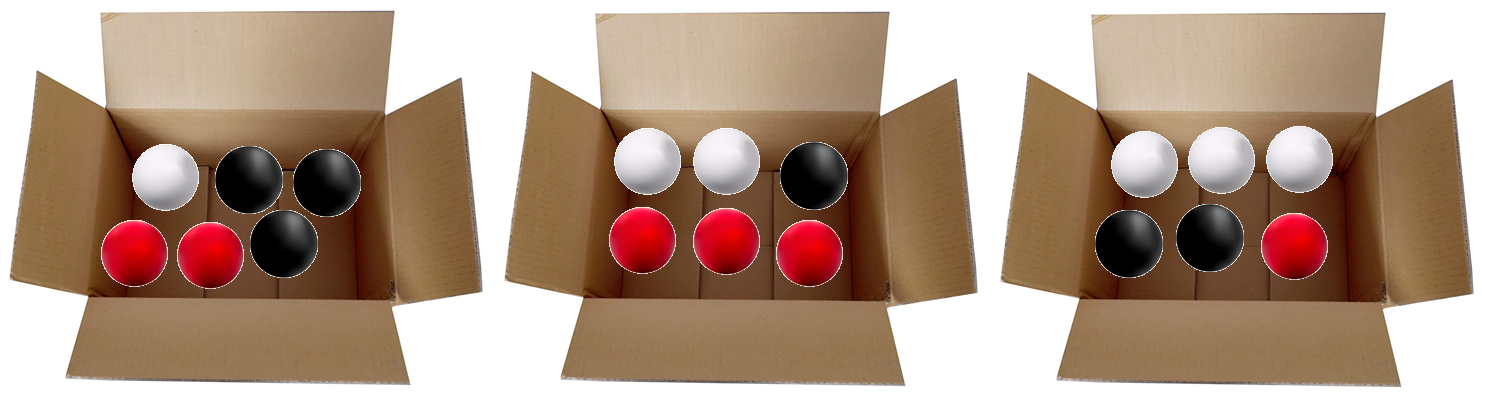
Box I contains $1$ white, $3$ black and $2$ red balls. Box II contains $2$ white, $1$ black and $3$ red balls. Box III contains $3$ white, $2$ black and $1$ red balls. One box is chosen at random and two balls are drawn with replacement.

If $E_1, E_2, E_3$ be the events that the balls drawn from box I, box II and box III respectively and E be the event that balls drawn are one white and one red, then answer the following questions.
  1. Probability of occurrence of event E given that the balls drawn are from box I, is:
  1. $\frac{1}{9}$
  2. $\frac{2}{6}$
  3. $\frac{3}{5}$
  4. $\frac{1}{7}$
  1. Probability of occurrence of event E, given that the balls drawn are from box II, is:
  1. $\frac{1}{3}$
  2. $\frac{1}{4}$
  3. $\frac{3}{4}$
  4. $\frac{3}{5}$
  1. Probability of occurrence of event E, given that balls drawn are from box III, is:
  1. $\frac{1}{12}$
  2. $\frac{3}{11}$
  3. $\frac{1}{6}$
  4. $\frac{4}{11}$
  1. The value of $\displaystyle{\sum^3_{\text{i}=1}}\text{P(E}|\text{E}_\text{i})$ is equal to.
  1. $\frac{5}{18}$
  2. $\frac{1}{2}$
  3. $\frac{1}{18}$
  4. $\frac{11}{18}$
  1. The probability that the balls drawn are from box II, given that event E has already occurred, is:
  1. $\frac{1}{11}$
  2. $\frac{6}{11}$
  3. $\frac{5}{11}$
  4. None of these
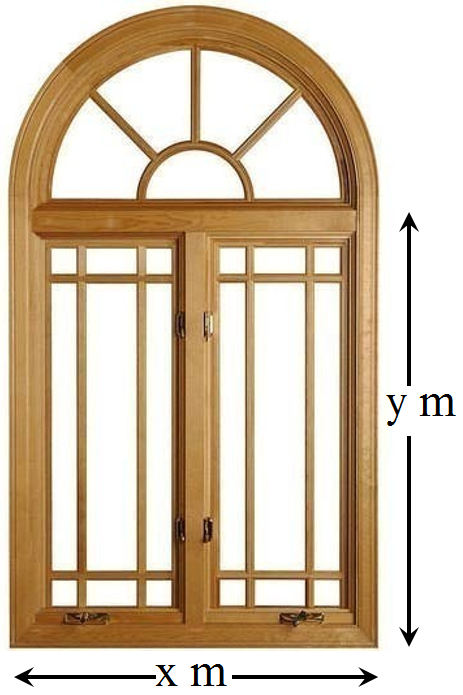
Rohan, a student of class XII, visited his uncle's flat with his father. He observe that the window of the house is in the form of a rectangle surmounted by a semicircular opening having perimeter 10m as shown in the figure.

Based on the above information, answer the following questions.
  1. If x and y represents the length and breadth of the rectangular region, then relation between x and y can be represented as.
  1. $\text{x}+\text{y}+\frac{\pi}{2}=10$
  2. $\text{x}+\text{2y}+\frac{\pi\text{x}}{2}=10$
  3. $\text{2x}+\text{2y}=10$
  4. $\text{x}+\text{2y}+\frac{\pi}{2}=10$
  1. The area (A) of the window can be given by.
  1. $\text{A}=\text{x}-\frac{\text{x}^3}{8}-\frac{\text{x}^2}{2}$
  2. $\text{A}=\text{5x}-\frac{\text{x}^2}{8}-\frac{\pi\text{x}^2}{8}$
  3. $\text{A}=\text{x}+\frac{\pi\text{x}^3}{8}-\frac{\text{3x}^2}{8}$
  4. $\text{A}=\text{5x}+\frac{\text{x}^3}{2}+\frac{\pi\text{x}^2}{8}$
  1. Rohan is interested in maximizing the area of the whole window, for this to happen, the value of x should be.
  1. $\frac{10}{2-\pi}$
  2. $\frac{20}{4-\pi}$
  3. $\frac{20}{4+\pi}$
  4. $\frac{10}{2+\pi}$
  1. Maximum area of the window is.
  1. $\frac{30}{4+\pi}$
  2. $\frac{30}{4-\pi}$
  3. $\frac{50}{4-\pi}$
  4. $\frac{50}{4+\pi}$
  1. For maximum value of A, the breadth of rectangular part of the window is.
  1. $\frac{10}{4+\pi}$
  2. $\frac{10}{4-\pi}$
  3. $\frac{20}{4+\pi}$
  4. $\frac{20}{4-\pi}$